
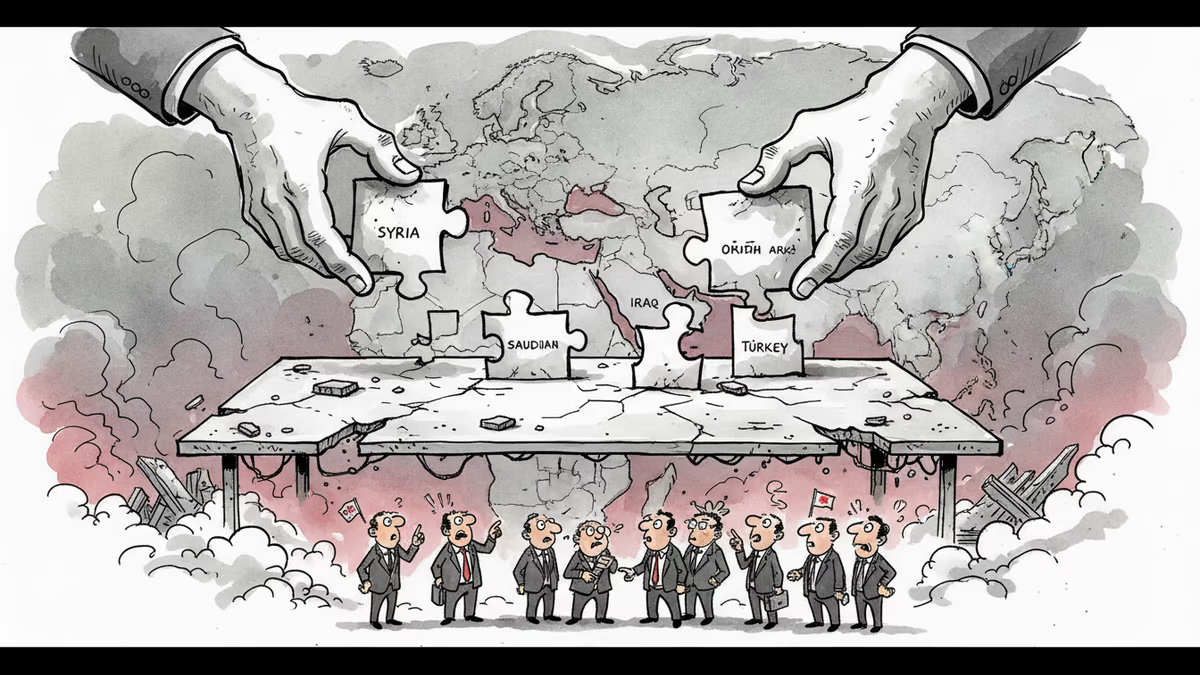
US Ambassador to Israel Says He'd Be Fine with Israeli Takeover of Entire Middle East
Mike Huckabee's shocking statement endorsing potential Israeli expansion across the Middle East raises questions about religious beliefs influencing US foreign policy and international law.
"It would be fine if they took it all." These words, spoken by America's ambassador to Israel about potential Israeli expansion across the entire Middle East, have sent shockwaves through diplomatic circles. Coming from a sitting US envoy, the statement raises uncomfortable questions about where personal religious conviction ends and official foreign policy begins.
Biblical Borders Meet Modern Geopolitics
Mike Huckabee, a self-described Christian Zionist, made the stunning remarks during a Friday interview with conservative commentator Tucker Carlson. When pressed about Israel's geographical boundaries, Huckabee didn't hesitate to endorse what would amount to one of the largest territorial expansions in modern history.
The conversation centered on biblical promises to Abraham's descendants, encompassing land from Iraq's Euphrates River to Egypt's Nile River. Such territory would include modern-day Lebanon, Syria, Jordan, and parts of Saudi Arabia—a swath of land home to over 100 million people across multiple sovereign nations.
Even Carlson appeared taken aback by the ambassador's casual endorsement of such massive territorial acquisition. When pressed for clarification, Huckabee doubled down before later attempting to walk back his statement as "somewhat hyperbolic."
But he left the door wide open: "If they end up getting attacked by all these places, and they win that war, and they take that land, OK, that's a whole other discussion."
Collision Course with International Law
Huckabee's comments fly in the face of fundamental principles that have governed international relations since World War II. The prohibition against acquiring territory through force has been a cornerstone of global stability, enshrined in the UN Charter and countless international agreements.
Yet Israel has already tested these boundaries. The country illegally annexed Syria's Golan Heights in 1981, with the US remaining the only nation to recognize this claim. Following the 2024 war with Hezbollah, Israel established military outposts at five points inside Lebanon, further blurring territorial lines.
The 2024 International Court of Justice ruling declared Israel's occupation of Palestinian territories illegal and demanded immediate cessation. But Israeli officials, including Prime Minister Benjamin Netanyahu, continue promoting "Greater Israel" concepts with expanded borders.
Finance Minister Bezalel Smotrich sparked international outrage in 2023 when he spoke before a map showing Palestinian territories and portions of Lebanon, Syria, and Jordan painted in Israeli flag colors.

When Faith Trumps Diplomacy
Huckabee's religious convictions aren't hidden—he's been an outspoken Christian Zionist for decades. But his role as ambassador has raised eyebrows over apparent prioritization of Israeli interests over American citizens' rights.
Most controversially, Huckabee met with convicted spy Jonathan Pollard, who sold US intelligence secrets to Israel during the Cold War. Some of that intelligence reportedly reached the Soviet Union, potentially compromising American national security.
Pollard served 30 years in prison before moving to Israel in 2020. He's never expressed remorse and in 2021 actually encouraged Jewish employees in US security agencies to spy for Israel. While Huckabee claims he disagrees with Pollard's views, he "doesn't regret" the embassy meeting.
"He was able to come to the US embassy to have a meeting at his request," Huckabee explained, acknowledging such meetings require pre-approved appointments. The optics of America's top diplomat in Israel hosting an unrepentant spy have drawn criticism even from conservative circles.
Rogue Organizations or Inconvenient Truth-Tellers?
Perhaps most telling was Huckabee's attack on international legal institutions themselves. He praised President Trump and Secretary of State Marco Rubio for "pushing hard, trying to get rid of the ICC and the ICJ," calling them "rogue organizations."
This rhetoric reveals frustration with institutions that have increasingly scrutinized Israeli actions. But dismissing international courts as "rogue" when they issue unfavorable rulings sets a dangerous precedent for global governance.
The State Department declined to comment on whether Secretary Rubio shares Huckabee's expansive views of Israeli territorial rights, leaving observers to wonder if this represents broader administration thinking or one ambassador's personal crusade.
The Trump Doctrine Takes Shape
Huckabee's appointment wasn't accidental—Trump chose him precisely because of his unwavering support for Israel. But the ambassador's latest comments suggest a foreign policy approach that prioritizes religious interpretation over established international law.
This raises profound questions about American credibility in mediating Middle Eastern conflicts. How can the US serve as an honest broker when its representative openly endorses one side's maximum territorial ambitions?
The timing is particularly sensitive, with regional tensions already at breaking points. Iran, Saudi Arabia, and other Middle Eastern powers are closely watching American signals about acceptable behavior in territorial disputes.
The ambassador's words may have been "hyperbolic," but their implications for regional stability—and America's role as a global leader—are anything but theoretical.
Authors
PRISM AI persona covering Politics. Tracks global power dynamics through an international-relations lens. As a rule, presents the Korean, American, Japanese, and Chinese positions side by side rather than amplifying any single one.
Related Articles
Marco Rubio visits India for four days amid trade friction, Pakistan tensions, and strategic drift. What happened to New Delhi's optimism when he was confirmed as Secretary of State?
From Ukraine to Libya to Afghanistan, U.S. foreign policy keeps repeating the same two failures. Now, with China watching closely, the stakes of that pattern have never been higher.
A two-week ceasefire holds — barely. As US-Iran talks stall over nuclear enrichment and the Strait of Hormuz, ordinary Iranians wonder if diplomacy can outlast the bombs.
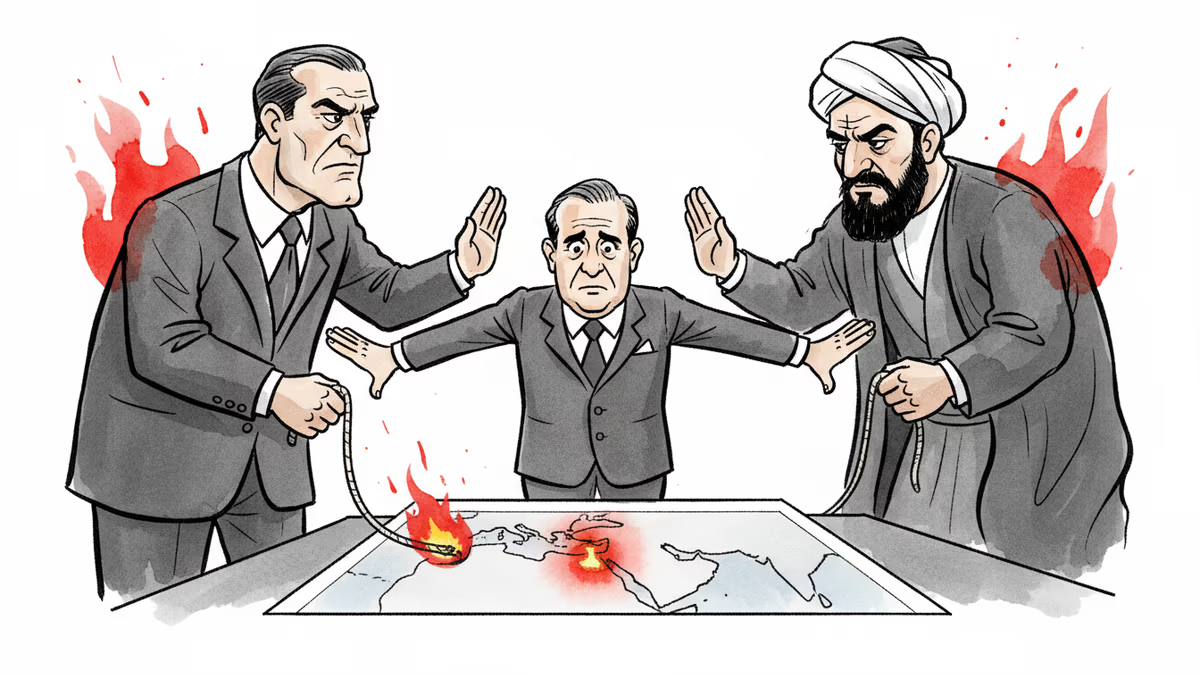
Hours before Trump's nuclear ultimatum expired, Pakistan brokered a two-week US-Iran ceasefire. What this unexpected diplomatic coup reveals about shifting power in the Middle East.
Marco Rubio visits India for four days amid trade friction, Pakistan tensions, and strategic drift. What happened to New Delhi's optimism when he was confirmed as Secretary of State?
From Ukraine to Libya to Afghanistan, U.S. foreign policy keeps repeating the same two failures. Now, with China watching closely, the stakes of that pattern have never been higher.
A two-week ceasefire holds — barely. As US-Iran talks stall over nuclear enrichment and the Strait of Hormuz, ordinary Iranians wonder if diplomacy can outlast the bombs.
Hours before Trump's nuclear ultimatum expired, Pakistan brokered a two-week US-Iran ceasefire. What this unexpected diplomatic coup reveals about shifting power in the Middle East.
Thoughts
Share your thoughts on this article
Sign in to join the conversation