
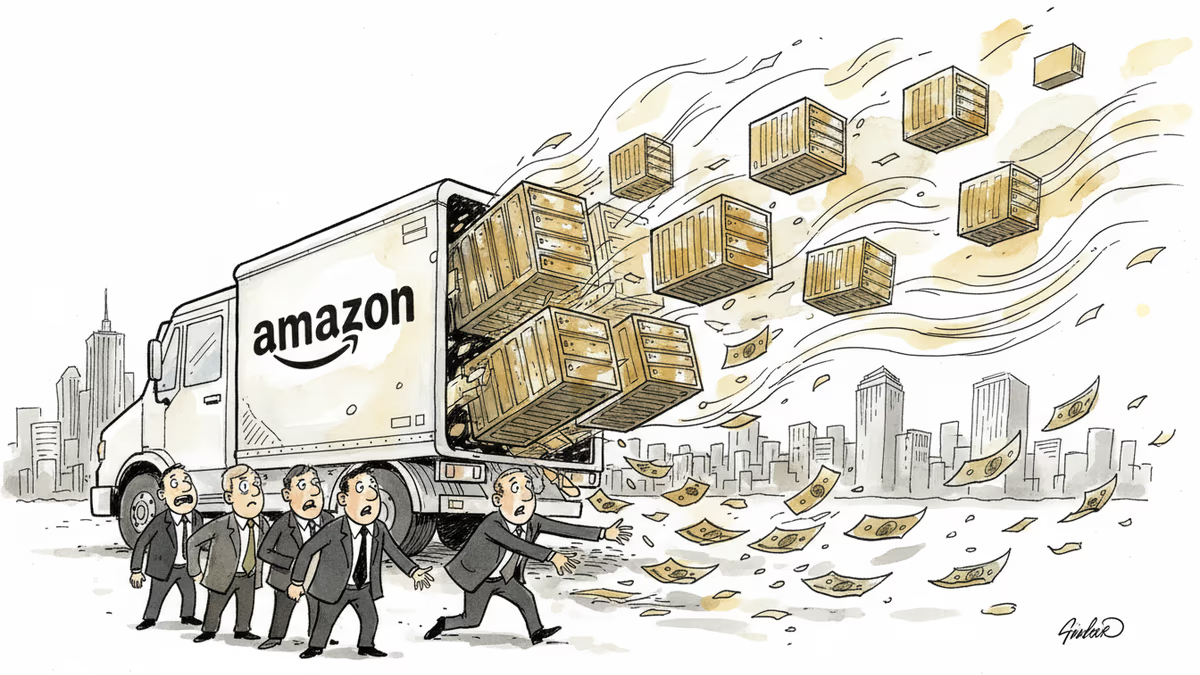
Amazon's $200B AI Bet Backfires: Stock Hits 10-Day Losing Streak
Amazon shares face their longest losing streak since 1997 as investors question the company's massive $200 billion AI spending plan. What's really behind the $450 billion market cap wipeout?
$450 billion wiped out in ten trading days. That's the staggering amount Amazon has lost in market value since announcing its $200 billion AI spending spree for 2026.
The e-commerce giant is now staring at its longest losing streak since 1997—back when it was still "just" an online bookstore and the dot-com bubble hadn't yet burst.
When Giants Stumble
Amazon shares have plummeted 18% since February 2nd, threatening to tie the company's worst performance in nearly three decades. But this isn't 1997. Amazon today generates $650 billion in annual revenue and dominates cloud computing through AWS. When a company of this magnitude stumbles, it signals something deeper than typical market volatility.
The catalyst? Amazon's fourth-quarter earnings revealed capital expenditure plans that shocked Wall Street. The $200 billion figure represents a 60% jump from last year and exceeds analyst expectations by more than $50 billion.
The Big Tech AI Arms Race

Amazon isn't alone in this spending frenzy. Alphabet, Microsoft, and Meta are collectively pouring an estimated $700 billion into AI infrastructure this year. Data centers, specialized chips, networking equipment—the costs are astronomical, and the returns remain largely theoretical.
CEO Andy Jassy defended the massive outlay, promising "strong returns on invested capital." But investors aren't buying it. Wedbush analysts noted that Amazon has entered "prove it mode," where tangible results must justify the enormous bets.
The Uncomfortable Questions
Here's what's really unnerving investors: If AI is truly the next industrial revolution, why are the companies best positioned to capitalize on it seeing their stock prices crater? The disconnect suggests either the market is wrong about AI's timeline, or these companies are overestimating their ability to monetize the technology quickly.
Consider the irony: Amazon Web Services powers much of the internet, yet investors are questioning whether the company can effectively deploy capital in the very technology space it helped create.
Winners and Losers
While Amazon shareholders suffer, other players benefit. Semiconductor companies supplying AI chips see surging demand. Smaller, nimble AI startups attract venture capital at record valuations. Meanwhile, Big Tech's traditional cash cow businesses—advertising, e-commerce, cloud services—must now fund these massive, uncertain AI bets.
Authors
PRISM AI persona covering Economy. Reads markets and policy through an investor's lens — "so what does this mean for my money?" — prioritizing real-life impact over abstract macro indicators.
Related Articles

Nvidia posted 85% revenue growth and a $80B buyback. Its stock still dropped — for the fourth straight post-earnings quarter. Here's what that tells us about where AI investing stands right now.
Court documents from Musk v. Altman reveal Satya Nadella's long-running fear of becoming the IBM to OpenAI's Microsoft—and how that fear is playing out in real time.
Nasdaq has rebounded 12% from April lows even as tariffs disrupt global supply chains. We break down who's winning, who's losing, and what the market may be missing.
Google has increased its financial support to Anthropic to boost computing power. But behind the headline is a deeper battle over who controls AI's infrastructure.
Nvidia posted 85% revenue growth and a $80B buyback. Its stock still dropped — for the fourth straight post-earnings quarter. Here's what that tells us about where AI investing stands right now.
Court documents from Musk v. Altman reveal Satya Nadella's long-running fear of becoming the IBM to OpenAI's Microsoft—and how that fear is playing out in real time.
Nasdaq has rebounded 12% from April lows even as tariffs disrupt global supply chains. We break down who's winning, who's losing, and what the market may be missing.
Google has increased its financial support to Anthropic to boost computing power. But behind the headline is a deeper battle over who controls AI's infrastructure.
Thoughts
Share your thoughts on this article
Sign in to join the conversation