
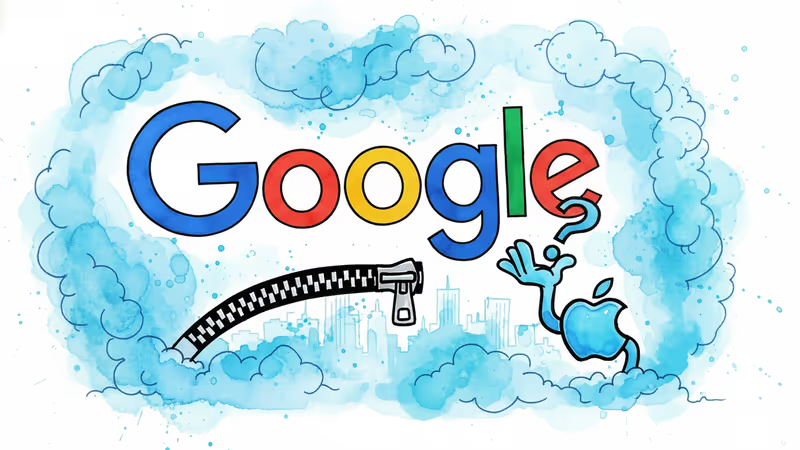
Why Google Went Silent on Its Apple AI Deal
Alphabet dodged questions about its Apple AI partnership during earnings, revealing deeper tensions in the shift from search ads to AI monetization.
For a company that's paid Apple$20 billion annually to be the default search engine, Google's sudden silence speaks volumes. When analysts pressed Alphabet about its AI partnership with Apple during Wednesday's earnings call, the tech giant simply... didn't answer.
That non-response might be the most telling part of the entire call.
The $20 Billion Question Mark
The Google-Apple relationship has been beautifully simple for years. Google pays massive sums to reach Apple's 2.5 billion active devices worldwide. Apple gets a hefty check. Users get Google search by default. Everyone wins.
But AI partnerships operate in murkier waters. The new Apple AI deal reportedly costs Google around $1 billion annually, yet unlike search, the immediate payoff isn't crystal clear. There's no obvious "click here, pay there" model when Siri uses Google's AI capabilities.
The Ad Model's Awkward Transition
Here's where things get complicated. Traditional Google Search places ads prominently at the top of results—a proven money-maker that's funded the company's growth for decades. But AI Mode ads? They're still in "experiment" phase, tucked below or integrated into chatbot responses.
Google announced plans to bring ads to AI Mode last May, but nearly a year later, they're still testing placement and effectiveness. The company is trying agentic shopping features like Shop with AI Mode, hoping to guide users seamlessly from AI query to checkout. But it's unclear whether these experiments can replace the reliable revenue stream of traditional search ads.

Competitors Take a Different Bet
Meanwhile, Anthropic is preparing a Super Bowl ad that directly challenges the ad-supported AI model embraced by both OpenAI and Google. It's a bold move that questions whether AI should be monetized through advertising at all.
This philosophical divide isn't just academic—it could determine which AI companies survive the next few years and how consumers interact with artificial intelligence.
What the Silence Reveals
During the earnings call, CEO Sundar Pichai offered only bland corporate speak, noting that Apple was Google's "preferred cloud provider" for developing "next generation foundation models." Chief Business Officer Philipp Schindler used identical phrasing—a coordination that suggests careful message control.
This isn't typical Google behavior. The company usually loves discussing partnerships and market expansion. Their silence suggests internal uncertainty about how AI partnerships will impact their core advertising business.
The Bigger Strategic Puzzle
Google finds itself in an unusual position: paying billions for AI partnerships while still figuring out how to monetize AI interactions. It's like buying expensive real estate in a neighborhood where property values are completely unknown.
The company is essentially betting that AI partnerships will eventually generate revenue streams that justify the investment. But "eventually" doesn't satisfy investors looking for immediate returns or clear growth trajectories.
Authors
Related Articles
In a post-Google I/O interview, Sundar Pichai acknowledged flawed search results, real AI anxiety, and an AGI timeline that makes the label irrelevant. Here's what he said — and what it means.
Google is building AI agents that search the web proactively, without user prompting. That's not just a product update — it's a fundamental shift in who controls the information you receive.
Google unveiled the 'Googlebook' platform to replace Chromebook and ChromeOS—but revealed zero hardware specs. What's the strategy, and what does it mean for users, manufacturers, and the education market?
After 15 years of fragmented mobile messaging, Apple and Google are rolling out end-to-end encrypted RCS messaging between iPhones and Android devices. Here's what changed, why it took so long, and what it means for your privacy.
In a post-Google I/O interview, Sundar Pichai acknowledged flawed search results, real AI anxiety, and an AGI timeline that makes the label irrelevant. Here's what he said — and what it means.
Google is building AI agents that search the web proactively, without user prompting. That's not just a product update — it's a fundamental shift in who controls the information you receive.
Google unveiled the 'Googlebook' platform to replace Chromebook and ChromeOS—but revealed zero hardware specs. What's the strategy, and what does it mean for users, manufacturers, and the education market?
After 15 years of fragmented mobile messaging, Apple and Google are rolling out end-to-end encrypted RCS messaging between iPhones and Android devices. Here's what changed, why it took so long, and what it means for your privacy.
Thoughts
Share your thoughts on this article
Sign in to join the conversation