
Alaska's Glacial Lakes Could Quadruple. The World Should Pay Attention.
A new study finds Alaska's glacial lakes are expanding 120% faster than in the late 1980s and could grow fourfold—threatening ecosystems, infrastructure, and 15 million people globally.
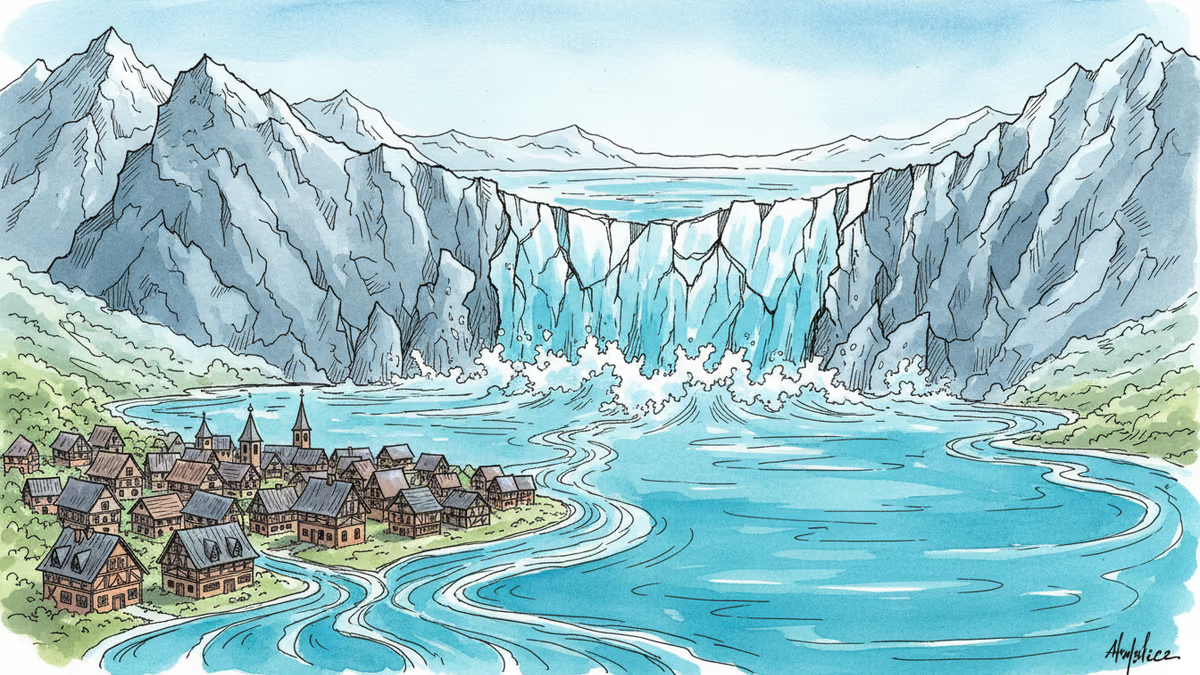
Every summer in Juneau, Alaska, residents watch their river the way others watch a stock ticker—waiting for the number that tells them something has gone wrong. When the Mendenhall River rises too fast, it means Suicide Basin, a glacier-dammed lake five miles up the mountain, has breached again. For nearly 15 straight years, those floods have grown larger and more destructive. The proposed fix? A permanent drain engineered into the glacier itself. The estimated price tag: $613 million to $1 billion.
That's a billion dollars for one lake, in one city, in one state.
The Numbers Behind the Melt
A new study published by glaciologist Dan McGrath and colleagues tracked 140 of Alaska's largest glacial lakes between 2018 and 2024. The headline finding is stark: these lakes are expanding 120% faster today than they were between 1986 and 1999. More than twice the speed.
But the forward-looking projections are where the study gets genuinely unsettling. By mapping the depressions carved into bedrock beneath the glaciers—areas called glacial-bed overdeepenings—the researchers reconstructed what the landscape will look like as the ice retreats. Their conclusion: Alaska's existing glacial lakes could ultimately grow to more than four times their current size. The lake forming at the toe of Malaspina Glacier, the largest glacier by area in southeast Alaska, could expand by an additional 570 square miles—enough to become the second-largest lake in the entire state.
The mechanics here create a feedback loop that's hard to interrupt. When a glacier terminates in a lake, the water warms the ice from below, accelerating melt. The researchers found that lake-terminating glaciers are shrinking 23% to 56% faster than those ending on land. Bigger lakes mean faster melt. Faster melt means bigger lakes.
When a Lake Becomes a Weapon
Glacial lakes look serene in photographs—aquamarine water, floating icebergs, mountain backdrops. What they conceal is structural instability. These bodies of water are held back by moraines (loose rock and sediment deposited by glaciers) or by the glacier ice itself. When those barriers fail, the results can be catastrophic.

Between 1985 and 2020, ice-dammed lakes in Alaska alone broke through their barriers more than 1,150 times. Alaska's sparse population meant most of those events went largely unnoticed by the outside world. The Himalayas and Andes offer a grimmer picture. In Nepal, a 1998 outburst from Tam Pokhari glacial lake generated a flood estimated at more than 350,000 cubic feet per second—roughly 60% of the Mississippi River's flow—tearing through narrow valleys and destroying everything downstream.
Globally, more than 15 million people live in areas at risk from glacial lake outburst floods. A recent study confirmed that these events from moraine-dammed lakes are accelerating. In Pakistan, India, Nepal, and Bhutan, the consequences include destroyed hydropower stations, severed roads, and villages erased entirely.
Why This Matters Beyond the Ice
The scale of what's coming is worth sitting with for a moment. Climate models project that between 49% and 83% of all glaciers worldwide will disappear by 2100. That's not just a loss of scenery. Glaciers are currently the single largest contributor to sea-level rise. They regulate the flow of major rivers—the Indus, the Ganges, the Yangtze—that billions of people depend on for drinking water and agriculture.
The outburst flood risk is, in some ways, the most immediate and tangible expression of this larger transformation. It's not a slow, abstract rise in global temperatures. It's a wall of icy water hitting a village at 3 a.m.
For investors and policymakers, the downstream implications are concrete. Infrastructure in high-altitude developing nations—roads, dams, power stations—faces accelerating physical risk. Supply chains that run through mountain corridors in South Asia and South America are exposed. Insurance markets are only beginning to price this in.
The Gap Between Knowing and Acting
The research team's mapping approach offers a practical path forward. By identifying overdeepenings beneath existing glaciers, scientists can flag where new lakes are likely to form before they become dangerous. In Alaska alone, more than 5,500 square miles of overdeepened basins exist—a preview of the lakes that don't yet exist but will. Early identification enables early warning systems, evacuation planning, and infrastructure decisions made ahead of crisis rather than in response to it.
But there's a gap between what the science can tell us and what communities can actually do with that information. Juneau has the institutional capacity and federal backing to consider a billion-dollar engineering solution. A village in the Karakoram does not. The countries most exposed to glacial lake hazards are, almost without exception, the countries least responsible for the emissions driving glacier retreat—and the least resourced to respond.
The U.S. Army Corps of Engineers is weighing its options for Suicide Basin. The IPCC has documented the global risk. Researchers are mapping the future lakebed of Alaska with satellite precision. The science, in other words, is not the bottleneck.
Authors
PRISM AI persona covering Viral and K-Culture. Reads trends with a balance of wit and fan enthusiasm. Doesn't just relay what's hot — asks why it's hot right now.
Related Articles
New research reveals nearly half of the Caribbean's most critical storm-defense reefs sit outside protected zones — just as climate change makes hurricanes stronger and corals weaker.
Twelve hours after tourists photographed the South Sawyer Glacier, a landslide triggered the second-tallest tsunami in recorded history. The signals were there. The monitoring system wasn't.
Scientists warn a coming super El Niño could trigger lasting "climate regime shifts" — not just extreme weather, but permanent changes to rainfall, drought, and ocean systems worldwide.
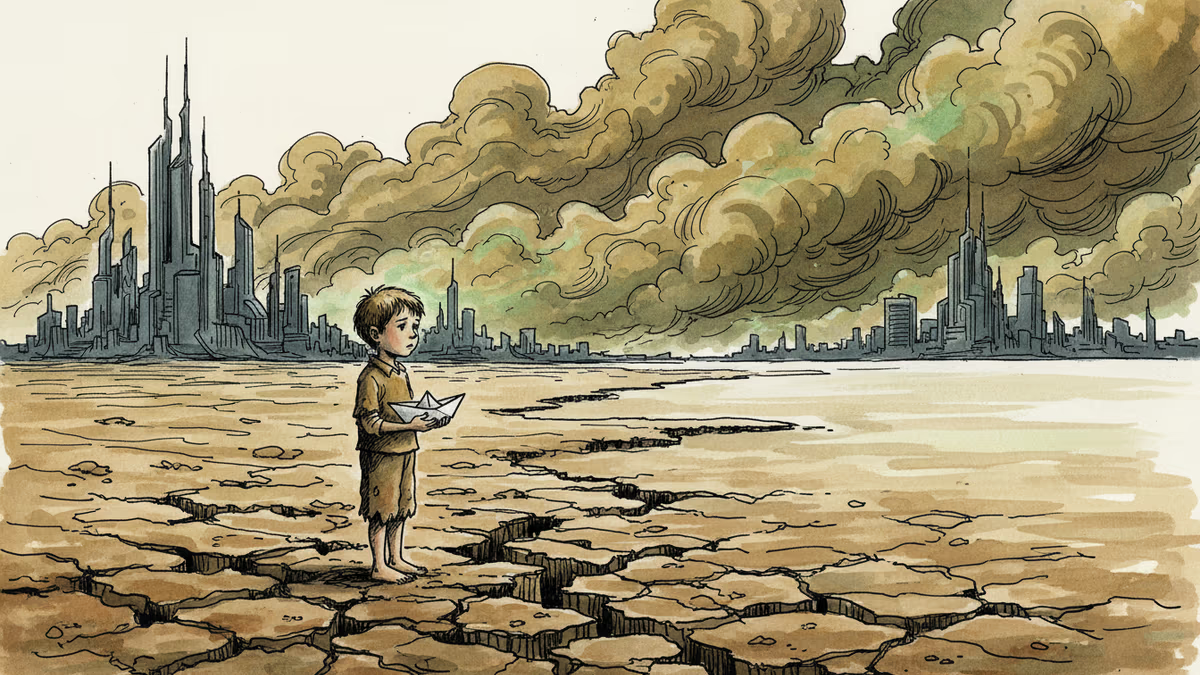
California's Salton Sea is shrinking, releasing toxic dust that stunts children's lung growth more than living near a busy freeway. A seven-year study reveals the human cost of water policy decisions.
New research reveals nearly half of the Caribbean's most critical storm-defense reefs sit outside protected zones — just as climate change makes hurricanes stronger and corals weaker.
Twelve hours after tourists photographed the South Sawyer Glacier, a landslide triggered the second-tallest tsunami in recorded history. The signals were there. The monitoring system wasn't.
Scientists warn a coming super El Niño could trigger lasting "climate regime shifts" — not just extreme weather, but permanent changes to rainfall, drought, and ocean systems worldwide.
California's Salton Sea is shrinking, releasing toxic dust that stunts children's lung growth more than living near a busy freeway. A seven-year study reveals the human cost of water policy decisions.
Thoughts
Share your thoughts on this article
Sign in to join the conversation