
Acer Predator Gaming Monitors CES 2026: The 1000Hz Era Has Arrived
Acer unleashes its Acer Predator gaming monitors at CES 2026, featuring the world's first 1000Hz-capable mode and a stunning 5K Nitro hybrid.
The 1000Hz refresh rate is no longer a spec-sheet fantasy. At CES 2026, tech giant Acer just shattered the speed ceiling by unveiling a new trio of monitors designed to satisfy the most demanding esports pros and content creators alike. It's not just about speed; it's about redefining the visual standard for the next generation of gaming.
Acer Predator Gaming Monitors CES 2026: Speed vs. Resolution Breakdown
The headliner is the Predator XB273U F6. This 27-inch IPS panel natively hits 500Hz, but the real magic happens in Dynamic Frequency and Resolution (DFR) mode. By dropping to 720p, the monitor pushes an astonishing 1000Hz, effectively eliminating motion blur. Charles Wang, Acer's Senior Product Manager, noted that this tech redefines what competitive players should expect from their hardware.

| Model | Display Tech | Max Refresh Rate | Price (Starting) |
|---|---|---|---|
| Predator XB273U F6 | 27" QHD IPS | 1000Hz (DFR) | $799.99 |
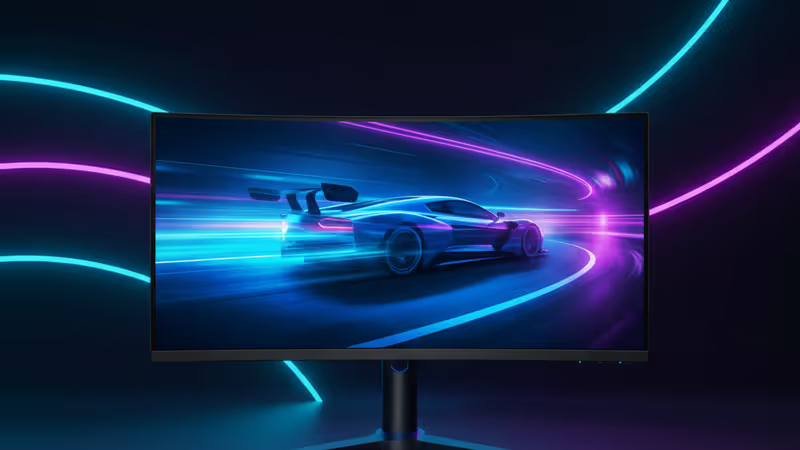
| Predator X34 F3 | 34" Curved QD-OLED | 360Hz | $1,199.99 |
| Nitro XV270X P | 27" 5K IPS | 330Hz (1440p) | $799.99 |
The OLED Curve and 5K Precision
For those seeking immersion, the Predator X34 F3 brings a 34-inch curved QD-OLED experience. It boasts a 0.03ms response time and an 1,000,000,000:1 contrast ratio, making it a dream for cinematic gaming. Meanwhile, the Nitro XV270X P bridges the gap between creators and gamers with a stunning 5K resolution that can still pivot to 330Hz for high-stakes competition.
Authors
Related Articles

Samsung Electronics' union branch revealed that 84% of survey respondents oppose the government's roughly $290 billion (₩400 trillion) semiconductor megaproject in Gwangju. Government, management, the union and shareholders are all reading the same national project in sharply different ways.

Nvidia shipped roughly a billion RISC-V cores in 2024, then announced it would run CUDA on the open standard. We break down how royalty-free instruction sets and open software stacks are trying to route around CUDA's lock-in. Part 2 of the Semiconductor Sovereignty series.

US AI-chip export controls split into three layers in the first half of 2026 — January easing, a May crackdown on circumvention, and a pending bill. Nvidia erased China from its guidance and still posted a record $81.6 billion quarter. A look at the export policy that both shields and cages it.

AMD's MI325X matches or beats Nvidia on memory and bandwidth — yet Nvidia's 86-92% share holds. The real moat is CUDA, 20 years in the making. Part 1 of 4.
Samsung Electronics' union branch revealed that 84% of survey respondents oppose the government's roughly $290 billion (₩400 trillion) semiconductor megaproject in Gwangju. Government, management, the union and shareholders are all reading the same national project in sharply different ways.
Nvidia shipped roughly a billion RISC-V cores in 2024, then announced it would run CUDA on the open standard. We break down how royalty-free instruction sets and open software stacks are trying to route around CUDA's lock-in. Part 2 of the Semiconductor Sovereignty series.
US AI-chip export controls split into three layers in the first half of 2026 — January easing, a May crackdown on circumvention, and a pending bill. Nvidia erased China from its guidance and still posted a record $81.6 billion quarter. A look at the export policy that both shields and cages it.
AMD's MI325X matches or beats Nvidia on memory and bandwidth — yet Nvidia's 86-92% share holds. The real moat is CUDA, 20 years in the making. Part 1 of 4.
Thoughts
Share your thoughts on this article
Sign in to join the conversation