

Over 1,000 Dead as Cyclone Senyar Hits Indonesia: Why the Nation's 20-Year Tsunami Lesson Failed
In November 2025, Cyclone Senyar killed over 1,000 people in Indonesia despite early warnings. An analysis of why the nation's disaster preparedness system, built after the 2004 tsunami, failed.
A devastating tsunami two decades ago was supposed to be Indonesia's defining lesson in disaster preparedness. Yet, Cyclone Senyar in November 2025 revealed just how fragile that lesson remains. Despite clear early warnings, the storm killed more than 1,000 people and displaced over a million, exposing critical failures in a system built from the ashes of a past catastrophe.
A Warning Heard, But Not Heeded
Indonesia's meteorological agency (BMKG) stated it had issued clear warnings 10 days before the disaster, forecasting extreme rainfall and heightened risks. But the chain of command to translate those warnings into protective action faltered. Evacuation plans were poorly communicated or underdeveloped, and many communities lacked the infrastructure to respond. As roads and bridges washed away, villages were cut off, leaving residents stranded despite knowing the danger was coming.
The bitter irony is that Aceh, one of the hardest-hit provinces, was the epicenter of the 2004 Indian Ocean tsunami. That tragedy, which claimed over 221,000 lives in Indonesia alone, prompted massive investment in early warning systems and community education. This latest disaster underscores that preparedness isn't a one-time achievement but a continuous process of maintenance and adaptation.
A Crisis Compounded by Environmental Decay
Experts stress this was not just a natural disaster. Widespread deforestation and watershed destruction significantly reduced the land's capacity to absorb rainfall, turning heavy downpours into deadly floods. According to Ministry of Forestry data, Aceh lost 21,476 hectares of forest cover between 2019 and 2024. Illegal logging exacerbated the damage, as floodwaters carried massive logs that acted as battering rams downstream.
Climate change appears to be the trigger for the unusual cyclone itself. Typically, tropical cyclones don't form near the equator due to the weak Coriolis force. However, the emergence of Cyclone Cempaka (2017), Seroja (2021), and now Senyar signals a dangerous shift in Indonesia's weather dynamics. On November 25-26, Senyar dumped over 375 mm of rain on parts of Aceh—an amount equivalent to a typical month's rainfall.
This content is AI-generated based on source articles. While we strive for accuracy, errors may occur. We recommend verifying with the original source.
Related Articles

Analysis suggests the slow disaster response in Aceh and President Prabowo's rejection of international aid could reignite separatist tensions, threatening the peace forged after the 2004 tsunami.
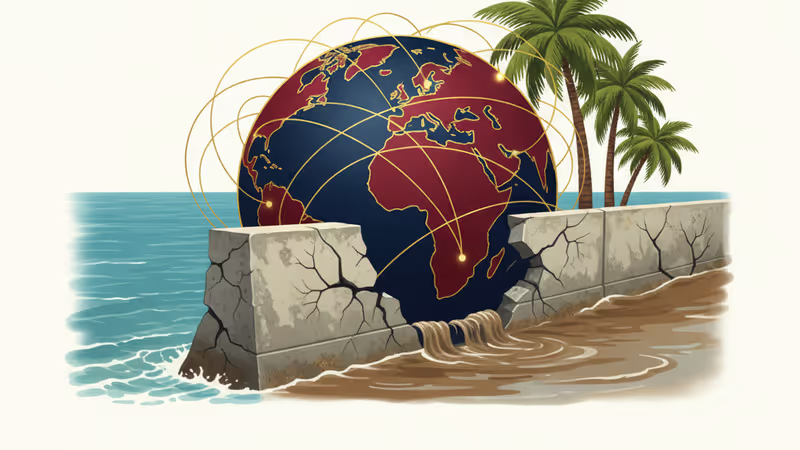
In a historic first for Switzerland, a court has agreed to hear a climate change case brought by Indonesian islanders against cement giant Holcim, setting a major precedent for corporate accountability.

The U.S. State Department is reviving the post of Arctic Ambassador after 8 years, a strategic move to counter growing Russian and Chinese influence and address the impacts of climate change in the High North.
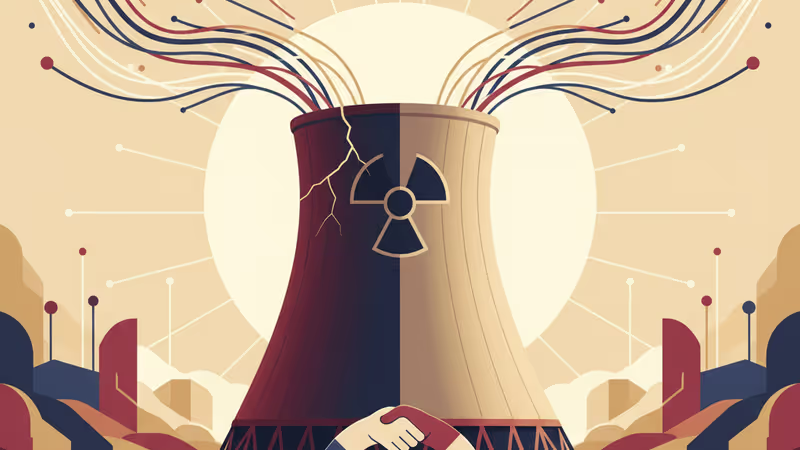
Japan's government has officially greenlit a new energy strategy to restart up to 17 nuclear reactors by 2030 and develop next-generation technology, marking a decisive shift away from its post-Fukushima caution amid energy security concerns.
Analysis suggests the slow disaster response in Aceh and President Prabowo's rejection of international aid could reignite separatist tensions, threatening the peace forged after the 2004 tsunami.
In a historic first for Switzerland, a court has agreed to hear a climate change case brought by Indonesian islanders against cement giant Holcim, setting a major precedent for corporate accountability.
The U.S. State Department is reviving the post of Arctic Ambassador after 8 years, a strategic move to counter growing Russian and Chinese influence and address the impacts of climate change in the High North.
Japan's government has officially greenlit a new energy strategy to restart up to 17 nuclear reactors by 2030 and develop next-generation technology, marking a decisive shift away from its post-Fukushima caution amid energy security concerns.