
U.S. to Appoint First Arctic Ambassador in 8 Years, Signaling Major Policy Shift in High North
The U.S. State Department is reviving the post of Arctic Ambassador after 8 years, a strategic move to counter growing Russian and Chinese influence and address the impacts of climate change in the High North.
The Lead: A New Diplomatic Front in the Far North
The U.S. State Department plans to create the position of Ambassador-at-Large for the Arctic Region, reviving a post that has been vacant since 2017. The move is a clear signal that Washington is escalating its diplomatic focus on a region being rapidly reshaped by climate change and growing great-power competition with Russia and China.
The Details: More Than a Title Change
According to a State Department spokesperson, the new ambassador will be tasked with advancing U.S. policy in the Arctic, engaging with counterparts from the seven other Arctic nations, non-Arctic states, and Indigenous groups. The role also involves close coordination with domestic stakeholders, including state, local, and Tribal governments. The plan is subject to consultation with the U.S. Congress.
Context: Restoring a Senior Diplomatic Post
The Ambassador-at-Large position was eliminated in 2017 during a restructuring under the Trump administration. Since then, U.S. diplomacy in the region has been led by a lower-ranking U.S. coordinator for the Arctic. Elevating the role to the ambassadorial level signifies the Biden administration's intent to treat Arctic issues as a core component of U.S. foreign policy.
The Geopolitical Backdrop: Why Now?
This decision is driven by intensifying geopolitical maneuvering in the High North. Russia, one of the eight members of the Arctic Council, has significantly ramped up its military presence, reopening Soviet-era bases and deploying new weapon systems along its Arctic coastline.
Meanwhile, China has declared itself a "near-Arctic state" and is actively pursuing its "Polar Silk Road" initiative to expand its economic and scientific footprint. As melting ice opens up new shipping lanes and access to resources, Beijing's activities are expanding. Washington views the actions of both rivals as a direct challenge to its strategic interests.
"A peaceful, stable, prosperous, and cooperative Arctic region is of critical strategic importance to the United States."
- U.S. State Department Statement
PRISM Insight: The End of Arctic Exceptionalism
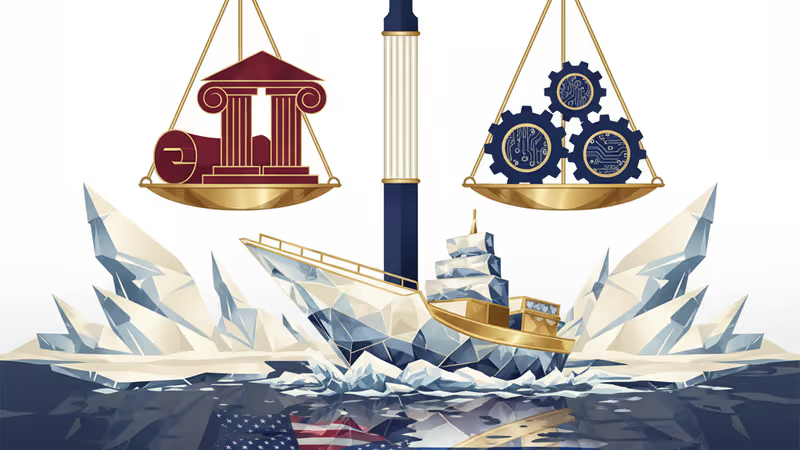
The appointment of an Arctic ambassador is Washington's formal acknowledgement that the era of "Arctic exceptionalism" is over. For decades, the region was largely viewed as a zone of peace, insulated from great-power politics and prioritized for scientific cooperation. This move confirms the Arctic is now fully integrated into the global strategic competition with Russia and China. The new envoy will face the daunting task of balancing traditional priorities like environmental protection and allied cooperation with the hard-edged realities of military tensions and resource competition on a rapidly melting frontier.
Related Articles

A new civilian-led political roadmap to end Sudan's war was announced in Nairobi, but it faces skepticism from domestic critics and international partners like the EU, who question its legitimacy and strategy.

President Donald Trump has appointed Louisiana Gov. Jeff Landry as a special envoy to Greenland, tasked with making the Danish territory part of the U.S., escalating geopolitical tensions in the Arctic.

U.S. and Ukrainian envoys held "productive" talks in Miami, but a major breakthrough to end the war remains out of reach amid conflicting signals from Russia and ongoing military attacks.

A new memoir by a former UK-based Confucius Institute director offers an insider's rebuttal to accusations that the centers are hubs for espionage and propaganda for Beijing.