
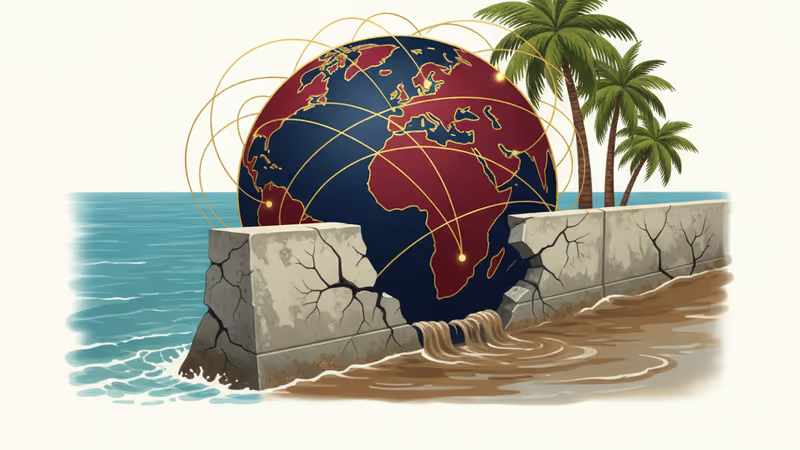
Swiss Court Admits Landmark Climate Lawsuit Against Cement Giant Holcim
In a historic first for Switzerland, a court has agreed to hear a climate change case brought by Indonesian islanders against cement giant Holcim, setting a major precedent for corporate accountability.
A Swiss court has agreed to hear a climate change lawsuit filed by Indonesian islanders against cement giant Holcim, a landmark decision that could hold a multinational corporation legally accountable for its contribution to global warming. The case, accepted by a court in Zug, Switzerland, on December 22, is the first of its kind to be admitted in the country and signals a new frontier in climate litigation.
The complaint was originally filed in January 2023 by four residents of Pari Island, a low-lying Indonesian community that has suffered repeated flooding due to rising sea levels. They brought their case to Zug, the location of Holcim’s corporate headquarters.
The NGO Swiss Church Aid (HEKS/EPER), which is supporting the plaintiffs, announced the court's decision on Monday. If successful, “it would be the first case seeking to hold a Swiss company legally responsible for its contribution to global warming,” the group previously stated. Holcim confirmed the court’s decision and says it plans to appeal.
The plaintiffs are seeking three outcomes: compensation for climate-related damages, financial contributions to flood protection measures on their island, and a court-ordered rapid reduction in Holcim’s global carbon emissions.
This lawsuit is part of a growing global movement to secure compensation for “loss and damage,” and is among the first climate cases brought directly by people in the Global South against a major corporation in the Global North.
Context: Why Target Holcim?According to HEKS, Holcim was selected because it's one of the world's largest carbon dioxide emitters and the biggest “carbon major” based in Switzerland. A study commissioned by the NGO found that between 1950 and 2021, Holcim emitted more than 7 billion tonnes of CO2. That figure, the study says, represents about 0.42% of total global industrial emissions over that period.
For its part, Holcim maintains that it's committed to reaching net-zero emissions by 2050 and is following a science-based pathway to meet that goal. The company also says it has cut direct CO2 emissions from its operations by more than 50% since 2015.
The cement industry is a significant source of greenhouse gases. According to the Global Cement and Concrete Association, cement production accounts for about 7% of the world's total carbon dioxide emissions.
PRISM InsightThe Swiss court's decision to proceed marks a critical shift in the climate battleground, moving from policy debates to direct corporate legal accountability. This case tests the legal boundaries of corporate responsibility across both borders and historical timelines. A ruling in favor of the plaintiffs would set a powerful precedent, potentially opening the floodgates for similar lawsuits against other “Carbon Majors” worldwide. It underscores a new reality for multinational corporations: historical emissions are no longer just a matter for ESG reports but are becoming a tangible legal and financial risk.
Related Articles

A new memoir by a former UK-based Confucius Institute director offers an insider's rebuttal to accusations that the centers are hubs for espionage and propaganda for Beijing.

South Korea's DAPA has decided on a selective bidding process for its ₩7 trillion ($5B) next-gen destroyer project, aiming to end a stalemate caused by a legal feud between Hanwha Ocean and HD Hyundai.

China's state media is highlighting the sentencing of two men for drug-related money laundering, a case that originated from a U.S. intelligence tip-off, signaling rare cooperation amid broader tensions.

At the Turning Point conference, Vice President J.D. Vance defined patriotism as the only boundary for the conservative movement, sparking a debate on its future and inclusivity.