
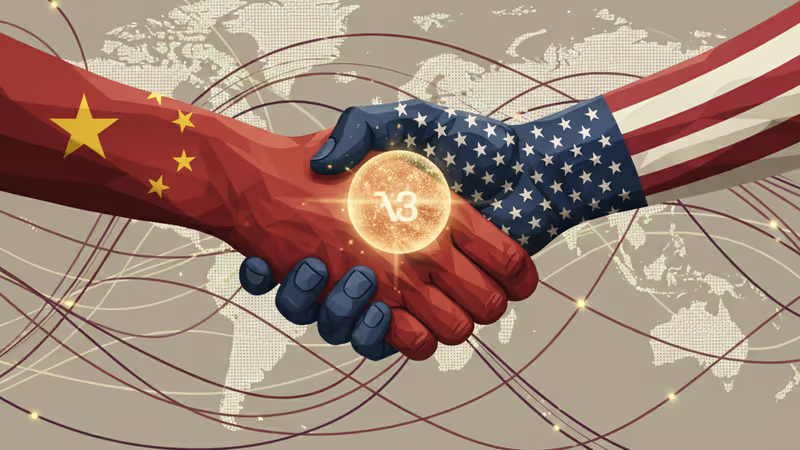
In Rare Accord, China Highlights Drug Bust Following U.S. Tip-Off
China's state media is highlighting the sentencing of two men for drug-related money laundering, a case that originated from a U.S. intelligence tip-off, signaling rare cooperation amid broader tensions.
A Signal of Cooperation in a Sea of Tension
In a notable display of bilateral cooperation amid otherwise strained relations, China is actively publicizing the sentencing of two men for drug-related money laundering, a successful prosecution that stemmed directly from a tip-off from the United States. The move signals a potential bright spot in the ongoing effort to combat transnational narcotics crimes.
Chinese state media, including the People's Daily, reported this past Saturday, December 20, that law enforcement officers in Shenyang, the capital of the northeastern Liaoning province, had acted on information provided by U.S. authorities. This intelligence led to the arrest and subsequent conviction of the pair, who were charged with laundering funds for drug traffickers. The case emerges amid what sources describe as "recent momentum" in U.S.-China counternarcotics cooperation.
"Officers in Shenyang... had received information in [a tip-off from the United States]... [the pair] were charged with money laundering for drug dealers."
— – As reported by Chinese state media
Beijing's decision to highlight this case is geopolitically significant. By showcasing a successful outcome directly following U.S. intelligence sharing, China is sending a clear message: practical collaboration on shared threats remains possible, even as the two superpowers compete fiercely in other arenas. It's a carefully managed piece of public diplomacy aimed at both domestic and international audiences.
Context: The Fentanyl Fault LineFor years, counternarcotics, particularly the fight against the synthetic opioid fentanyl, has been a major point of friction. The U.S. has repeatedly pressed China to crack down on the export of precursor chemicals, while Beijing has pointed to America's domestic demand as the root of the problem. However, recent high-level diplomatic engagements have led to the re-establishment of a bilateral counternarcotics working group, paving the way for renewed intelligence sharing and joint enforcement actions like the one in Shenyang.
PRISM Insight: A Model for Transactional Diplomacy?
This case serves as a powerful example of transactional cooperation. While strategic competition over technology and regional influence continues to define the U.S.-China relationship, this joint effort demonstrates a pragmatic path forward on non-traditional security threats. For both Washington and Beijing, it’s a relatively low-cost way to signal a willingness to engage constructively, building a small measure of trust without conceding ground on core geopolitical disputes. The key question now is whether this model can be replicated in other areas of mutual concern.
Related Articles

A car bomb in Moscow killed Lieutenant General Fanil Sarvarov on Dec. 22, 2025. Russia's Investigative Committee has opened a murder investigation, citing Ukrainian intelligence as a possible orchestrator.

A new civilian-led political roadmap to end Sudan's war was announced in Nairobi, but it faces skepticism from domestic critics and international partners like the EU, who question its legitimacy and strategy.

President Donald Trump has appointed Louisiana Gov. Jeff Landry as a special envoy to Greenland, tasked with making the Danish territory part of the U.S., escalating geopolitical tensions in the Arctic.

U.S. and Ukrainian envoys held "productive" talks in Miami, but a major breakthrough to end the war remains out of reach amid conflicting signals from Russia and ongoing military attacks.