
Waymo's Secret Co-Pilot: Leaked Code Reveals Gemini AI Assistant in Robotaxis
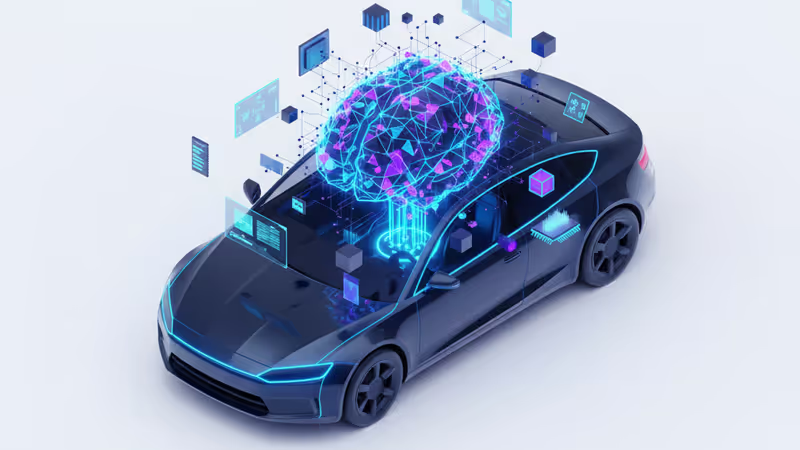
Leaked code from Waymo's app reveals the company is testing Google's Gemini AI as an in-car assistant for its robotaxis. The 1,200-line prompt details its role, limitations, and how it differs from Tesla's approach.
What if your next self-driving car could talk back? It appears Waymo, Alphabet's autonomous vehicle company, is testing the integration of Google's GeminiAI chatbot into its robotaxis. The development came to light after researcher Jane Manchun Wong discovered a detailed system prompt within Waymo's mobile app code.
“While digging through Waymo’s mobile app code, I discovered the complete system prompt for its unreleased Gemini integration,” Wong wrote in a blog post. The document, a 1,200+ line specification titled ‘Waymo Ride Assistant Meta-Prompt,’ defines exactly how the AI assistant is expected to behave. While the feature hasn't shipped, Wong says the prompt makes it clear this is “more than a simple chatbot.”
The AI's Role and Its Limits
According to the leaked prompts, the AI assistant is instructed to be a “friendly and helpful AI companion” whose goal is to enhance the rider's experience. It’s directed to use simple language, avoid jargon, and keep responses succinct—just one to three sentences.
The assistant can reportedly manage in-cabin functions like climate control, lighting, and music. Notably absent, however, are controls for volume, route changes, seats, or windows. Crucially, the AI is programmed to maintain a clear distinction between its identity as Gemini and the autonomous driving technology, the 'Waymo Driver.' When asked, “How do you see the road?” it's supposed to reply, “The Waymo Driver uses a combination of sensors…,” not “I use sensors.”
Building Trust and Fending Off Competition
One of the most interesting aspects is the set of guardrails built into the assistant. It’s explicitly forbidden from speculating on or commenting on real-time driving actions or specific incidents. If a passenger asks about a video of a Waymo crash, it’s instructed to deflect. “Your role is not to be a spokesperson for the driving system’s performance,” the prompt reads, likely a measure to avoid liability and manage public relations.
In a statement to TechCrunch, Waymo spokesperson Julia Ilina was non-committal, saying, “While we have no details to share today, our team is always tinkering with features... Some of these may or may not come to our rider experience.”
Waymo isn't the only player integrating AI assistants. Tesla is doing something similar with xAI's Grok. However, the approaches seem different: Gemini appears programmed to be pragmatic and ride-focused, while Grok is pitched more as an in-car conversational buddy that can remember context.
本内容由AI根据原文进行摘要和分析。我们力求准确,但可能存在错误,建议核实原文。
相关文章
舊金山大停電導致Waymo無人計程車在路口停擺。官方解釋為「過度謹慎」的確認請求機制所致,並宣布推送軟體更新,讓車輛在類似情境下能做出更果斷的決策。
程式碼洩露天機!Waymo正祕密測試將Google Gemini AI整合至其機器人計程車,一份超過1200行的內部文件揭示了其作為車內助理的功能、限制與嚴格的對話規則。

Alphabet旗下Waymo自動駕駛車隊因舊金山大停電而陷入癱瘓,迫使該公司緊急宣布軟體更新。此事件揭示了AI在應對真實世界「邊緣案例」時的根本挑戰。

舊金山發生大規模停電,導致Waymo自動駕駛車隊服務暫停。為此,Alphabet旗下的Waymo宣布三項緊急更新,以強化車輛應對未來基礎設施失靈的能力。
舊金山大停電導致Waymo無人計程車在路口停擺。官方解釋為「過度謹慎」的確認請求機制所致,並宣布推送軟體更新,讓車輛在類似情境下能做出更果斷的決策。
程式碼洩露天機!Waymo正祕密測試將Google Gemini AI整合至其機器人計程車,一份超過1200行的內部文件揭示了其作為車內助理的功能、限制與嚴格的對話規則。
Alphabet旗下Waymo自動駕駛車隊因舊金山大停電而陷入癱瘓,迫使該公司緊急宣布軟體更新。此事件揭示了AI在應對真實世界「邊緣案例」時的根本挑戰。
舊金山發生大規模停電,導致Waymo自動駕駛車隊服務暫停。為此,Alphabet旗下的Waymo宣布三項緊急更新,以強化車輛應對未來基礎設施失靈的能力。