

The Shadow Fleet: Inside CBP's Pivot to a New Era of Drone Surveillance
CBP's pivot from Predator drones to a portable 'shadow fleet' isn't just a border strategy—it's a blueprint for widespread domestic surveillance.
The Lede: The Predator is Dead, Long Live the Swarm
A quiet but strategic pivot is underway within US Customs and Border Protection (CBP). The agency is moving away from the lumbering, high-altitude Predator drone model and aggressively building a distributed, ground-level fleet of hundreds of portable, human-launched drones. For business leaders and technologists, this is more than a procurement shift; it’s the beta test of a new, agile, and scalable surveillance architecture. Forget the single, all-seeing eye in the sky. The future of government surveillance is a network of intelligent, tactical eyes on the ground, and this model is explicitly designed for export from the border to our backyards.
Why It Matters: The New Surveillance Stack
This strategic change has significant second-order effects that extend far beyond border enforcement. It represents a fundamental rewiring of how surveillance is conducted, with three core implications:
- From Strategic to Tactical: Large Predator drones provide strategic oversight, but with significant lag time between spotting and interception. This new fleet of smaller, backpack-sized drones closes that loop. They are designed to pipe real-time location data directly to agents' handheld devices, turning surveillance from a passive observation tool into an active, real-time tactical asset. The goal is to shrink the 'detect-to-intercept' window from hours to minutes.
- Market Disruption & Creation: This move sidelines a market dominated by large defense contractors like General Atomics. It opens the floodgates for a new ecosystem of agile hardware and software companies specializing in ruggedized drones, edge-based AI for object detection, and secure mesh-network communications. CBP's requirements for portability and durability are creating a new class of government-grade commercial drones.
- The Border-to-City Pipeline: Department of Homeland Security (DHS) officials are not hiding their intentions. The mention of a $1.5 billion investment and partnerships with cities and states for events like the 2026 World Cup confirms the strategy: perfect the technology and tactics in the constitutionally-flexible zone of the border, then deploy this proven model domestically. This is mission creep by design.
The Analysis: Mainframe vs. Edge Computing, Applied to State Power
Historically, CBP's drone program, particularly the Predator fleet, mirrored a mainframe computing model: a centralized, expensive, and resource-intensive asset providing data to a central command. Federal watchdogs have long criticized this model as a billion-dollar boondoggle with questionable effectiveness and staggering operational costs. It was a sledgehammer approach to a problem requiring surgical precision.
The new strategy is a classic shift to edge computing. By distributing smaller, cheaper, and more intelligent drones to frontline units, CBP is pushing processing and decision-making to the network's edge. Each Border Patrol team effectively becomes a mobile, data-collecting node. This makes the entire system more resilient, responsive, and scalable. A single Predator being grounded is a major loss of capability; a single small drone going down is a negligible event. This distributed model allows for persistent, wide-area surveillance at a fraction of the cost and with exponentially greater tactical flexibility.
PRISM Insight: The Real Value is in the Software, Not the Hardware
While the focus is on the drone hardware, the real technological leap and investment opportunity lie in the software stack that makes this fleet effective. The critical technology isn't just the ability to fly in high winds; it's the AI-powered software that can autonomously detect human movement, the secure data links that pipe coordinates to an agent's phone without being intercepted, and the user interface that integrates this new data stream into existing digital mapping and coordination tools. Companies that can provide this full-stack solution—from sensor to software to secure signal—are the ones poised to dominate this emerging sector of 'GovTech'. The drone is just the delivery mechanism for the data package.
PRISM's Take: A Blueprint for Persistent, Low-Altitude Surveillance
CBP's shift to a distributed 'shadow fleet' is a watershed moment. While justified on the grounds of efficiency and agent safety, it represents a dangerous normalization of persistent, real-time surveillance. The technology being honed in the harsh deserts of Arizona is a blueprint for a new type of domestic law enforcement. The true significance of this strategy is not its application at the border, but its inevitable proliferation into mainstream policing. We are witnessing the creation of a surveillance model that is cheaper, more effective, and more easily deployed than anything that has come before it. The debate we should be having is not whether this technology works, but how we will govern its use when it arrives in our own communities—because it is unequivocally on its way.
관련 기사
미국 국경순찰대(CBP)가 대형 프레데터 드론 대신 소형 휴대용 드론 네트워크로 전환합니다. 이는 감시 기술의 효율성을 높이지만, 사생활 침해 우려를 낳고 있습니다.

한국 정부가 150조원 규모의 성장사다리 펀드를 통해 AI, 반도체, 배터리 산업에 대한 국가적 베팅을 시작했습니다. 글로벌 기술 패권 경쟁의 판도를 바꿀 전략을 심층 분석합니다.
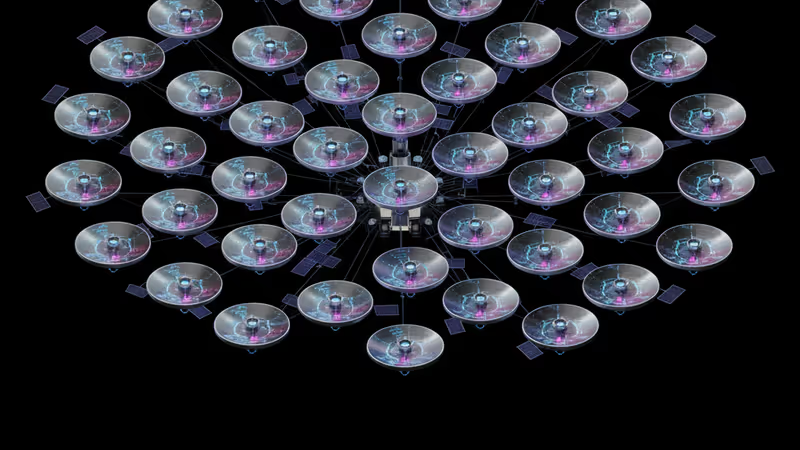
로켓랩이 발사한 접시 모양의 '디스크샛'은 단순한 기술 시연이 아닙니다. 차세대 위성 표준을 선점하려는 NASA와 미 우주군의 전략적 행보를 분석합니다.

AI 데이터센터 수요 폭증으로 램, SSD 가격이 400%까지 치솟았습니다. PC 빌더들이 직면한 새로운 현실과 시장의 미래를 심층 분석합니다.