
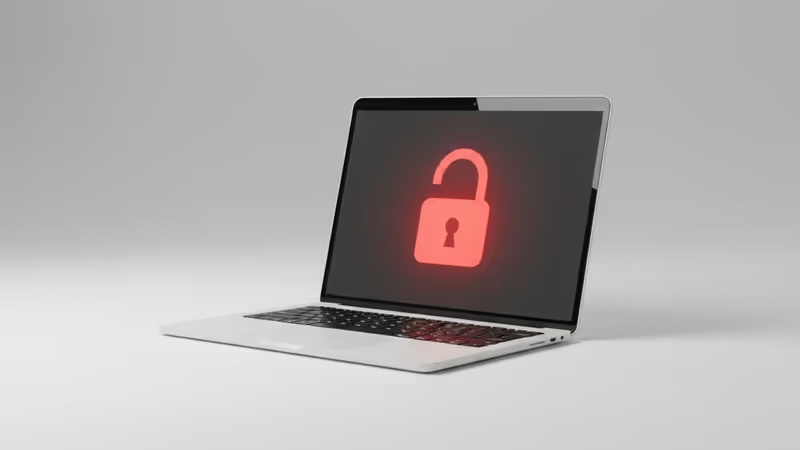
The Public Wi-Fi Paradox: Your Free Connection Is a Security Minefield
Free public Wi-Fi isn't a utility; it's a transaction. PRISM analyzes the hidden security risks and why treating every connection as hostile is the new standard.
The Lede: The Unmanaged Risk in Your Pocket
The free Wi-Fi at your airport lounge or local coffee shop isn't a utility; it's an unmanaged, high-risk extension of your personal and corporate network. For the busy executive, every connection to these public networks is a roll of the dice, expanding your organization's attack surface to an insecure environment you don't control. The perceived convenience masks a critical vulnerability that threat actors actively exploit.
Why It Matters: The True Cost of 'Free'
The ubiquity of public Wi-Fi has created a dangerous paradox. As connectivity has become an ambient expectation, our collective security posture has dangerously eroded. This has profound second-order effects:
- The Normalization of Data Harvesting: Venues offering 'free' Wi-Fi are not altruistic. They are data brokers. The price of admission is your email address, which is immediately funneled into marketing databases, or worse, your browsing habits, which are tracked and sold.
- The Distributed Workforce's Achilles' Heel: The 'work-from-anywhere' revolution is built on a foundation of insecure public infrastructure. A single employee accessing sensitive corporate data from a compromised coffee shop network can trigger a multi-million dollar breach.
- The Consumer as the Product: This ecosystem thrives on a transactional relationship where user data is the currency. This trains consumers to trade privacy for convenience, a behavioral shift with long-term consequences for digital rights.
The Analysis: From Paid Amenity to Insecure Expectation
In the early 2000s, public Wi-Fi was a premium, paid service from providers like Boingo. It was a deliberate act to connect. Today, it’s a 'freemium' expectation, and the underlying technology has not kept pace with the security threats. Most public hotspots are open, unencrypted networks, making them trivial environments for Man-in-the-Middle (MitM) attacks. An attacker on the same network can easily intercept traffic, steal credentials, and monitor activity.
The advice to use a VPN or a disposable email address treats the symptom, not the disease. The core issue is a fundamental misalignment: we are placing 21st-century data needs onto a 20th-century security architecture. The convenience has completely overshadowed the inherent risk, and platform providers have done little to enforce higher security standards like WPA3 or Hotspot 2.0 (Passpoint) which would automate secure connections.
PRISM Insight: The Rise of Consumer Zero Trust
The insecurity of the public digital commons is accelerating a key trend: the consumerization of Zero Trust architecture. Once an enterprise-only concept, the principle of 'never trust, always verify' is becoming a personal security mandate. This is not just about VPNs; it's about a stack of personal security tools becoming non-negotiable for the informed user.
This trend has clear investment implications. The market for consumer cybersecurity—including premium VPNs, private DNS services, hardware security keys, and identity monitoring—is being directly fueled by the failure of public infrastructure. Furthermore, the continued growth and falling cost of 5G cellular data present a direct existential threat to the public Wi-Fi model. Why risk an insecure hotspot when secure, high-speed cellular is readily available? The future of public connectivity will be a battleground between upgraded, secure Wi-Fi standards and the overwhelming convenience of 5G/6G.
PRISM's Take: Treat Every Network as Actively Hostile
Public Wi-Fi is a legacy convenience clashing with modern security realities. The default action should no longer be to connect, but to question the necessity. Simple tips and tricks are no longer sufficient; a fundamental mindset shift is required. Every public network must be treated as actively hostile until proven otherwise. For most tasks, your smartphone's secure cellular hotspot is a vastly superior and safer alternative. The convenience of 'free' Wi-Fi is a siren song that often leads directly to data exposure and compromise. In the current threat landscape, the price of free is simply too high.
관련 기사
카페, 공항의 무료 와이파이, 정말 안전할까요? 당신의 개인정보를 노리는 위협과 VPN을 활용한 전문가 수준의 보안 팁을 심층 분석합니다.
더 버지의 연말연시 테크 선물 가이드 심층 분석: '후회 없는 선물'을 위한 현명한 소비 전략과 PRISM이 제시하는 시장 트렌드를 확인하세요.
구글과 애플이 비자 소지 직원에게 해외여행 자제를 권고했습니다. 장기화되는 비자 수속, 강화된 심사 기준이 미 테크 산업과 글로벌 인재 이동에 미칠 파장을 PRISM이 심층 분석합니다.

AI 데이터센터 시장이 610억 달러로 성장했지만, 민간 투자 위험, 막대한 전력 소비, 환경 및 지역 사회의 반발이라는 그림자에 직면했습니다. 지속 가능한 AI 인프라의 미래를 분석합니다.