
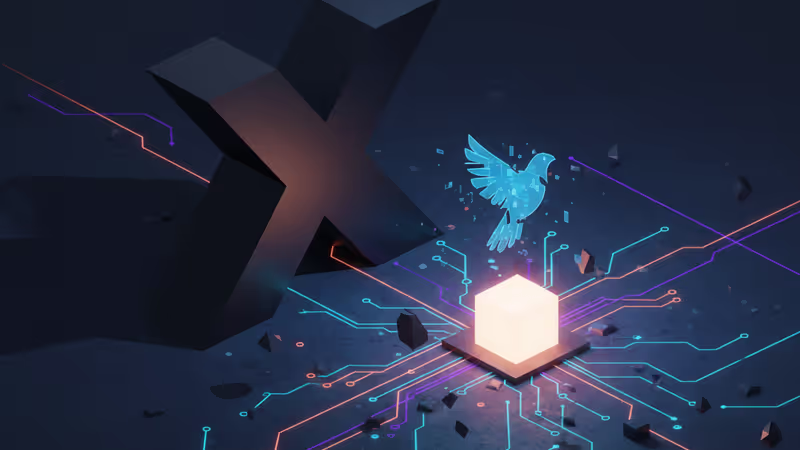
The Ghost of Twitter: Why X's Lawsuit Against a Tiny Startup Reveals a Billion-Dollar Branding Crisis
X Corp is suing a startup for using the 'Twitter' name. Our analysis reveals why this legal fight is a symptom of a massive, self-inflicted branding failure.
The Lede: More Than a Lawsuit, It's a Referendum
X Corp’s lawsuit against 'Operation Bluebird'—a startup aiming to resurrect the Twitter brand—is far more than a standard trademark dispute. It's a forced public admission of a critical strategic failure: despite sinking billions into his 'everything app,' Elon Musk is now legally fighting to control the ghost of the very brand he tried to kill. For executives and investors, this isn't a legal curiosity; it's a high-stakes case study on the immense, lingering power of brand equity and the chaos that ensues when it's mismanaged.
Why It Matters: The Second-Order Effects
On the surface, this is David vs. Goliath. But the implications ripple far beyond this specific case. Most are missing the bigger picture:
- The Precedent for Brand Squatting: If Operation Bluebird gains any legal traction, it could inspire a new wave of opportunistic startups targeting other controversial or poorly executed rebrands. Every company from Meta to Warner Bros. Discovery should be watching. It weaponizes public nostalgia against corporate strategy.
- An Admission of Weakness: The lawsuit is a tacit acknowledgment from X Corp that the 'Twitter' name and the blue bird icon still hold immense cultural and commercial power—power that the 'X' brand has failed to capture. Suing to protect a brand you publicly discarded is the ultimate strategic paradox.
- The ROI of Nostalgia: Operation Bluebird is proving that the goodwill Musk abandoned is now an asset others can leverage. Their real goal may not be to win in court, but to win in the court of public opinion, positioning themselves as the saviors of a beloved platform and generating millions in free press.
The Analysis: Deconstructing the Battlefield
The Legal Minefield: Can You Really 'Abandon' a Global Brand?
Legally, X Corp is on solid ground. Trademark abandonment requires proving an 'intent not to resume use.' Since X is a direct continuation of the Twitter service, using the same infrastructure and user base, it’s nearly impossible to argue the mark was legally abandoned. X’s lawyers will correctly argue this was a rebrand, not a desertion.
However, Operation Bluebird isn't just making a legal argument; it's making a cultural one. Their gambit is to argue that Musk’s public actions—from physically removing the sign from the San Francisco HQ to his vocal disdain for the old 'bird app' culture—constituted a de facto abandonment in the public's mind. It's a long shot in court, but a powerful narrative for the media and disenfranchised users.
A Battle for Identity: The Lingering Soul of the Bird App
This conflict underscores a fundamental truth of modern branding: a company doesn't fully own its brand—the public does. Terms like 'Tweet' and 'Retweet' have entered the global lexicon. The blue bird is an icon recognizable from rural villages to Wall Street trading floors. Musk could change the name on the building, but he couldn't erase a decade of cultural embeddedness.
This lawsuit is X Corp spending money to extinguish the embers of an identity it set on fire. It proves that the 'Twitter' brand equity is not just a line item on a balance sheet, but an active, potent force that now exists independently of its corporate owner.
PRISM Insight: The True Cost of a Rushed Rebrand
The core lesson here for every business leader is about the execution of brand transformation. Musk’s 'rip the band-aid off' approach created a strategic vacuum. A well-managed rebrand (like Accenture from Andersen Consulting) involves a long, deliberate transition that transfers brand equity from the old to the new. Musk opted for a hard cut, severing ties with the old brand before the new one had established any meaningful equity of its own.
This void is what Operation Bluebird is exploiting. They are building their entire identity on the positive equity X Corp discarded. The lawsuit, therefore, is not a sign of strength from X, but a defensive reaction to a problem of its own making. It is forced to acknowledge and defend the value of something it publicly deemed worthless.
PRISM's Take: Winning the Battle, Losing the War
X Corp will almost certainly win this lawsuit. The legal framework for trademark infringement is heavily in its favor. But make no mistake: this is a pyrrhic victory. The very act of filing this suit is a strategic loss. It amplifies the narrative that 'X' is a failure, that the 'Twitter' brand is still yearned for, and that the company is haunted by the ghost of its former self. Operation Bluebird has already achieved its primary goal: it has used the legal system to force a global conversation about the botched X rebrand, cementing itself as a champion for disillusioned users—all on X Corp’s dime. The real winner isn't decided in a Delaware courtroom, but in the ongoing battle for the future of online discourse, a battle where the memory of the blue bird still casts a long shadow.
관련 기사

2015년 스페이스X의 첫 로켓 회수 성공은 단순한 기술적 성과가 아니었습니다. 실패를 딛고 우주 산업의 패러다임을 바꾼 결정적 순간을 심층 분석합니다.

트럼프 미디어가 구글 후원 핵융합 기업 TAE와 합병합니다. AI 시대의 전력난이 어떻게 정치, 자본, 딥테크를 뒤섞는 새로운 투자 지형을 만드는지 분석합니다.

2026년 F1이 '부스트 모드'와 액티브 에어로 기술로 대변혁을 맞습니다. 더 작고 민첩해진 머신이 레이싱의 판도를 어떻게 바꿀지 심층 분석합니다.

100만원 넘는 플래그십 스마트폰 대신, 놀라운 가성비를 제공하는 중저가 폰이 시장의 새로운 표준이 되고 있습니다. 그 배경과 소비자 전략을 분석합니다.