
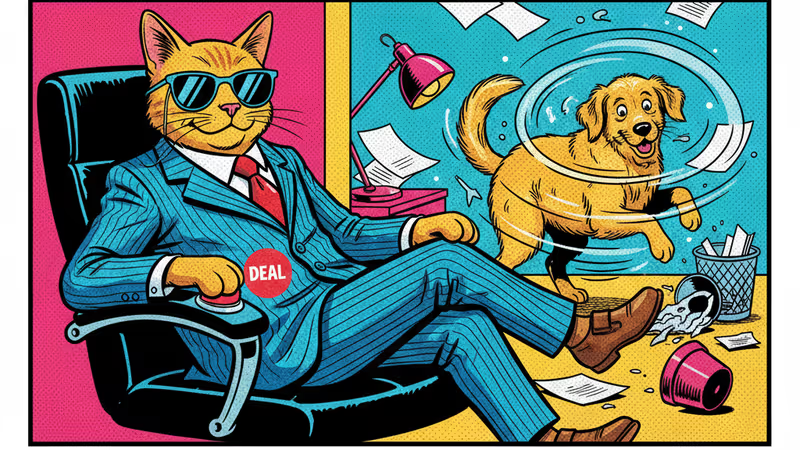
The Feline Economy: Why Your Next Business Model Should Be More Cat, Less Dog
Beyond cute photos, the independent nature of cats offers a powerful blueprint for the future of AI, UX design, and low-overhead business models. Analysis for leaders.
The Lede: Beyond Cuteness, A Blueprint for Autonomy
As a leader, you're conditioned to admire the 'canine' model: loyal, eager to please, and constantly engaged. But while social media platforms and legacy software demand this high-touch, needy interaction, a more powerful and efficient paradigm is emerging. It’s sitting in a sunbeam, silently judging your operational inefficiencies. The common house cat, often dismissed as aloof, is a masterclass in autonomous, low-overhead, high-value systems. The viral trend of sharing 'Why You Should Have A Cat' isn't just about cute photos; it’s a subconscious signal of a major shift in consumer and user expectations toward what we call the Feline Principle of System Design.
Why It Matters: The End of 'Engagement' as a Metric
The obsession with 'user engagement'—constant notifications, infinite scrolls, daily check-ins—is becoming a liability. This 'canine' approach leads to user burnout, notification fatigue, and brand resentment. The market is pivoting towards systems that provide value with minimal cognitive load.
Second-order effects are already visible:
- Subscription Fatigue: Consumers are cutting services that demand too much attention for too little passive value.
- Enterprise Software Revolt: Employees are rejecting clunky, demanding software for streamlined, intuitive tools that operate in the background.
- The Rise of Ambient AI: The next generation of AI won't be a chatbot you constantly have to prompt; it will be an ambient intelligence that anticipates needs and solves problems autonomously, much like a cat navigates a home with quiet confidence.
Companies clinging to the high-engagement, 'dog-like' model of interaction will be perceived as noisy and inefficient, while those adopting the 'feline' model of quiet competence will win the next decade of user loyalty.
The Analysis: From High-Touch to High-Trust
Historically, technology has followed a canine path. Early command-line interfaces required precise, constant instruction. The social media era weaponized it, designing for addiction through relentless interaction. This is the technological equivalent of a dog needing to be walked and played with constantly.
The 'feline' model represents the evolution to ambient computing and true AI. A cat doesn’t need to be walked. It manages its own time, provides comfort and utility on its own terms (what the source material calls 'cuddles' and 'stress reduction'), and operates with extreme energy efficiency. It builds a bond based on trust and quiet presence, not on frantic, repeated demands for attention. This is the blueprint for a 'high-trust' system: one that users know is working for them without needing constant validation.
Canine vs. Feline Business Models:
- Canine Model: Success measured by Daily Active Users, notifications opened, time-on-page. Requires a large support and 'community management' infrastructure. Example: Facebook, traditional CRM software.
- Feline Model: Success measured by problem-resolution rate, user retention, and low interaction-per-outcome. Built on elegant automation and self-sufficiency. Example: A well-designed API, a smart thermostat, advanced cybersecurity software.
PRISM Insight: Invest in 'Ambient Companionship' Tech
The core investment thesis is the shift from active-use tools to passive-value platforms. The source article highlights cats providing comfort and mental health benefits passively—their purr has a calming effect. This points directly to the burgeoning market for 'Ambient Companionship' technology. This isn't about novelty pet-tech; it’s about technology that improves human well-being with minimal direct input.
Key investment sectors include:
- AI-driven Wellness Platforms: Apps and devices that monitor vitals and stress markers to proactively adjust environments (e.g., lighting, soundscapes) without user commands.
- Autonomous Home Robotics: Beyond vacuums, think of systems that manage home inventory, security, and maintenance with near-zero user oversight.
- 'Set-and-Forget' SaaS: Enterprise tools that use AI to automate complex workflows, requiring human intervention only for high-level strategic decisions, not for mundane data entry.
PRISM's Take: Adopt the Feline Principle or Become Obsolete
The internet's love for cats is more than a meme; it's a market signal. Users are tired of needy technology. They crave the quiet, self-sufficient elegance that a cat embodies. The most disruptive and valuable products of the near future will not be the ones that bark the loudest for our attention. They will be the ones that, like a cat, find the sunniest spot in our lives, curl up, and silently make everything better. Leaders and builders must ask themselves: Are we building a system that needs constant attention, or are we building one that earns trust through quiet, autonomous competence? In the new economy, it pays to be more cat.
관련 기사
지도에서 사라진 유령섬들. 이는 단순한 옛날이야기가 아니라, 데이터의 진실성이 중요해진 AI 시대에 우리에게 보내는 강력한 경고 메시지입니다.
세계 아랍어의 날을 맞아, 단순한 어원을 넘어 기술과 경제의 중심으로 부상하는 아랍어의 전략적 가치와 미래 AI 시장에서의 기회를 분석합니다.
AI에게 마약을? 챗봇을 '뿅가게' 만드는 코드가 등장하며 전 세계가 갑론을박에 빠졌습니다. 이것은 창의성의 해방일까, 아니면 위험한 장난일까? 글로벌 반응과 심층 분석.

미 법무부의 엡스타인 파일 부분 공개가 거센 반발을 사고 있습니다. 이는 단순한 정보 공개를 넘어, 투명성과 권력, 기술이 충돌하는 현대 사회의 단면을 보여줍니다.