
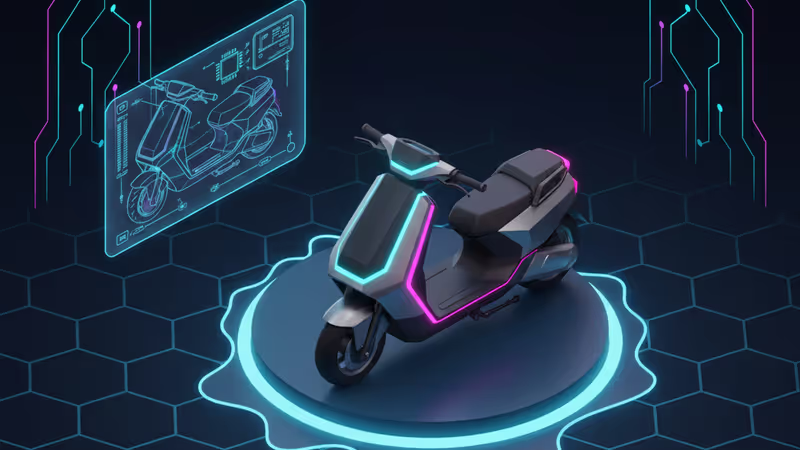
The E-Scooter 2.0 Era: Why Your Next Ride is an Investment, Not a Toy
The e-scooter market is maturing beyond speed and hype. Our analysis reveals why safety, brand trust, and long-term service are now the key factors.
The Lede
The conversation around electric scooters is undergoing a critical evolution. Once dismissed as a fleeting tech novelty, the personal e-scooter has firmly established itself as a serious vehicle for urban mobility. The market is rapidly maturing, shifting the consumer calculus from a simple focus on speed and range to a sophisticated assessment of safety, reliability, and long-term cost of ownership. This isn't just about better scooters; it's a fundamental signal that the micromobility sector's 'Wild West' era is over.
Why It Matters
This market maturation has profound second-order effects. For the industry, it's forcing a consolidation where fly-by-night brands with questionable safety standards and non-existent post-purchase support are being systematically squeezed out. For consumers, the purchase journey now mirrors that of a major appliance or vehicle, demanding deeper research into factors like UL certifications and parts availability. For urban planners, it validates the e-scooter as a permanent fixture in the transit landscape, demanding proportional investment in infrastructure and regulation.
The Analysis
The End of the "Spec Sheet War"
The initial e-scooter boom was a race to the bottom on price and a race to the top on specs. Manufacturers battled over top speed and maximum range, often at the expense of build quality and safety. We are now entering a post-spec-war era. As evidenced by comprehensive testing and long-term reviews, the most recommended models, like the Apollo Go, are not necessarily the fastest or longest-range. Instead, they represent a balanced triangulation of performance, build quality, and crucial safety features like dual suspension, self-healing tubeless tires, and robust braking systems (both regenerative and mechanical).
From Gadget to Vehicle: The New Consumer Calculus
The key questions potential buyers are asking have fundamentally changed. The discussion has moved beyond "How fast does it go?" to more critical, long-term considerations:
- Safety & Certification: The explicit warnings about charging protocols and the importance of UL-certified batteries are no longer fine print. Reports of battery fires have made safety a primary purchasing driver, pushing reputable brands to invest in and advertise these certifications.
- Serviceability & Ecosystem: A scooter's value is now intrinsically linked to its manufacturer's support ecosystem. Can you easily source a replacement battery in three years? Does the company offer spare parts? Are local shops able to service the vehicle? A low upfront cost is irrelevant if the device becomes a paperweight after its first major component failure.
- Durability & Infrastructure-Readiness: The distinction between solid, tubed, and tubeless tires is a perfect example of this new calculus. A consumer in a city with pristine bike lanes might opt for a low-maintenance solid tire, whereas a commuter in a city riddled with potholes must prioritize the superior shock absorption of a tubeless pneumatic tire and suspension system. The purchase is now tailored to the reality of the urban environment, not just an idealized performance metric.
Brand Trust as the New Currency
In a flooded market, brand reputation is becoming the most valuable asset. Companies like Segway, Apollo, and Niu are pulling away from the pack not just through engineering, but by building trust. This is achieved through transparent communication, investment in customer support, and building vehicles designed for longevity rather than disposability. This trend directly benefits consumers, as it fosters competition based on quality and long-term value rather than unsustainable, low-margin pricing.
PRISM Insight
Investment & Technology Outlook
The future of e-scooter innovation lies less in raw power and more in intelligent systems. The integration of sophisticated mobile apps for customizing performance—like adjusting regenerative braking levels on the Apollo Go—is just the beginning. The next frontier will be dominated by advancements in Battery Management Systems (BMS) for enhanced safety and longevity, better integration with urban transit apps, and potentially, the adoption of standardized, swappable batteries. This shift from hardware-centric to software-enabled features marks the category's transition into a mature consumer electronics space.
Actionable Guidance for Buyers
For individuals or businesses considering an e-scooter purchase, the evaluation framework must be updated. Prioritize the following:
- Verify Safety Certifications: Insist on clear UL certification for the battery, charger, and overall electrical system. This is a non-negotiable baseline for safety.
- Investigate the Post-Purchase Ecosystem: Before buying, check the manufacturer's website for the availability and pricing of spare parts like tires, brake pads, and replacement batteries. A brand that doesn't offer this is a significant red flag.
- Match the Technology to Your Terrain: Don't be sold on a single feature. Assess the complete system—tires, suspension, and frame—in the context of your daily commute. A powerful motor is useless without the suspension and tires to handle your city's roads safely.
PRISM's Take
The electric scooter has successfully navigated the treacherous hype cycle, emerging not as a fad, but as a durable and essential component of the modern urban mobility stack. The market's pivot toward safety, reliability, and serviceability is the strongest indicator of its long-term viability. The winners in this new 2.0 era will be the manufacturers who treat their products as serious vehicles, and the consumers who are savvy enough to buy them as such.
관련 기사

한국 정부가 150조원 규모의 성장사다리 펀드를 통해 AI, 반도체, 배터리 산업에 대한 국가적 베팅을 시작했습니다. 글로벌 기술 패권 경쟁의 판도를 바꿀 전략을 심층 분석합니다.
로켓랩이 발사한 접시 모양의 '디스크샛'은 단순한 기술 시연이 아닙니다. 차세대 위성 표준을 선점하려는 NASA와 미 우주군의 전략적 행보를 분석합니다.

AI 데이터센터 수요 폭증으로 램, SSD 가격이 400%까지 치솟았습니다. PC 빌더들이 직면한 새로운 현실과 시장의 미래를 심층 분석합니다.

유튜브가 200만 구독자의 AI 가짜 예고편 채널을 폐쇄했습니다. 이는 단순한 제재를 넘어, AI 콘텐츠의 '투명성'과 '책임'을 요구하는 새로운 시대의 시작을 의미합니다.