
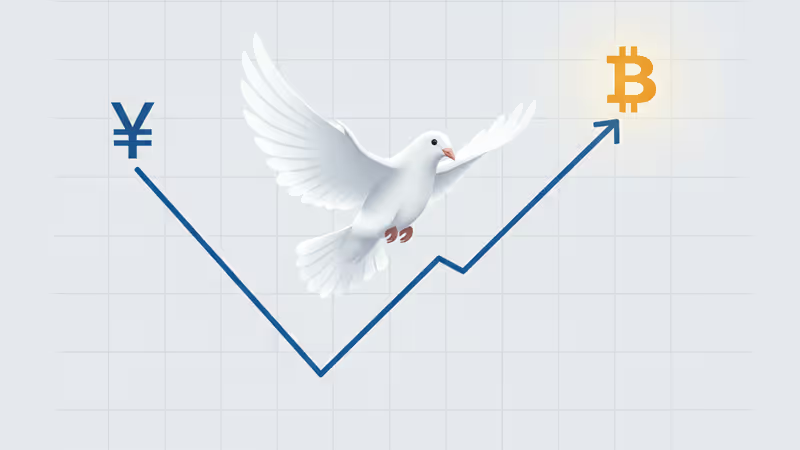
The Dovish Hike: Why a Weaker Yen After BOJ's Rate Rise Is Bullish for Bitcoin
The Bank of Japan's rate hike paradoxically weakened the yen, signaling global liquidity remains intact. Discover why this matters for risk assets like Bitcoin.
The Lede: The Paradox Signal
The Bank of Japan (BOJ) just hiked interest rates to a 30-year high, and its currency, the yen, promptly fell. This isn't a typo; it's a critical signal for global investors. The market's counterintuitive reaction reveals a deeper truth: the era of ultra-cheap money, a cornerstone of global liquidity for decades, is not ending with a bang, but a whimper. For executives and investors, this means the 'risk-on' environment that fuels everything from tech stocks to Bitcoin isn't facing the immediate threat many feared.
Why It Matters: The Ghost in the Machine
For over two decades, the Japanese yen has been the ghost in the global financial machine. By holding interest rates at or below zero, the BOJ effectively offered the world a free loan. This spawned the 'Yen Carry Trade': investors borrowed yen for next to nothing and invested it in higher-yielding assets globally. This trade amplified liquidity and propped up asset prices worldwide.
The fear was that a series of aggressive BOJ rate hikes would strengthen the yen, forcing a violent 'unwinding' of these trades. This would mean investors selling off their global assets to pay back their now-more-expensive yen loans, triggering a potential market crash. Yesterday’s 'dovish hike' signals this apocalypse has been postponed. The BOJ’s move was so well-telegraphed and its accompanying language so cautious—stressing that monetary conditions remain 'accommodative'—that it effectively gave the carry trade a green light to continue.
The Analysis: A Central Bank Trapped
To understand the yen's weakness, you must understand the BOJ's predicament. After decades of fighting deflation with extreme monetary stimulus, Japan is saddled with monumental government debt, much of which is owned by the central bank itself. A significant, rapid increase in interest rates would not only crush the Japanese economy but also render its government finances unsustainable.
The market sees this clearly. It interpreted the 0.25% hike not as the first step in a determined inflation fight, but as a token gesture from a central bank with very little room to maneuver. The vast interest rate differential between Japan (0.75%) and the U.S. (still significantly higher) remains a chasm. Why hold a low-yielding yen when you can get a much higher return in dollars? This simple calculus is why capital continues to flow out of Japan, weakening its currency despite the rate hike.
PRISM Insight: Bitcoin and the Fiat Debasement Thesis
Bitcoin's jump above $87,000 in the wake of the news is not a coincidence. It reflects two powerful undercurrents:
- Global Liquidity Persists: As long as the Yen Carry Trade remains viable, the flow of cheap leverage into global markets continues. Bitcoin, as a high-beta risk asset, thrives in this environment. The BOJ’s gentle tap on the brakes reassures markets that the liquidity punch bowl isn’t being taken away just yet.
- The Yen as a Warning: More fundamentally, the yen's slide is a live case study in fiat currency debasement. A major G7 economy is unable to defend its currency's value through conventional monetary policy because its debt burden has rendered its central bank impotent. This reinforces the core value proposition of scarce, non-sovereign assets like Bitcoin as a long-term hedge against the inevitable endgame facing highly indebted economies.
PRISM's Take: The Real Story is the Inaction
The headline is the Bank of Japan's rate hike. The real story is its profound inability to hike further in any meaningful way. The BOJ is trapped, and its policy normalisation will be the slowest and shallowest in modern history. This ensures the yen remains a structurally weak currency, solidifying its role as the world’s preferred funding source for risk-taking.
For investors, this means the 'risk-off' shock from Japan is a low-probability event in the near term. More importantly, it serves as a stark reminder that in a world of unsustainable debt, the value of sovereign currencies is not guaranteed. The weakness of the yen is not just a trading opportunity; it's a secular trend that highlights the fragility of the global fiat system and validates the search for alternatives.
관련 기사

미국 인플레이션과 일본은행의 금리 인상이란 두 개의 거시경제 파도가 비트코인을 덮치고 있습니다. 단순한 가격 조정을 넘어선 '엔 캐리 트레이드' 청산 리스크를 심층 분석합니다.

중국이 복제약 생산을 넘어 1/5 비용으로 신약을 개발하는 글로벌 바이오 혁신 허브로 부상했습니다. 이 변화가 글로벌 제약 시장과 투자에 미치는 영향을 심층 분석합니다.
중국이 미 국채 보유량을 17년 만의 최저치로 줄였습니다. 이는 단순한 자산 조정을 넘어, 가속화되는 탈달러화와 미중 갈등의 새로운 단면을 보여줍니다.

일본은행이 30년 만의 금리 인상을 단행, 초저금리 시대의 종언을 알렸다. 글로벌 엔 캐리 트레이드 청산과 자금 흐름의 지각변동이 예상된다.