
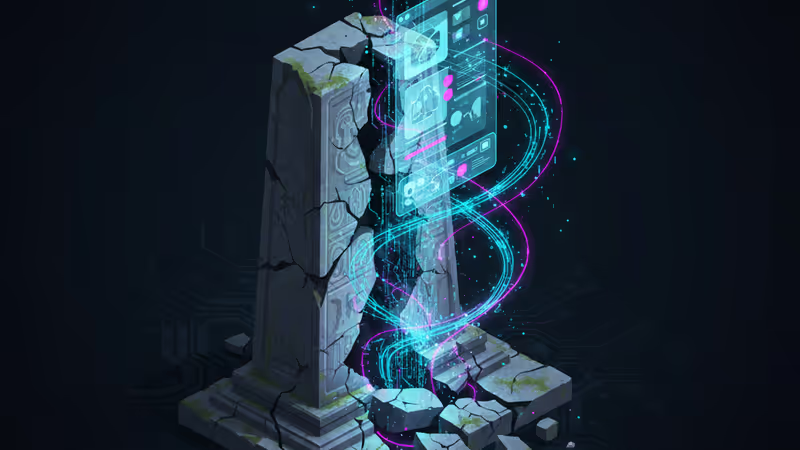
The 28-Day App: OpenAI's Sora Launch Signals the End of Traditional Software Development
OpenAI shipped Sora for Android in just 28 days using AI. PRISM's analysis breaks down why this isn't just fast—it's a fundamental threat to the entire software industry.
The Lede: A New Benchmark for Speed
OpenAI didn't just launch a new app. By shipping Sora for Android in a mere 28 days, it fired a starting pistol for a race the software industry was not prepared for. Using AI tools like Codex for planning, code translation, and parallel development, a small team achieved what typically takes large teams six to twelve months. For any investor, developer, or C-suite executive, this isn't just an impressive metric—it's a fundamental rewriting of the rules of technology and competition.
Why It Matters: The Collapse of Development Timelines
The strategic implications of a 28-day development cycle are seismic. Speed has always been a competitive advantage, but this is a phase shift. It moves the goalposts from incremental improvements in efficiency (like Agile or DevOps) to a near-total collapse of the time between idea and execution.
- Competitive Moats Evaporate: A startup with a lean, AI-augmented team can now potentially out-maneuver a well-funded incumbent, shipping a rival product in a fraction of the time. The traditional advantage of a large engineering department is now in question.
- The Economics of Software Are Upended: When the cost and time to build complex applications plummet, it dramatically lowers the barrier to entry. This will trigger a cambrian explosion of new software but also create immense downward pressure on pricing for SaaS products and development agencies.
- The Talent Stack Is Inverted: The most valuable skill is no longer writing flawless code line-by-line. It's the ability to architect systems, define problems for an AI, and expertly validate the output. The developer's role is elevating from a craftsperson to a systems conductor.
The Analysis: Deconstructing the AI-First Workflow
From Agile to Autonomous: A New Development Paradigm
For two decades, the industry has optimized human collaboration through methodologies like Agile and DevOps. The goal was to make teams of people work faster and more efficiently. OpenAI’s achievement demonstrates the next leap: the AI-First development cycle. This isn't about humans using AI tools; it's about AI performing the bulk of the work, with human oversight. The core components of this new model, as demonstrated by the Sora launch, are game-changers:
- AI-Assisted Planning: Forget endless sprint planning meetings. This involves AI generating project architecture, user stories, and technical specifications from a high-level product brief.
- Automated Code Translation: The ability to translate an entire iOS codebase to Android (or any language to another) in days, not months, eliminates one of the most resource-intensive tasks in mobile development. This was the holy grail, and it's now a reality.
- Parallel Coding at Scale: An AI doesn't need to sync up with the team. Multiple AI agents can work on different modules of an application simultaneously, 24/7, integrating their work without the communication overhead and merge conflicts that plague human teams.
The Human Role: From Coder to AI Supervisor
This shift doesn't make developers obsolete, but it radically transforms their function. The 10x developer of tomorrow won't write 10 times more code. They will be the one who can effectively manage a team of 10 AI agents to produce 100x the output. Their core competencies will be critical thinking, system design, prompt engineering, and rigorous quality assurance. The focus moves from the keyboard to the whiteboard—from writing code to directing the AI that writes the code.
PRISM Insight: Market Impact and Strategic Imperatives
Investment Thesis: The New 'Picks and Shovels'
The most immediate impact is on the investment landscape. The value in the software development market is rapidly shifting from human capital to AI-native tools. Investors should be re-evaluating their portfolios accordingly.
- Winners: Companies building the foundational AI development platforms are the new 'picks and shovels' in this gold rush. This includes Microsoft (via GitHub Copilot and OpenAI), Google, and a new generation of startups focused on AI agents and automated code generation.
- At Risk: Traditional IT outsourcing and consulting firms that bill by the hour based on large pools of human developers are facing an existential threat. Their entire business model is predicated on the time and complexity of human-led coding. They must pivot to an AI-first service model or risk being undercut on price and speed.
Enterprise Mandate: Adapt or Be Disrupted
For enterprise decision-makers, this is a moment of truth. Continuing with traditional development cycles is now a significant competitive liability. The key question for every CTO is no longer "How can we use AI to help our developers?" but rather, "How do we rebuild our entire development process around an AI core to achieve a 10x reduction in our time-to-market?" This requires a fundamental rethink of team structure, budget allocation, and hiring profiles.
PRISM's Take
The 28-day development cycle for a complex application like Sora is the 'iPhone moment' for software creation. It's the first tangible proof that AI-native workflows are not a theoretical future but a present-day reality with staggering performance advantages. Companies that treat AI as a mere 'copilot' to assist their existing processes will be decisively outmaneuvered by competitors who embrace AI as the primary engine of creation. The software industry has entered a new era defined by unprecedented speed, and the clock is ticking for everyone to adapt.
관련 기사

중국이 생각만으로 로봇을 제어하는 BCI 기술 상용화에 성공하며 뉴럴링크를 앞서고 있습니다. 기술 경쟁의 판도를 바꿀 BCI 생태계의 중요성을 분석합니다.

영국 스타트업 RheEnergise가 고밀도 유체를 이용한 양수 발전 기술로 기존의 지리적 한계를 극복하며 에너지 저장 시장의 게임 체인저로 부상하고 있습니다.

최신 iOS 업데이트에 대한 전 세계적 분노는 단순한 버그 문제가 아닙니다. 애플의 디자인 철학 변화와 사용자 경험의 위기를 심층 분석합니다.
한 감독이 샘 알트만 딥페이크를 만들었습니다. 이 다큐는 AI 시대의 진실, 정체성, 그리고 기술의 미래에 대한 심오한 질문을 던집니다.