
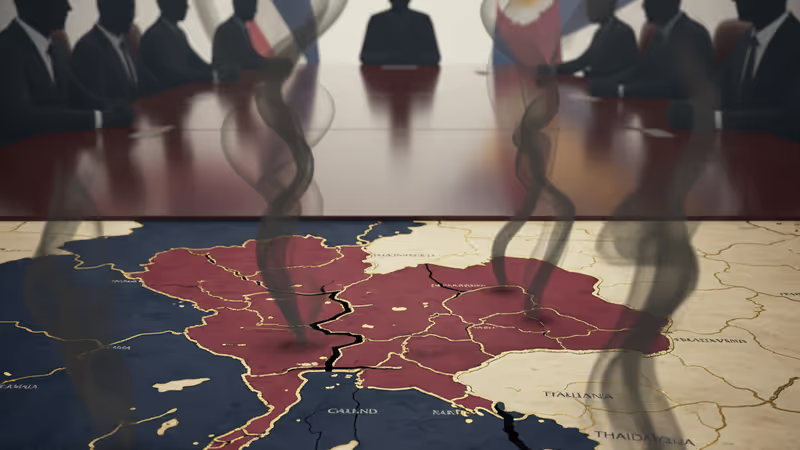
Thailand Strikes Defiant Tone as ASEAN Convenes to End Cambodia Border War
As ASEAN foreign ministers meet to mediate the deadly Thailand-Cambodia border conflict, Thailand's government remains defiant, resisting foreign pressure amid domestic political calculations.
With at least 40 dead and over 750,000 displaced in two weeks of fighting, ASEAN is making its first major diplomatic push to halt the conflict. But Thailand, citing domestic pressures, is signaling it won't be easily swayed by international calls for peace.
Thailand's government says it will not be pressured by foreign powers as the Association of Southeast Asian Nations (ASEAN) convenes a special meeting in Kuala Lumpur today to address a two-week border war with Cambodia. The meeting is the bloc's first significant attempt to end fighting that has raged along the two nations’ 817-kilometer border since December 7, killing at least 40 people and displacing more than 750,000 on both sides.
Speaking to reporters yesterday, Thai Prime Minister Anutin Charnvirakul struck a defiant tone. "Thailand no longer believes this person or that person. Thailand believes in itself, and we will act in the way we deem appropriate," he said. "We cannot allow our fellow soldiers – our people – to be bullied like this."
Ahead of the talks, Thailand laid out three preconditions for a ceasefire. According to Foreign Ministry deputy spokesperson Maratee Nalita Andamo, Cambodia must first declare the ceasefire, guarantee it is “real and continuous,” and cooperate in removing landmines from the border region.
Context: A Cycle of Accusations
Thailand accuses Cambodia of breaching a July 28 ceasefire and a peace declaration signed in Malaysia on October 26. It frames its actions—which have included artillery attacks, F-16 airstrikes, and the capture of disputed territories—as a response to Cambodian provocations. The Thai army has stated its goal is to degrade Cambodia’s military so that it “will not pose a military threat to Thailand for a long time.” A key grievance is the alleged laying of new landmines by Cambodian forces, which Thailand claims caused an eighth explosion since July just yesterday, reportedly severing a soldier's foot.
Cambodia, the militarily weaker party, has been more receptive to international mediation. In a statement yesterday, its government said it would “reaffirm its firm position of resolving differences and disputes through all peaceful means.” It denies laying new mines, attributing recent explosions to remnants from previous conflicts, and accuses Thailand of waging an aggressive war to appease domestic ultra-nationalists.
International Pressure Mounts
The ASEAN meeting follows a flurry of diplomatic activity aimed at de-escalating the crisis, with China, Malaysia, and the United States all urging a return to dialogue.
Timeline of Diplomatic Efforts
• Dec. 19: China’s special envoy for Asian affairs, Deng Xijun, met with Cambodian PM Hun Manet in Phnom Penh to urge an immediate ceasefire.
• Dec. 21: Malaysian Prime Minister Anwar Ibrahim held separate calls with both Hun Manet and Anutin to “discuss the best way forward to ease the tensions.”
• Dec. 19: U.S. Secretary of State Marco Rubio said Washington is pushing both nations to honor their October 26 commitments, stating he was “cautiously optimistic” for a return to the peace accord “by Monday or Tuesday of next week.”
PRISM Insight: Thai Domestic Politics Complicates Peace
Thailand's hardline stance appears heavily influenced by domestic politics. With a general election scheduled for February 8, Prime Minister Anutin is under pressure over his government's handling of recent floods and alleged links to online scam networks. The border conflict offers a chance to project an image of a strong, decisive leader, a narrative that plays well with powerful nationalist and royalist constituencies who favor a military solution.
As the Bangkok Post noted, “Anutin’s leadership has gained new, much-needed visibility” since the conflict began. His frequent appearances at military command centers and briefings have cultivated an image of an engaged wartime leader. While the international community may be eager for a ceasefire, Anutin may calculate that a prolonged, firm stance on the border is politically beneficial, making him less inclined to 'give in' to foreign pressure, regardless of the outcome in Kuala Lumpur.
관련 기사

J.D. 밴스 부통령이 터닝포인트 컨퍼런스에서 보수 운동의 유일한 경계선으로 '애국심'을 제시했다. 이는 운동의 포용 범위와 방향성에 대한 중대한 논쟁을 불러일으키고 있다.

스위스 법원이 시멘트 대기업 홀심을 상대로 인도네시아 주민들이 제기한 기후 소송을 심리하기로 결정했다. 스위스 역사상 첫 사례로, 기업의 기후 책임에 대한 중대한 선례가 될 전망이다.

2025년 12월 22일, 러시아 모스크바에서 파닐 사르바로프 중장이 차량 폭탄 테러로 사망했다. 러시아 수사위원회는 우크라이나의 소행 가능성을 염두에 두고 살인 사건 수사에 착수했다.

트럼프 행정부가 파격적인 '이라크 다시 위대하게' 전략을 발표했다. 사업가 출신 마크 사바야 특사를 통해 이란의 영향력을 줄이고 경제적 재건을 꾀하는 이 '거대한 도박'은 중동의 지정학적 지형을 바꿀 수 있을까?