
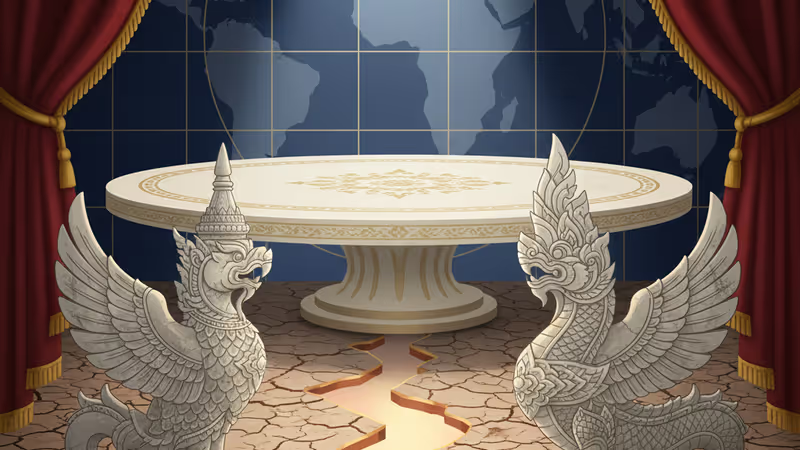
Thailand and Cambodia Agree to Ceasefire Talks, But Deep Distrust Lingers
Thailand and Cambodia have agreed to hold ceasefire talks on December 24 after an ASEAN-led meeting, following border clashes that killed over 40 people. However, deep mistrust and conflicting claims over landmines threaten the prospects for lasting peace.
Defense officials from Thailand and Cambodia have agreed to hold ceasefire talks on December 24, following an emergency meeting of Southeast Asian foreign ministers in Kuala Lumpur on Monday. The move comes after more than two weeks of border clashes that began on December 15 and have killed at least 41 soldiers and several civilians, while displacing upwards of 750,000 people. However, the ASEAN-led meeting itself stopped short of brokering an immediate end to the hostilities.
ASEAN Urges Restraint as Clashes Continue
In a chair’s statement, the ASEAN foreign ministers said they “welcomed the discussions on resumption of the ceasefire and cessation of hostilities.” While an immediate truce wasn't achieved, the statement announced that the General Border Committee (GBC), an existing bilateral mechanism, will convene on Christmas Eve “to discuss the implementation and verification of the ceasefire.” The ministers urged both Thailand and Cambodia to “exercise maximum restraint” and restore dialogue.
According to Thai Foreign Minister Maris Sangiampongsa, the GBC meeting will take place in Thailand’s Chanthaburi province, and both sides will take “as much time as needed” to reach an agreement. Singapore’s Foreign Minister Vivian Balakrishnan echoed the sentiment, stating, “As ASEAN, our collective future is brighter only if we stand united.”
Conflicting Narratives and 'Peace on Paper'
While the GBC meeting is a step forward, the chances of a breakthrough are slim. The two sides remain far apart, particularly over alleged landmine incidents. Thailand is resistant to returning to previous peace pacts, accusing Cambodia of violating them by planting new landmines that have killed and maimed its troops. In a statement, Bangkok said that “repeated breaches of the Joint Declaration – including landmine incidents... cannot be ignored.” The Thai foreign ministry concluded that it “hopes to see Cambodia’s sincerity reflected in concrete actions in pursuit of genuine and lasting peace, not merely peace on paper,” effectively placing the onus on Phnom Penh.
Cambodia has denied planting new mines, suggesting the explosions are from munitions left over from its civil war. Cambodian officials also accused Thailand of continuing attacks during the meeting, including F-16 strikes. Underscoring the skepticism, a commentary in the pro-government outlet Fresh News stated that “ASEAN’s diplomatic appeals were drowned out by the thunder of F-16 fighter jets dropping bombs on Cambodian territory.”
The agreement to hold talks is a procedural step to avoid diplomatic collapse, not a substantive breakthrough. The core issue is a complete breakdown of trust, with the landmine dispute serving as a proxy for deeper animosity. This conflict is a critical test of ASEAN's ability to manage internal crises, exposing the limits of its non-interference doctrine when member states are engaged in active hostilities.
본 콘텐츠는 AI가 원문 기사를 기반으로 요약 및 분석한 것입니다. 정확성을 위해 노력하지만 오류가 있을 수 있으며, 원문 확인을 권장합니다.
관련 기사

이스라엘의 '가자 영구 주둔' 선언부터 러시아의 우크라이나 공습까지, 전 세계적으로 강경 발언과 비타협적 태도가 확산하며 외교적 해법의 공간이 축소되고 있다.

미국 CBS 뉴스가 트럼프 행정부의 이민자 추방과 연관된 엘살바도르 교도소 고발 보도를 방영 직전 취소해 '정치적 검열' 논란에 휩싸였다. 모기업의 인수합병을 앞두고 행정부 압력에 굴복했다는 비판이 거세다.
미국 무역대표부(USTR)가 중국의 반도체 정책을 '불공정하고 차별적'이라 공식 판정하고, 18개월 후 인상되는 '0% 유예 관세' 조치를 발표했다. 이는 미중 기술 패권 경쟁의 새로운 압박 카드로 분석된다.

가자 지구 보건부, 이스라엘의 의료품 봉쇄로 보건 시스템이 전례 없는 붕괴 직전에 처했다고 경고. 수술용품, 의약품 부족으로 수천 명이 사망 위기에 놓였으며, 2만 명의 환자가 해외 치료를 기다리고 있다.