
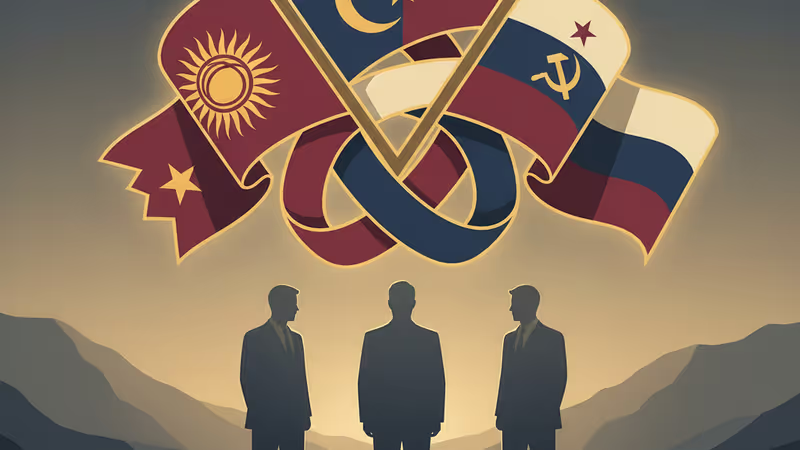
Sahel's 'Three Musketeers' Form 5,000-Strong Force, Deepening Reliance on Russia
Mali, Burkina Faso, and Niger have formed a 5,000-strong joint military force to combat armed groups. This analysis explores whether their deepening alliance with Russia can solve the region's security crisis.
Three West African nations have joined forces to create a new military battalion, but their gamble on a new security partner could make a volatile region even more dangerous. As Mali, Burkina Faso, and Niger turn their backs on the West and embrace Russia, analysts warn their military-first approach may backfire.
The Alliance of Sahel States (AES), comprised of the three military-run countries, announced the launch of the joint force on December 24 after a two-day summit in Bamako, Mali. The move comes as the nations struggle to contain escalating attacks from separatist movements and armed groups linked to al-Qaeda and ISIL (ISIS).
A New Battalion, A New Broadcast
The new joint battalion is expected to consist of an estimated 5,000 soldiers from the three countries. Its mandate will center on counterterrorism and border security. Captain Ibrahim Traore of Burkina Faso, named head of the alliance, announced that "large-scale" joint operations would begin in the coming days. In a parallel move, the leaders also launched AES Television, a joint media outlet intended to counter what they call disinformation and promote a regional narrative.
The Russian Pivot: Has It Worked?
This initiative solidifies a major geopolitical shift. In recent years, the three juntas have expelled longtime security partners France and the United States, turning instead to Russia. Around 1,000 fighters from the Kremlin-controlled Africa Corps are now operating in Mali, with smaller Russian contingents also present in Burkina Faso and Niger.
However, analysts argue that this reliance on Russian forces has failed to improve security. "Since the Russians arrived in Mali, the security situation has worsened because they don’t distinguish between fighters and civilians," said Ulf Laessing, a Sahel analyst at the Konrad-Adenauer Stiftung, according to news agencies. Rida Lyammouri, a senior fellow at the Policy Center for the New South, noted that while Russian mercenaries helped retake the city of Kidal from Tuareg rebels, they have struggled against extremist groups, which have expanded into new territories.
A Complex Web of Threats
The AES states face a multi-pronged threat. The most influential armed group is Jama’at Nusrat al-Islam wal-Muslimin (JNIM), an al-Qaeda-linked coalition formed in 2017. Another major player is the ISIL affiliate in the Greater Sahara (ISGS), which is highly active in the tri-border zone. These threats are compounded by Tuareg-led separatist movements.
The conflict has crippled the economies of these landlocked nations. JNIM has imposed blockades on key roads since September, choking supply lines. Diplomatic tensions with Western nations and the regional bloc ECOWAS have further isolated the AES states, leading to rising prices and shortages of basic goods.
본 콘텐츠는 AI가 원문 기사를 기반으로 요약 및 분석한 것입니다. 정확성을 위해 노력하지만 오류가 있을 수 있으며, 원문 확인을 권장합니다.
관련 기사
말리, 부르키나파소, 니제르 등 사헬 3국이 5천 명 규모의 연합군을 창설했다. 러시아와의 군사 협력을 강화하는 가운데, 이 조치가 역내 안보를 개선할 수 있을지 분석한다.
16일간의 치열한 국경 교전으로 최소 86명의 사망자가 발생한 가운데, 태국과 캄보디아가 휴전 재개를 위한 공식 협상을 시작했다. 국제 사회는 즉각적인 적대 행위 중단을 촉구하고 있다.

미국 케네디 센터가 '트럼프-케네디 센터'로 명칭을 변경하자, 민주당 소속 이사가 불법이라며 소송을 제기했다. 백악관과 케네디 가문의 입장이 엇갈리며 법적 공방이 시작됐다.

시리아 내무부가 수도 다마스쿠스 지역 ISIS 총책 타하 알-주비를 검거했다고 발표했다. 시리아는 미군 주도 연합군과의 공조를 주장했지만, 미 중부사령부는 확인을 거부해 그 배경에 관심이 쏠린다.
말리, 부르키나파소, 니제르 등 사헬 3국이 5천 명 규모의 연합군을 창설했다. 러시아와의 군사 협력을 강화하는 가운데, 이 조치가 역내 안보를 개선할 수 있을지 분석한다.
16일간의 치열한 국경 교전으로 최소 86명의 사망자가 발생한 가운데, 태국과 캄보디아가 휴전 재개를 위한 공식 협상을 시작했다. 국제 사회는 즉각적인 적대 행위 중단을 촉구하고 있다.
미국 케네디 센터가 '트럼프-케네디 센터'로 명칭을 변경하자, 민주당 소속 이사가 불법이라며 소송을 제기했다. 백악관과 케네디 가문의 입장이 엇갈리며 법적 공방이 시작됐다.
시리아 내무부가 수도 다마스쿠스 지역 ISIS 총책 타하 알-주비를 검거했다고 발표했다. 시리아는 미군 주도 연합군과의 공조를 주장했지만, 미 중부사령부는 확인을 거부해 그 배경에 관심이 쏠린다.