
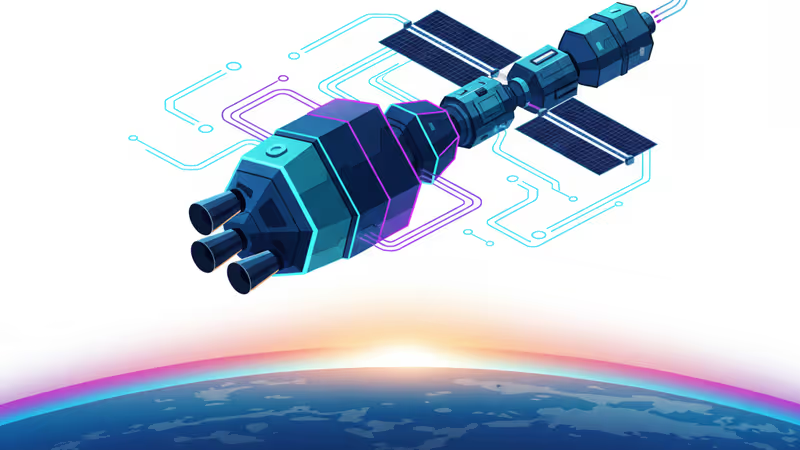
Stranded: How Boeing's Starliner Failure Left NASA Astronauts in Orbit for 9 Months
An in-depth look at the critical malfunctions on Boeing's Starliner that stranded two NASA astronauts on the ISS for nine months, forcing a rescue mission by rival SpaceX.
Two astronauts, launched aboard Boeing's much-delayed spacecraft in June 2024 for what was meant to be a week-long mission, were ultimately forced to return to Earth nine months later aboard a rival SpaceX Dragon capsule. A series of critical malfunctions on the Starliner made it too risky for the return journey, leaving the crew stranded on the International Space Station (ISS) and raising serious questions about Boeing's role in human spaceflight.
A Cascade of Failures En Route
The first crewed flight of the , carrying astronauts Butch Wilmore and Suni Williams, was a milestone over a decade in the making. But trouble began during its trip to the ISS. Engineers detected multiple, pernicious and, more alarmingly, several of the spacecraft's began to fail due to overheating.
The situation became critical as the capsule approached the station. For a short time, Starliner commander Wilmore lost the ability to control the spacecraft's movements. While engineers on the ground managed to recover most thruster functions to allow for a successful docking, the vehicle's reliability was now in serious doubt.
The Long Wait and a Rival's Rescue
After evaluating the thruster and leak issues, officials determined it was too risky to bring Wilmore and Williams home in the compromised Boeing capsule. Their planned one or two-week stay turned into a nine-month orbital marathon while the agency figured out a new ride home.
The solution came from Boeing's chief competitor. Last March, the two astronauts flew back to Earth aboard a spacecraft, a scenario that underscored the severity of the Starliner's problems. A subsequent safety advisory panel found that this uncertainty about the vehicle's health had also permeated NASA's own workforce during the crisis.
The Starliner incident is more than a technical failure; it's a critical stress test of NASA's Commercial Crew Program. It starkly contrasts Boeing's troubled development with SpaceX's operational dominance, raising serious questions about vendor reliability and the future of competition in human spaceflight.
본 콘텐츠는 AI가 원문 기사를 기반으로 요약 및 분석한 것입니다. 정확성을 위해 노력하지만 오류가 있을 수 있으며, 원문 확인을 권장합니다.
관련 기사
보잉 스타라이너의 첫 유인 비행이 심각한 결함으로 9개월간의 우주 표류로 이어졌다. NASA 우주비행사들이 스페이스X 우주선을 타고 귀환해야 했던 이유와 사건의 전말을 분석합니다.
민간 우주인 NASA 수장 임명과 '우주 우위' 행정명령의 의미를 심층 분석합니다. 우주 산업의 패러다임 변화와 지정학적 경쟁의 서막을 읽어보세요.
억만장자이자 민간 우주비행사인 재러드 아이작먼의 NASA 국장 임명. 이는 스페이스X의 승리이자, 우주 산업의 미래를 바꿀 거대한 패러다임 전환입니다.
민간 우주비행사 자레드 아이작먼의 NASA 수장 임명은 무엇을 의미할까? PRISM이 뉴 스페이스 시대의 도래와 우주 산업 지형의 격변을 심층 분석합니다.