
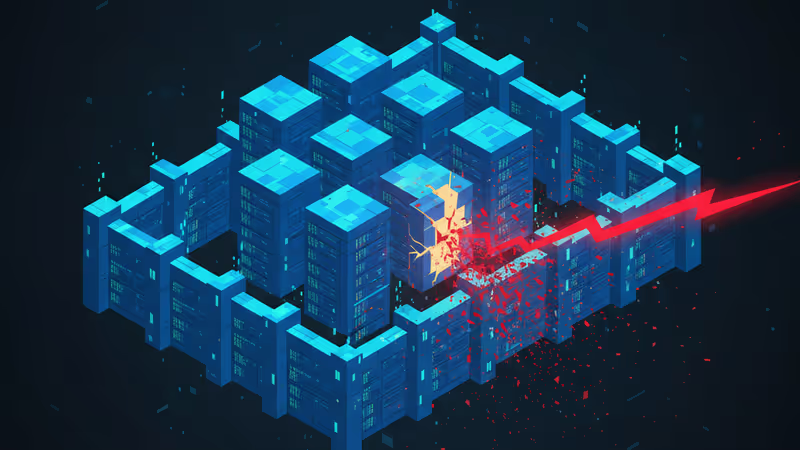
Russia's AWS Attack Signals a New Front in Cyber War: Your Own Misconfigurations
Analysis of Russia's multi-year cyberattack on AWS. The true threat isn't a flaw in the cloud, but the weaponization of customer misconfigurations.
The Lede: Why This Matters Now
A multi-year cyber campaign by Russia's elite Sandworm unit against Amazon Web Services (AWS) wasn't thwarted by some new, unbreakable Amazon shield. Instead, it thrived for years by exploiting the simplest of weaknesses: customer misconfigurations. For any leader running on the cloud, this is a blaring siren. The primary threat to your cloud infrastructure isn't a flaw in AWS, Azure, or Google Cloud; it's the operational hygiene of your own teams. This incident reframes the cyber war battleground from the cloud provider's fortress to your own digital backyard.
Why It Matters: The Shared Responsibility Model on Trial
This campaign is a brutal, real-world stress test of the cloud's foundational security principle: the Shared Responsibility Model. AWS secures the cloud; the customer secures everything *in* the cloud. Sandworm’s strategy demonstrates a profound understanding of this model, bypassing Amazon's hardened perimeter to weaponize the customer side of the equation. The second-order effects are significant:
- Critical Infrastructure is Exposed: The targeting of Western energy sectors isn't theoretical. It's a clear move by a nation-state to map, and potentially disrupt, critical infrastructure by leveraging the cloud supply chain.
- The Threat Surface is Redefined: The enemy isn't at the gate; they're looking for unlocked windows. The focus on 'low-hanging fruit' like misconfigured network edge devices means your attack surface is no longer a centralized data center but a sprawling, decentralized fleet of devices and settings managed by your teams.
- Security ROI is Flipped: For attackers, the return on investment for finding a single customer misconfiguration is now higher, and far less risky, than spending months trying to crack the cloud provider itself.
The Analysis: The Evolution of a Top-Tier Threat Actor
To understand the gravity, one must understand the attacker. Sandworm, an arm of Russia's GRU, is not a common cybercriminal. This is the group credited with the devastating NotPetya attacks and the blackouts in Ukraine. Their tactical pivot here is what's critical. Previously, a group like Sandworm might have focused on exploiting zero-day vulnerabilities in core software. Instead, they’ve shifted to a more scalable, persistent strategy: patiently scanning for and exploiting the inevitable human errors that occur in complex cloud environments.
This isn't a failure of AWS's technology. In fact, their Threat Intelligence team's ability to identify and attribute this long-term campaign is a testament to their capabilities. However, it highlights a competitive dynamic for all cloud providers. The best cloud platform isn't just the one with the most features, but the one that makes it easiest for customers not to fail. The future of cloud security competition will revolve around default-secure configurations, intuitive security dashboards, and proactive misconfiguration alerts.
PRISM Insight: The Mandate for Automated Governance
This incident is a massive validation for the entire Cloud Security Posture Management (CSPM) and Cloud-Native Application Protection Platform (CNAPP) market. The era of manual audits and periodic configuration checks is over. It’s simply not possible for human teams to keep pace with the scale of cloud deployments and the persistence of automated attackers.
Investment and enterprise adoption will accelerate in tools that provide continuous, automated monitoring of cloud configurations. Companies like Wiz, Orca Security, and Palo Alto Networks' Prisma Cloud are no longer 'nice-to-have' insurance policies; they are becoming a mandatory cost of doing business in the cloud. The key trend is shifting security left, embedding automated configuration checks directly into the development pipeline (DevSecOps) to prevent these 'low-hanging fruit' vulnerabilities from ever being deployed.
PRISM's Take: The Perimeter Has Moved Inside Your Head
The key takeaway from Amazon's disclosure is stark: the strategic high ground in cloud security has shifted. Nation-states are no longer just trying to breach the fortress; they are exploiting the operational tempo and complexity that leads to mistakes by the people inside. The new perimeter isn't a firewall; it's the discipline and tooling of your engineering and IT teams.
This is a C-suite issue, not an IT ticket. It requires a cultural commitment to security hygiene and investment in the automation platforms that can enforce it. For years, we've talked about a 'skills gap' in cybersecurity. Sandworm's campaign reveals the more dangerous threat: a 'configuration gap' that state-level adversaries are now driving a truck through.
관련 기사
AWS에 대한 러시아의 5년간 사이버 공격은 클라우드 자체보다 잘못 설정된 고객 장비를 노렸습니다. 클라우드 시대의 새로운 보안 위협과 공동 책임 모델을 분석합니다.

모두가 AI 모델 경쟁에 뛰어들 때, 아마존 AWS는 다른 길을 선택했다. 그들의 '엔터프라이즈 AI'와 '노바 포지' 전략이 시장의 판도를 어떻게 바꾸는지 심층 분석한다.
AI 경쟁에서 조용했던 아마존. AWS CEO가 밝힌 진짜 전략은 챗GPT가 아닌 '기업의 돈'을 겨냥한 인프라 전쟁입니다. PRISM이 그 숨겨진 의도를 심층 분석합니다.

AWS CEO 맷 가먼의 인터뷰를 통해 아마존이 왜 화려한 AI 경쟁 대신 '지루한' 기업 솔루션에 집중하는지, 그리고 이것이 어떻게 시장의 판도를 바꿀 수 있는지 심층 분석합니다.