
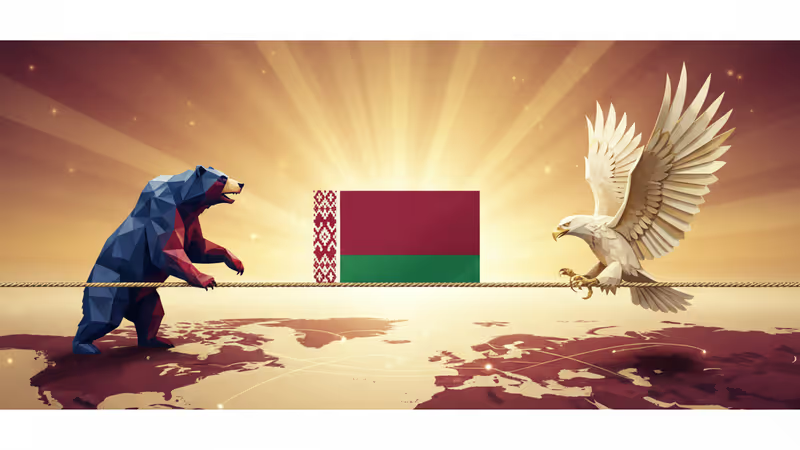
Belarus Courts U.S. in High-Stakes Pivot From Moscow
As Russia's war in Ukraine continues, its key ally Belarus is making overtures to the U.S., releasing political prisoners in exchange for potential sanctions relief. The move signals a high-stakes attempt by President Lukashenko to reduce dependence on Moscow.
With Russia still mired in its war in Ukraine, its sole European ally, Belarus, is making a calculated bid to thaw relations with the United States. In a bid to reduce his nation's heavy dependence on the Kremlin, Belarusian President Alexander Lukashenko appears to be reviving his long-standing "multi-vector" foreign policy, trading the release of political prisoners for the prospect of sanctions relief and diplomatic normalization with Washington.
Throughout 2025, Lukashenko's government has made a series of moves aimed at mending ties with the Trump administration. In early March, he publicly praised President Donald Trump, and by June, he had freed a group of political prisoners, including Siarhei Tsikhanouski, the husband of exiled opposition leader Sviatlana Tsikhanouskaya.
The diplomatic dance continued with an August phone call between Lukashenko and Trump. A month later, another group of prisoners was released. According to a report from the South China Morning Post, these actions prompted a significant response. In September, U.S. representative John Coale announced that the U.S. might soon reopen its embassy in Minsk and work to normalize economic ties, signaling a potential rollback of restrictions imposed after the controversial 2020 Belarusian presidential election.
The most substantial development came this month. Following another meeting with Lukashenko, Coale declared that the U.S. would lift sanctions on Belarusian potassium, the country's key export. In what appears to be a direct exchange, Belarusian authorities released 123 political prisoners. This group notably included Nobel Peace Prize laureate Ales Bialiatski and key opposition figure Maria Kolesnikova. This quid pro quo suggests a serious, if tentative, recalibration of Minsk's foreign policy and a clear strategic opening for Washington to weaken Moscow's influence in its own backyard.
This U.S.-Belarus rapprochement is highly conditional. Lukashenko's survival has long depended on Moscow's security and economic backing, a reality that hasn't fundamentally changed. Washington is betting it can create a lasting wedge, but any serious pressure from the Kremlin or a shift in the Ukraine war could force Minsk to snap back into Russia's orbit, making this a reversible and fragile diplomatic maneuver.
본 콘텐츠는 AI가 원문 기사를 기반으로 요약 및 분석한 것입니다. 정확성을 위해 노력하지만 오류가 있을 수 있으며, 원문 확인을 권장합니다.
관련 기사

이스라엘의 '가자 영구 주둔' 선언부터 러시아의 우크라이나 공습까지, 전 세계적으로 강경 발언과 비타협적 태도가 확산하며 외교적 해법의 공간이 축소되고 있다.
미국 CBS 뉴스가 트럼프 행정부의 이민자 추방과 연관된 엘살바도르 교도소 고발 보도를 방영 직전 취소해 '정치적 검열' 논란에 휩싸였다. 모기업의 인수합병을 앞두고 행정부 압력에 굴복했다는 비판이 거세다.
미국 무역대표부(USTR)가 중국의 반도체 정책을 '불공정하고 차별적'이라 공식 판정하고, 18개월 후 인상되는 '0% 유예 관세' 조치를 발표했다. 이는 미중 기술 패권 경쟁의 새로운 압박 카드로 분석된다.

가자 지구 보건부, 이스라엘의 의료품 봉쇄로 보건 시스템이 전례 없는 붕괴 직전에 처했다고 경고. 수술용품, 의약품 부족으로 수천 명이 사망 위기에 놓였으며, 2만 명의 환자가 해외 치료를 기다리고 있다.