

Rivian's Autonomy Pivot: Why Building a Brain is the New Automotive Endgame
Rivian is building its own self-driving tech, a high-stakes pivot against Waymo and Tesla. PRISM analyzes the strategic choice that will define the auto industry.
The Lede: A Ghost in the Machine
When a Waymo robotaxi glided past Rivian’s Palo Alto office, carrying a Goldman Sachs analyst, it wasn't just a coincidence—it was a premonition. For CEO RJ Scaringe, it was a physical manifestation of the most critical strategic decision facing every modern automaker: Do you build the soul of your vehicle, or do you buy it from someone else? Rivian’s recent declaration to develop its own autonomous driving stack is its answer. This isn't a feature update; it's a high-stakes, capital-intensive bet that redefines Rivian from an adventure EV company into a vertically integrated AI firm that happens to make trucks.
Why It Matters: The Great Bifurcation
Rivian’s decision sends a shockwave through the industry, signaling a coming split in the automotive world. The choice to develop an in-house autonomy stack—the car's 'brain'—is about more than just a self-driving feature. It's about long-term survival and profitability.
- Owning the Experience (and the Margin): Companies like Rivian and Tesla are betting that a proprietary, deeply integrated hardware and software stack will create a superior user experience that commands premium pricing and unlocks future subscription revenue. Ceding this to a third party risks becoming a low-margin hardware commodity.
- The Platform Wars: The industry is bifurcating into two camps. On one side, the 'Integrators' (Tesla, Rivian) who control their own destiny. On the other, the 'Partners' (Volvo with Waymo, Polestar with Mobileye) who leverage specialized tech firms. This creates a dynamic akin to Apple's iOS vs. Google's Android, but for the multi-trillion-dollar mobility market.
- Redefining the Supply Chain: Tech giants like Waymo (Google) and Mobileye (Intel) aren't just suppliers; they are potential usurpers of the core value proposition. Automakers who partner with them risk being relegated to 'metal benders' while the tech layer captures the data, the customer relationship, and the recurring revenue.
The Analysis: The Tesla Playbook vs. The Waymo Doctrine
The scene at Rivian’s office perfectly captures the two competing philosophies for achieving automotive autonomy.
The Waymo Doctrine, represented by the ghost in the machine outside, posits that true Level 4/5 autonomy is a general AI problem so monumentally complex and expensive that it can only be solved by a handful of dedicated, deep-pocketed tech companies. Their business model is to become the 'Intel Inside' for a generation of vehicles, licensing out their solution to automakers who can't or won't make the investment.
The Tesla Playbook, which Rivian is now overtly adopting, argues the opposite. It claims that the best autonomous system is not a generalized one, but a specialized one, deeply integrated with the vehicle's unique hardware and powered by data from a massive, homogenous fleet. This approach sees autonomy not as a bolt-on feature, but as the core operating system of the machine itself. While Tesla’s FSD has a controversial track record, its strategic value is undeniable—it underpins the company's tech-first valuation and brand identity.
Rivian is entering this race late. Tesla has a near-insurmountable lead in real-world driving data. Waymo has a decade-plus head start on geofenced Level 4 technology. Scaringe's challenge is to carve out a defensible niche, likely by focusing its autonomous capabilities on the brand's 'adventure' promise—excelling in complex off-road and recreational scenarios where generic L4 systems may falter.
PRISM Insight: Valuing the Vision
For investors, Rivian has just become a fundamentally different company to analyze. The valuation case no longer rests solely on production ramps, delivery numbers, and vehicle margins. It now includes a high-risk, high-reward call option on the success of a proprietary AI software stack.
This pivot invites volatility. The stock will now be just as sensitive to announcements about neural net architecture, data engine progress, and 'perception stack' milestones as it is to quarterly earnings. Rivian is asking the market to value it not as a car company, but as an AI company. This is the same strategic move that has allowed Tesla to command a valuation far beyond its automotive fundamentals. The risk is immense, but succeeding means capturing a vastly larger slice of the future mobility profit pool.
PRISM's Take
Rivian’s decision to build its own brain is the only logical move for a brand that wants to own the premium market in the next decade. Outsourcing the core intelligence of your product to a company like Waymo is a long-term surrender. It’s an admission that you are a hardware company in a world where value is relentlessly shifting to software and AI.
That Waymo appearing outside Scaringe's window wasn't just a funny coincidence. It was a warning shot. It symbolizes the immense, focused, and well-capitalized competition that Rivian is willingly taking on. Scaringe’s chuckle wasn't just amusement; it was the nervous acknowledgment of a leader who has just bet the entire future of his company on one of the hardest technological problems of our time. The EV wars were just the warm-up; the battle for the car's soul has just begun.
관련 기사
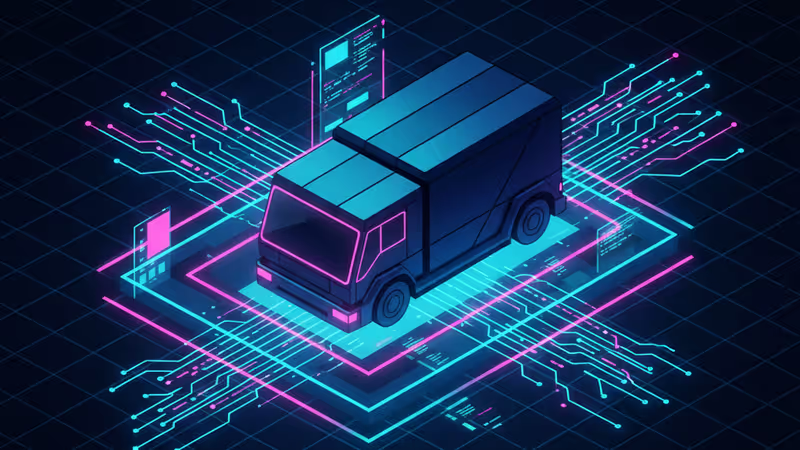
리비안이 단순 전기차 제조사를 넘어 테슬라식 소프트웨어 구독 및 기술 플랫폼 기업으로 변신을 선언했습니다. 그들의 생존 전략과 산업에 미칠 영향을 심층 분석합니다.
LG 스마트 TV에 MS 코파일럿이 강제 탑재되며 사용자 불만이 커지고 있습니다. 사용자 통제권, 기업의 AI 전략, 그리고 스마트 TV의 미래 수익 모델에 대한 심층 분석.

JAXA H3 로켓의 끈질긴 도전과 재사용 로켓 RV-X 엔진 시험 성공은 일본 우주 기술의 미래를 보여줍니다. 글로벌 우주 경쟁 속 일본의 전략과 투자 가치를 분석합니다.
2025년 식물 선물 트렌드 심층 분석. 스마트 기술과 감성 소비가 '플랜트 페어런츠' 라이프스타일을 어떻게 변화시키는지 PRISM이 제시하는 인사이트를 확인하세요.