

Trump Administration Seizes Venezuela-Linked Oil Tankers, Drawing Fire from Congress
The Trump administration's seizure of Venezuela-linked oil tankers has been criticized by Rep. Adam Smith as a 'dangerous provocation.' We analyze the context, risks, and global implications.
The Trump administration has seized several oil tankers linked to Venezuela, a move that immediately drew sharp criticism from the Democratic leader of the House Armed Services Committee. In a December 22nd interview with NPR, Rep. Adam Smith (D-Wash.) called the action a 'dangerous provocation' that risks military escalation and may violate international law.
According to initial reports, the U.S. Navy and Coast Guard intercepted three tankers in the Caribbean Sea over the weekend. The White House defended the operation as a legitimate enforcement of existing sanctions designed to cut off revenue to the government of Nicolás Maduro, which the U.S. considers illegitimate.
For years, the United States has maintained a comprehensive sanctions regime against Venezuela, targeting its state-run oil company, PDVSA, to punish the Maduro government for what Washington calls anti-democratic actions and human rights abuses. These sanctions aim to cripple the country's primary source of income: its oil exports.
This kind of unilateral military action sets an incredibly dangerous precedent. We need clarity on the legal basis for these seizures under maritime law. Instead of pursuing diplomatic solutions, the administration is raising the risk of a military conflict.
Rep. Smith's comments highlight a growing concern within Congress over the administration's assertive foreign policy. Critics argue the seizures could alienate allies, destabilize global oil prices, and fuel anti-American sentiment in Latin America. Conversely, supporters of the administration's hardline stance have praised the move as a decisive step to weaken the Maduro regime.
The seizure of these tankers is a clear signal of the Trump administration's renewed commitment to a 'maximum pressure' campaign. It's a strategic shift from purely economic sanctions to direct physical interdiction. The key question now is whether this escalation will compel a change in behavior from the Maduro regime or simply backfire, triggering a regional conflict or a spike in energy prices. This incident will serve as a crucial test case for the future of U.S. sanctions policy and freedom of navigation.
본 콘텐츠는 AI가 원문 기사를 기반으로 요약 및 분석한 것입니다. 정확성을 위해 노력하지만 오류가 있을 수 있으며, 원문 확인을 권장합니다.
관련 기사
도널드 트럼프 전 대통령의 열렬한 비판가이자 보수 논객인 조지 콘웨이가 뉴욕 하원의원직에 민주당 후보로 출마했다. 케네디 가문의 잭 슐로스버그 등과 치열한 경선을 예고하고 있다.
미국 내무부가 불특정한 '국가 안보 위협'을 이유로 해상풍력 프로젝트에 제동을 걸었다. 업계는 트럼프 행정부의 이번 조치가 재생에너지 산업을 억제하려는 의도라며 강하게 반발하고 있다.

사우디아라비아가 러시아 점령지에서 약탈된 것으로 의심되는 우크라이나산 곡물을 수입하고 있다는 의혹이 제기되었습니다. 식량 안보와 지정학적 이해관계가 얽힌 복잡한 실태를 분석합니다.
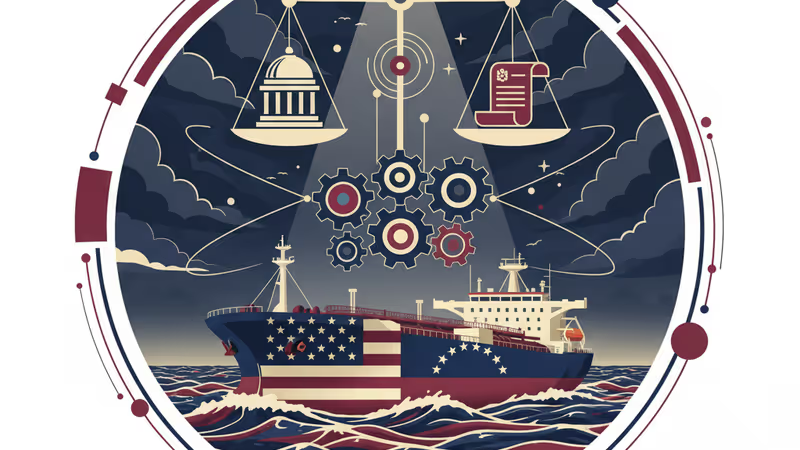
미국의 베네수엘라 유조선 나포는 합법적 제재 집행일까, 아니면 주권을 침해하는 현대판 해적 행위일까? 국제법의 회색지대에서 벌어지는 지정학적 갈등의 핵심 쟁점을 분석한다.