
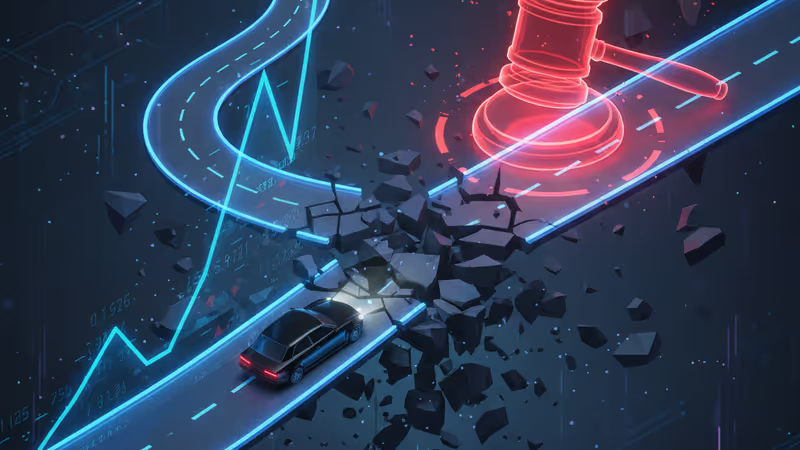
Reality Check: California's FSD Ruling Reveals the Dangerous Disconnect in Tesla's Valuation
A California judge found Tesla's 'Full Self-Driving' marketing deceptive. PRISM analyzes why this ruling is a major red flag for investors and the entire EV industry.
The Lede: A Slap on the Wrist or a Crack in the Foundation?
While Tesla's stock soared to record highs on the promise of a robotaxi future, a California judge delivered a verdict that strikes at the very heart of the company's narrative: its marketing for "Autopilot" and "Full Self-Driving" (FSD) is deceptive. The California DMV's subsequent 60-day ultimatum for Tesla to correct its claims isn't just a minor regulatory headache; it's a foundational challenge to the storytelling that has fueled Tesla's valuation and a critical red flag for investors betting on an imminent autonomous revolution.
Why It Matters: The Narrative Hits a Regulatory Wall
For years, Tesla has operated in a gray area, masterfully branding its driver-assist systems with aspirational names that suggest full autonomy. This ruling marks one of the most significant regulatory pushbacks to that strategy. The core issue isn't just about a name; it's about consumer perception and safety. While the financial penalty—a potential 30-day sales suspension in California—is manageable, the precedent is not. This decision provides a legal framework for other regulators, both in the U.S. and globally, to scrutinize and penalize similar marketing tactics. It exposes the widening chasm between Elon Musk's futuristic promises and the present-day capabilities of Tesla's technology.
The Analysis: Deconstructing the Disconnect
The Branding Paradox: When Marketing Becomes a Liability
Tesla's decision to name its Level 2 driver-assist system "Full Self-Driving" was a marketing masterstroke. It created a powerful perception of technological superiority and allowed the company to sell a high-margin software package for years based on a future promise. However, as the judge noted, this created a misleading belief for a "reasonable consumer." The recent rebranding to "Full Self-Driving (Supervised)" is a tacit admission of this very problem, but it came too late to avoid regulatory action. This ruling forces a critical question: how much of Tesla's market cap is tied to a marketing narrative that is now legally classified as deceptive? This isn't just semantics; it's a direct challenge to a core value proposition.
A Market High on Hype, A Regulator Focused on Reality
The juxtaposition of this ruling with Tesla's stock hitting a record high on the same day is the most telling detail. Wall Street is pricing Tesla based on the potential of a fully autonomous robotaxi network—a Level 5 dream. Meanwhile, California regulators are penalizing the company for misleading consumers about its current Level 2 system. This creates a dangerous disconnect. Investors are cheering for a destination Tesla hasn't reached, while regulators are putting up roadblocks based on the journey so far. This ruling serves as a grounding wire, reminding the market that the path to autonomy is paved with legal and regulatory hurdles, not just software updates.
PRISM Insight: The New Risk Factor for Investors
For tech and auto investors, this ruling introduces a significant new risk vector: narrative risk. Tesla's valuation has long been decoupled from traditional automotive metrics, buoyed instead by its identity as a revolutionary AI and robotics company. This identity is built on the FSD and robotaxi story.
- Regulatory Contagion: The primary risk is that this California ruling becomes a template. What happens if the EU, with its stricter consumer protection laws, or the NHTSA, which has multiple ongoing investigations into Autopilot, take similar action? A cascade of regulatory limitations could severely hamper Tesla's ability to market and sell its most profitable software feature globally.
- Erosion of Trust: While die-hard fans may dismiss this, a legal finding of "deceptive marketing" can erode trust with mainstream consumers who are critical for Tesla's next phase of growth. It provides ammunition for competitors who have taken a more conservative and arguably more transparent approach to branding their driver-assist technologies (e.g., Ford's BlueCruise, GM's Super Cruise).
Actionable Insight: Investors should now monitor changes in Tesla's marketing language globally as a leading indicator of regulatory pressure. Any further watering down of the "FSD" brand could signal a broader retreat, potentially impacting the perceived timeline and viability of the robotaxi network that underpins the current valuation.
PRISM's Take
The California DMV's decision is far more than a slap on the wrist. It is the first formal, legal declaration that the emperor of autonomy has, for now, no clothes. Tesla has been given 60 days to align its marketing with reality, but the company's long-term challenge is aligning its multi-trillion-dollar narrative with that same reality. For years, the market has rewarded Tesla for selling the future. Regulators are now demanding it be honest about the present. This is not the end of Tesla's autonomous ambitions, but it marks the end of the beginning, where unchecked marketing hype gives way to sober regulatory reality.
관련 기사

AI 데이터센터 수요 폭증으로 램, SSD 가격이 400%까지 치솟았습니다. PC 빌더들이 직면한 새로운 현실과 시장의 미래를 심층 분석합니다.

유튜브가 200만 구독자의 AI 가짜 예고편 채널을 폐쇄했습니다. 이는 단순한 제재를 넘어, AI 콘텐츠의 '투명성'과 '책임'을 요구하는 새로운 시대의 시작을 의미합니다.
민간 우주인 NASA 수장 임명과 '우주 우위' 행정명령의 의미를 심층 분석합니다. 우주 산업의 패러다임 변화와 지정학적 경쟁의 서막을 읽어보세요.
틱톡과 미국 정부의 빅딜이 임박했습니다. 이는 단순한 합의를 넘어 데이터 주권과 '디지털 국경'의 미래를 결정할 중대한 사건입니다.