
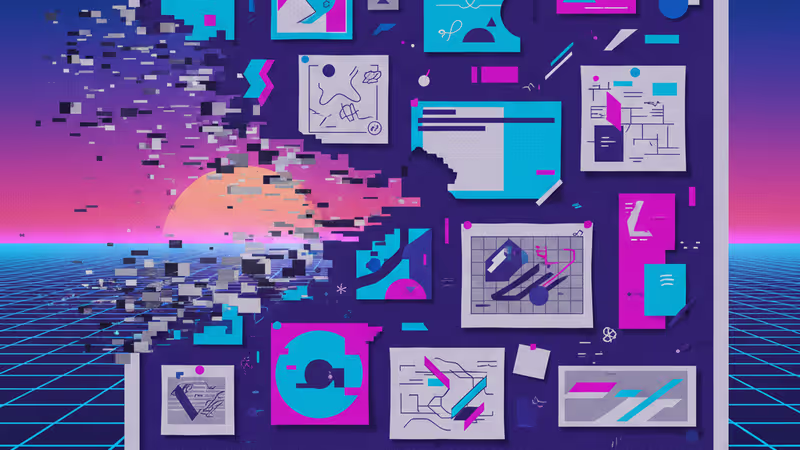
Pinterest's Authenticity Crisis: How AI 'Slop' Turned Inspiration into Enshittification
Pinterest, once a haven for creativity, is now flooded with low-quality AI-generated 'slop' and fraudulent 'ghost stores,' leading to a user experience crisis known as 'enshittification.'
Pinterest was built on human creativity. Now, users say it's being overrun by an army of AI-generated ghosts. For five years, Caitlyn Jones used the platform for recipes, but after a nonsensical AI-generated recipe for chicken led to a watery, bland dinner, she deleted the app for good. According to a WIRED report, her experience is just the tip of the iceberg of a much larger problem.
The Rise of 'Enshittification'
Author Cory Doctorow coined the term 'enshittification' to describe the decay of online platforms as they prioritize profits over user experience. Many argue that's exactly what's happening to Pinterest. In late 2022, the company began rebranding itself as an “AI-powered shopping assistant,” showering feeds with ads. When WIRED searched for “ballet pumps,” over 40 percent of the first 73 Pins shown were ads.
The problem was amplified when Pinterest launched a generative AI tool for advertisers, opening the floodgates for low-quality, mass-produced content known as 'AI slop.' Alexios Mantzarlis of Cornell Tech describes it as an “unappetizing gruel being forcefully fed to us,” noting that image-heavy platforms like Pinterest are more susceptible than video-led sites.
Ghost Stores and Uncanny Valleys
The AI slop isn't just benignly weird. Users clicking on AI-generated images are often funneled to generic blogs littered with pop-ups. Janet Katz, a user from Texas, called it the “décor equivalent of the uncanny valley” after repeatedly finding interior design images with physics-defying furniture, like coffee tables with two legs.
More troubling is the proliferation of fraudulent 'ghost stores.' WIRED investigated 25 ads on Pinterest and found many led to nearly identical fake e-commerce sites. These sites offered steep discounts, had no physical address, and featured synthetic-seeming photos of owners with generic origin stories. In response to WIRED's findings, Pinterest deactivated 15 of the sites for policy violations.
Pinterest's Response: Too Little, Too Late?
Human creators feel their authentic content is being drowned out. One jewelry maker reported her monthly page views on Pinterest plummeted to less than 5,000, while her content performs much better on Instagram and TikTok. Pinterest has introduced “Gen AI Labels” and tools for users to customize how much AI content they see.
However, critics point out these labels only appear after a user clicks on a Pin and don't apply to ads. The platform's struggles appear to be financial as well; Pinterest's shares tanked 20 percent last month after a disappointing revenue outlook, suggesting that its pivot to AI-driven commerce may be backfiring.
본 콘텐츠는 AI가 원문 기사를 기반으로 요약 및 분석한 것입니다. 정확성을 위해 노력하지만 오류가 있을 수 있으며, 원문 확인을 권장합니다.
관련 기사
BBVA가 12만 전직원에 ChatGPT를 도입합니다. 이는 단순한 기술 계약을 넘어, 'AI 네이티브 은행'의 미래를 여는 청사진이 될 수 있습니다. PRISM의 전문가 분석을 확인하세요.

2025년 TV 쇼 시장을 결산합니다. 넷플릭스와 애플TV+가 스트리밍 시장을 어떻게 지배했는지, '데어데블: 본 어게인'부터 '세브란스'까지 올해를 빛낸 최고의 작품들을 확인하세요.
2025년 최고의 재택근무 선물 가이드. 로지텍 MX 마스터 4부터 벤큐 스크린바까지, 전문가가 추천하는 생산성과 디자인을 모두 잡는 13가지 아이템을 확인하세요.
2025년 최신 모니터 구매를 위한 완벽 가이드. OLED, Mini-LED, IPS 패널 기술부터 4K 해상도, PPI, 울트라와이드 화면 비율까지 전문가처럼 선택하는 법을 알려드립니다.
BBVA가 12만 전직원에 ChatGPT를 도입합니다. 이는 단순한 기술 계약을 넘어, 'AI 네이티브 은행'의 미래를 여는 청사진이 될 수 있습니다. PRISM의 전문가 분석을 확인하세요.
2025년 TV 쇼 시장을 결산합니다. 넷플릭스와 애플TV+가 스트리밍 시장을 어떻게 지배했는지, '데어데블: 본 어게인'부터 '세브란스'까지 올해를 빛낸 최고의 작품들을 확인하세요.
2025년 최고의 재택근무 선물 가이드. 로지텍 MX 마스터 4부터 벤큐 스크린바까지, 전문가가 추천하는 생산성과 디자인을 모두 잡는 13가지 아이템을 확인하세요.
2025년 최신 모니터 구매를 위한 완벽 가이드. OLED, Mini-LED, IPS 패널 기술부터 4K 해상도, PPI, 울트라와이드 화면 비율까지 전문가처럼 선택하는 법을 알려드립니다.