
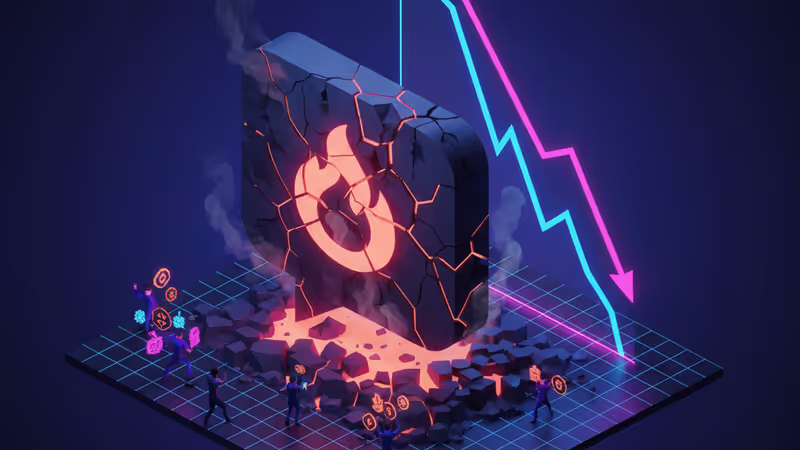
NGL's Fire Sale: The Unceremonious End of a Viral-Growth Cautionary Tale
Controversial anonymous app NGL is acquired by ad-rewards firm Mode Mobile. PRISM analyzes the endgame for unethical growth-hacking and its dire consequences.
The Lede: Why This Matters
The acquisition of anonymous messaging app NGL by ad-rewards company Mode Mobile isn't a success story; it's a quiet funeral for a specific, reckless era of consumer tech. For executives and investors, this isn't just about one app's flameout. It’s a stark signal of the new reality: the “growth-at-all-costs” playbook, built on ethically dubious tactics, now leads directly to the scrap heap of ad-tech monetization engines. This deal reveals the low-value endgame for apps that prioritize viral mechanics over user trust and safety.
Why It Matters: The Industry Impact
The NGL saga serves as a critical case study with significant second-order effects for the tech ecosystem:
- Regulatory Precedent Solidified: The FTC's intervention was not a slap on the wrist; it was a death blow. Banning NGL from serving minors—its core demographic—and levying a $5 million fine created a no-go zone for future investment or a premium acquisition. This demonstrates that regulatory risk is now a primary, and potentially fatal, business risk for consumer apps.
- The Rise of 'Attention Scavengers': Mode Mobile's business is flooding users with ads in exchange for rewards. They are not acquiring NGL for its brand or technology. They are buying a distressed asset: a list of users whose attention can be harvested and plugged into their monetization machine. This signals the emergence of a class of buyers who specialize in scavenging the remains of failed social platforms.
- Platform Power as Kingmaker (and Executioner): Snapchat’s decision to ban NGL and similar anonymous apps in 2022 was the beginning of the end. It severed NGL's primary user acquisition and engagement channel. This reinforces the absolute power of major platforms to dictate the viability of the third-party apps built upon them.
The Analysis: A Familiar Boom-and-Bust Cycle
NGL was never an anomaly; it was a repeat of a tired formula. The history of anonymous social apps—from Ask.fm to Yik Yak and Secret—is a graveyard of platforms that flared brightly on the promise of uninhibited communication before collapsing under the weight of cyberbullying and user safety scandals. NGL’s fatal error was running this playbook in an era of heightened scrutiny.
Its core growth loop was not just problematic; it was, according to the FTC, deceptive. The app used bots to send users fake anonymous messages to feign engagement. This “bait-and-switch” tactic goaded users into paying a $9.99 monthly subscription for “hints” about senders who never existed. The FTC’s revelation that NGL executives dismissed these duped users as “suckers” stripped away any remaining veneer of legitimacy.
Stripped of its ability to target teens and carrying the stench of an FTC enforcement action, NGL became commercially toxic. A strategic acquisition by a major social player was impossible. The only exit left was a fire sale to a company whose business model is predicated on high-volume user monetization, not community-building.
PRISM Insight: The New Calculus for Viral Apps
The investment thesis for consumer social has fundamentally shifted. Venture capitalists can no longer write checks based on skyrocketing user numbers alone. The new due diligence must heavily weigh the following:
- Ethical Mechanics: Is growth organic and value-driven, or is it reliant on dark patterns and deception? An app built on the latter has a built-in time bomb.
- Platform Dependency Risk: How vulnerable is the app to a policy change from Apple, Google, or a major social platform like Snap or Meta? Diversified distribution is now a critical measure of resilience.
- Regulatory Headwinds: With child safety laws like the Children's Online Privacy Protection Act (COPPA) and increasing FTC vigilance, any app targeting or attracting a youth audience must have ironclad compliance from day one.
Mode Mobile's acquisition of NGL is not a merger of equals; it's the absorption of a failed experiment. It highlights a brutal truth: user attention, when decoupled from trust, becomes a low-grade commodity to be sold to the highest-bidding ad engine.
PRISM's Take
This is the logical, undignified conclusion for a company that viewed its users as “suckers.” NGL's journey from App Store chart-topper to a mere cog in an ad-rewards machine is a potent cautionary tale. It proves that in today's tech landscape, growth achieved through deception is not an asset; it's a liability. The market has rendered its verdict: sustainable value cannot be built on a foundation of broken trust. The only exit you’ll find is through the back door, sold for parts to a company that will squeeze the last drops of value from the attention you managed to capture before your reputation caught up with you.
관련 기사
논란의 익명 앱 NGL이 광고 플랫폼에 매각되었습니다. 이는 비윤리적 성장 해킹의 종말과 '좀비 앱 경제'의 부상을 보여주는 상징적 사건입니다.
인스타카트의 AI 가격 책정 도구가 FTC 조사를 받습니다. 단순한 A/B 테스트일까, 아니면 알고리즘에 의한 가격 차별의 시작일까? AI 시대의 공정성에 대한 심층 분석.
미 FTC가 인스타카트의 AI 기반 가격 책정을 조사합니다. 단순한 기업 조사를 넘어 알고리즘 경제의 투명성과 공정성에 대한 중대한 질문을 던집니다.

우버가 구독 서비스의 기만적 관행으로 집단 소송에 직면했습니다. 이 사건이 구독 경제 전반에 미칠 영향과 소비자가 스스로를 보호할 방법을 심층 분석합니다.