
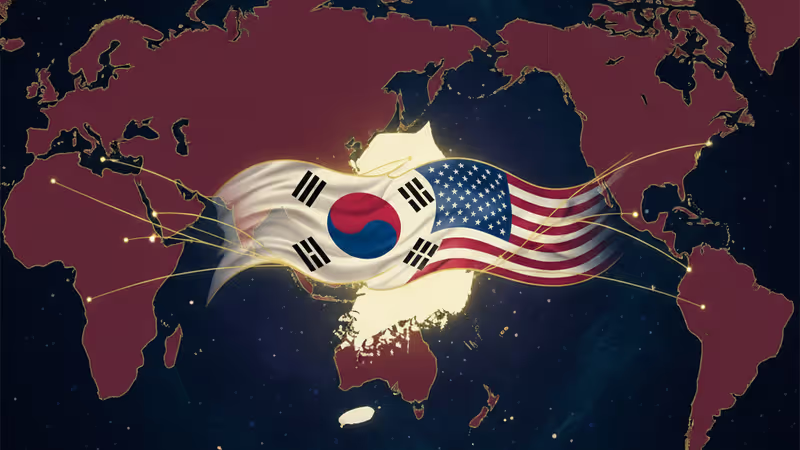
South Korea's Push for Military Autonomy Puts 70-Year U.S. Alliance at a Crossroads
As South Korea pursues greater military autonomy, including the OPCON transfer and nuclear submarines, the 70-year alliance with the U.S. is at a turning point. An analysis of the motives and future.
They're shaking hands, but the calculations under the table are complex. South Korea is accelerating its push for greater military autonomy—from seeking to retake wartime operational control (OPCON) from Washington to building its own nuclear-powered submarines. While the U.S. appears to be receptive, this shift in the decades-old alliance is being driven by a much larger geopolitical game: containing China.
Seoul's Drive for Self-Reliance
South Korean President Lee Jae Myung’s administration is aiming to retake wartime OPCON before his term ends in 2030. A transition would mean a South Korean general would lead the allies' combined forces during a conflict. In a sign of progress, Defense Minister Ahn Gyu-back and U.S. Defense Secretary Pete Hegseth agreed last month in Seoul to develop a roadmap to "expedite" the process, according to a Yonhap report.
This pursuit of autonomy extends beyond command structures. After bilateral missile guidelines were lifted in 2021, South Korea gained the ability to develop ballistic missiles with ranges greater than 800 kilometers. More recently, Seoul has been pushing to acquire nuclear-powered submarines, an effort that received backing from U.S. President Donald Trump during their summit in late October.
Washington's Strategic Calculus
The U.S. appears receptive because a stronger, more autonomous South Korea aligns with its broader strategy of countering China. Nam Chang-hee, a professor at Inha University, told Yonhap that Washington believes the benefits of bolstering its ally's capabilities to check China outweigh the risks of its increased autonomy. RAND Corp. senior defense analyst Bruce Bennett added that the U.S. government realizes that both the economic burden and control must be shared with its allies.
However, some observers argue that Trump's support is more transactional than strategic. His backing for the submarine project followed grueling trade negotiations where Seoul committed to investing US$350 billion in the U.S. The view on the ground is also more cautious. Gen. Xavier Brunson, commander of U.S. Forces Korea (USFK), has stressed that meeting the agreed-upon conditions for the OPCON transfer is more important than adhering to a specific timeline.
본 콘텐츠는 AI가 원문 기사를 기반으로 요약 및 분석한 것입니다. 정확성을 위해 노력하지만 오류가 있을 수 있으며, 원문 확인을 권장합니다.
관련 기사
한국이 전시작전통제권(OPCON) 전환과 핵잠수함 확보 등 군사적 자율성을 추구하면서 70년 된 한미동맹이 중대한 변화를 맞고 있다. 미국의 용인 배경과 동맹의 미래를 분석한다.

한국 제조업 임금이 일본보다 27.8%, 대만보다 25.9% 높은 것으로 나타났다. 생산성을 초과하는 가파른 임금 상승이 한국 산업의 글로벌 경쟁력을 위협하고 있다는 분석이다.

일본 국회에서 제기된 외국인 범죄율 1.72배 통계가 논란인 가운데, 도쿄 지방 법원 재판 참관 기록은 단순한 숫자로 설명할 수 없는 사법 시스템의 현실과 과제를 보여준다.
나이지리아 북동부 마이두구리 모스크에서 저녁 기도 중 폭발이 발생해 최소 7명이 사망했다. 2021년 이후 최대 규모의 공격으로, 보코하람 등 무장 단체 활동 재개 우려가 커지고 있다.
한국이 전시작전통제권(OPCON) 전환과 핵잠수함 확보 등 군사적 자율성을 추구하면서 70년 된 한미동맹이 중대한 변화를 맞고 있다. 미국의 용인 배경과 동맹의 미래를 분석한다.
한국 제조업 임금이 일본보다 27.8%, 대만보다 25.9% 높은 것으로 나타났다. 생산성을 초과하는 가파른 임금 상승이 한국 산업의 글로벌 경쟁력을 위협하고 있다는 분석이다.
일본 국회에서 제기된 외국인 범죄율 1.72배 통계가 논란인 가운데, 도쿄 지방 법원 재판 참관 기록은 단순한 숫자로 설명할 수 없는 사법 시스템의 현실과 과제를 보여준다.
나이지리아 북동부 마이두구리 모스크에서 저녁 기도 중 폭발이 발생해 최소 7명이 사망했다. 2021년 이후 최대 규모의 공격으로, 보코하람 등 무장 단체 활동 재개 우려가 커지고 있다.