
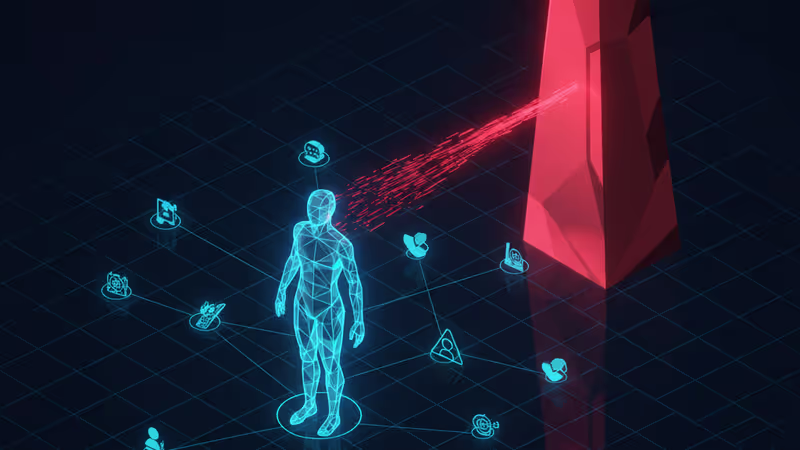
Netflix's Avatar Gambit: Why Acquiring Ready Player Me is a Deeper Play for Digital Identity
Netflix acquires Ready Player Me, signaling a strategic shift from passive streaming to building an interactive gaming ecosystem with persistent digital identity.
The Lede: Beyond the Binge
Netflix’s acquisition of avatar platform Ready Player Me isn't another minor studio pickup; it's the company’s most significant strategic pivot in gaming to date. For the C-suite, this isn't about adding a feature. It's a deliberate move to transition Netflix from a passive content library into an active, participatory ecosystem. The company is no longer content to own your watchlist; it now wants to own your digital identity within its universe. This is the foundational plumbing for a persistent, cross-platform entertainment world designed to compete directly with gaming giants like Microsoft and Sony.
Why It Matters: The Three-Dimensional Chess Move
This acquisition signals a fundamental shift with powerful second-order effects for the entire media landscape:
- The End of the Mobile-Only Experiment: The initial strategy of offering a fragmented collection of mobile games saw tepid engagement. Acquiring a sophisticated avatar platform confirms a major pivot towards a more serious, console-and-TV-centric gaming experience where persistent player identity is paramount.
- Building the Engagement Flywheel: A customizable avatar that carries your persona, achievements, and fandom across different games creates a powerful lock-in effect. It deepens user investment, transforming passive viewers into active participants and dramatically increasing the switching costs associated with unsubscribing.
- Unlocking New IP Revenue: The real prize is a new monetization channel beyond subscriptions. Imagine equipping your avatar with a 'Stranger Things' Hellfire Club t-shirt or a 'Bridgerton'-inspired outfit. This opens a direct-to-consumer digital goods market, turning Netflix's vast IP library from something you merely watch into something you can embody and express.
The Analysis: From Content King to Platform Builder
Netflix's first foray into gaming was a tactical failure. It was an add-on, not an integration. This move shows they've learned their lesson. The competitive landscape for digital attention is no longer just about streaming video; it’s a battle of ecosystems.
Consider the rivals. Microsoft has its Xbox network and integrated avatars. Epic Games turned 'Fortnite' into a social hub where your identity is defined by brand crossovers. Meta and Roblox have built entire platforms on the foundation of user avatars. Ready Player Me’s original mission was to be the “passport for the metaverse”—an open, interoperable identity layer. Netflix is now taking that ambitious vision and applying it within its own proprietary “Netflix-verse.” It’s a pragmatic, walled-garden approach to a concept that has proven too abstract for mass adoption. Netflix isn't chasing a decentralized metaverse; it's building a centralized empire of interactive content, and your avatar is your entry visa.
PRISM Insight: The Platformization of Media
This deal exemplifies a critical trend: the “platformization” of media companies. To survive and grow, streaming services must evolve beyond being simple digital libraries. They must become interactive platforms. Disney leverages its IP across theme parks, merchandise, and games. Netflix is now making its most aggressive move to build a similar, digitally-native flywheel.
For investors, this signals that Netflix is willing to deploy significant capital to build a new, potentially high-margin business unit that isn't solely dependent on subscriber growth. The $72 million in venture funding that propelled Ready Player Me, backed by heavyweights like a16z, is now being repurposed to serve Netflix's strategic goals. Expect further acquisitions in gaming infrastructure, tooling, and studios capable of building experiences that leverage this new identity layer.
PRISM's Take: A Necessary, Ambitious Bet
Acquiring Ready Player Me is Netflix’s admission that its initial gaming strategy was flawed. They are not just buying technology; they are acquiring a team and a vision centered on the future of digital identity. This is the first foundational brick in a much larger structure. The true challenge will not be technical but strategic: Can Netflix successfully weave this identity system across a diverse and growing portfolio of games? More importantly, can it convince users to invest in a “Netflix identity” when they already have deeply established personas on Xbox, PlayStation, and Steam? The goal is clear and audacious: to transform the Netflix subscription from a monthly movie ticket into an all-access pass for an interconnected world of entertainment. It’s a smart, necessary, and monumental undertaking.
관련 기사
AWS에 대한 러시아의 5년간 사이버 공격은 클라우드 자체보다 잘못 설정된 고객 장비를 노렸습니다. 클라우드 시대의 새로운 보안 위협과 공동 책임 모델을 분석합니다.
주요 4대 AI 모델에게 고전 게임 '지뢰찾기' 개발을 맡겼습니다. AI 코딩 어시스턴트의 현주소와 실제 개발 능력을 심층 분석합니다.
애플의 첫 폴더블 아이폰이 2026년 출시될 전망입니다. 하지만 역대급 공급난과 2,400달러라는 초고가 정책이 성공의 두 가지 그림자로 떠오르고 있습니다. PRISM의 심층 분석.

스트라바가 연말 결산 기능을 유료화하며 사용자 반발에 부딪혔습니다. 단순한 기능 변경을 넘어, 프리미엄 모델의 미래와 앱 경제의 패러다임 변화를 분석합니다.