
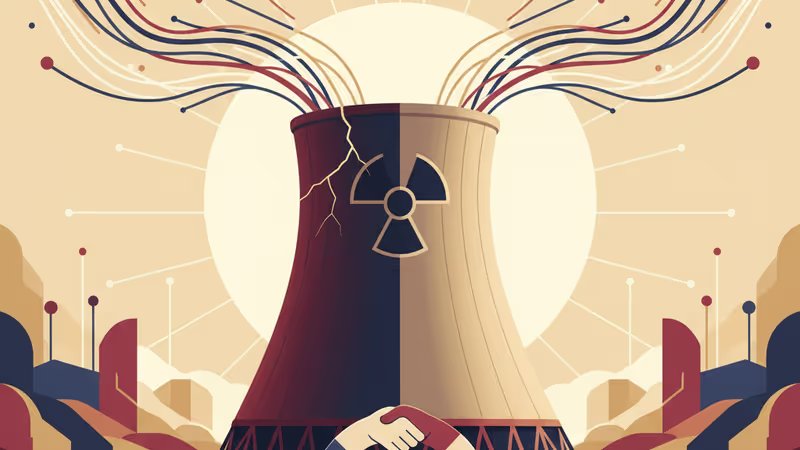
Japan Formally Approves Major Nuclear Power Expansion, Aims to Restart 17 Reactors by 2030
Japan's government has officially greenlit a new energy strategy to restart up to 17 nuclear reactors by 2030 and develop next-generation technology, marking a decisive shift away from its post-Fukushima caution amid energy security concerns.
In a major policy shift 14 years after Fukushima, Tokyo prioritizes energy security.
Japan's government has officially approved a new energy strategy that paves the way for restarting up to 17 nuclear reactors by 2030 and developing next-generation reactors. The decision, finalized in a cabinet meeting on December 22, 2025, marks a definitive pivot away from the cautious, phase-out approach adopted after the 2011 Fukushima Daiichi nuclear disaster.
The government frames the move as a necessary response to secure the nation's energy supply amid volatile global markets and to meet its 2050 carbon neutrality commitments. "This is a pivotal decision for Japan's energy security and our commitment to decarbonization," said METI Minister Ken Saito. "We will proceed with the utmost priority on safety, learning the lessons from the past."
Timeline: Japan's Post-Fukushima Nuclear Policy
- March 2011: The Great East Japan Earthquake triggers a meltdown at the Fukushima Daiichi plant, leading to a nationwide shutdown of all reactors.
- August 2015: The first reactor is restarted under new, stricter safety standards set by the Nuclear Regulation Authority (NRA).
- 2022: The government signals a major policy shift, indicating it would once again embrace nuclear as a core energy source.
- December 2025: The cabinet formally approves a long-term plan to restart up to 17 reactors and develop next-gen technology.
A Nation Still Divided
Despite the government's push, public opinion remains deeply divided. A recent poll by Kyodo News found that 58% of the public is still opposed to or wary of restarting nuclear reactors, a testament to the lasting trauma of the Fukushima catastrophe.
The decision has drawn sharp criticism from environmental groups. Greenpeace Japan called it a "dangerous step backward," urging the government to accelerate investment in renewables like offshore wind. In contrast, the business community, represented by the powerful Keidanren (Japan Business Federation), has welcomed the policy, arguing it's essential for stable electricity prices and industrial competitiveness.
"This isn't just about kilowatts; it's a strategic realignment. By securing a stable baseload power source, Japan is fortifying its industrial backbone—from semiconductors to EVs—and seeking greater strategic autonomy in an increasingly unpredictable world."
Officials stress that all restarts are contingent upon passing the independent and rigorous safety reviews of the Nuclear Regulation Authority (NRA). However, with significant hurdles remaining, including securing local consent and addressing the perennial issue of spent nuclear fuel, the path to a nuclear renaissance in Japan is far from guaranteed.
관련 기사

미 법무부가 제프리 엡스타인 관련 문서 공개 속도에 대해 공식 해명했습니다. 법무부는 피해자 신원 보호를 위한 법률팀의 검토가 진행 중이며, 이것이 최우선 과제라고 강조했습니다.

한국 정부가 HD현대중공업, 삼성중공업 등과 손잡고 LNG 운반선 핵심 기술인 화물창 국산화에 나선다. 매년 수조 원에 달하는 해외 기술료 의존도를 낮추고 기술 주권을 확보하기 위한 전략이다.

중국과 한국이 9년 만에 중단됐던 자유무역협정(FTA) 2단계 협상을 재개합니다. 제조업을 넘어 서비스 분야로 경제 협력을 확대하려는 이번 움직임의 배경과 지정학적 함의를 분석합니다.

아세안 외교장관들이 2주째 이어진 태국-캄보디아 국경 분쟁을 중재하기 위해 쿠알라룸푸르에서 긴급 회의를 열었다. 수십 명의 사망자를 낸 이번 충돌은 아세안의 단합을 시험하고 있다.