
Anarchy in Dhaka: Assassination Unleashes Mob Violence as Bangladesh's Government Stands By
Following the assassination of politician Sharif Osman Hadi, Bangladesh's capital, Dhaka, has descended into violence. The interim government's failure to stop attacks on media outlets raises questions of complicity and state failure.
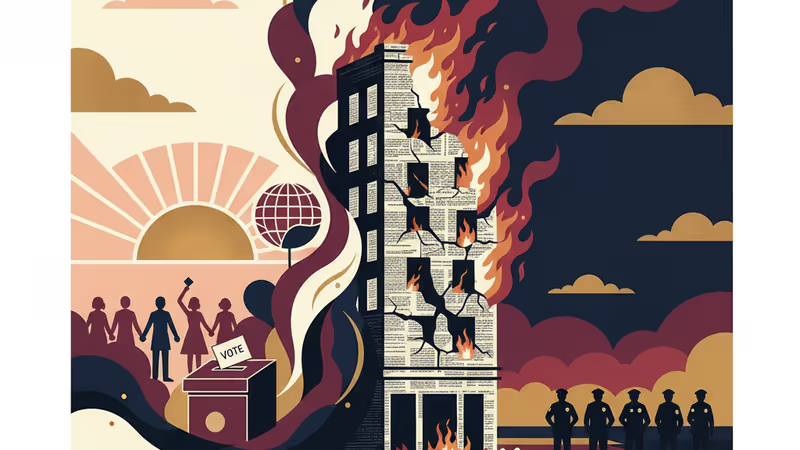
The assassination of a rising political figure, Sharif Osman Hadi, has plunged Bangladesh's capital into chaos. But the riots that erupted following his death on December 18 weren't the most alarming part. As organized mobs burned down media offices with journalists trapped inside, the interim government led by Dr. Muhammad Yunus and its security forces conspicuously failed to act, revealing a profound crisis of state responsibility and pushing the nation towards anarchy.
A Predictable Inferno, An Inactive State
The violence was neither spontaneous nor sudden. According to observers, it was the expected culmination of months of rising tension. Right-wing groups, including Chhatra Shibir—the student wing of Bangladesh's largest Islamist party, Jamaat-e-Islami (BJI)—had openly called for the shutdown of the targeted newspapers. Their plans to attack were reportedly an "open secret," yet the government took no preventative measures.
Even after attackers set the Prothom Alo building ablaze, they were allowed to march unimpeded to the Daily Star office. Journalists were forced to shelter on the roof for hours as the mob below blocked the army, police, and fire services from entering. Security forces, eyewitnesses said, appeared to be mere spectators.
Selective Inaction and Political Calculation
Critics argue the interim government's inaction isn't a sign of incapacity, but a conscious political choice. The Yunus administration has demonstrated it can act decisively when it wants to, particularly against its critics. Respected journalist Anis Alamgir was recently arrested under anti-terrorism laws for criticizing the government. Meanwhile, leftist protestors and teachers pressing for legitimate demands have been brutally dispersed by police.
This stark contrast—swift action against dissidents versus passivity towards violent mobs—leads to an unsettling conclusion: the interim government appears to have deliberately chosen not to intervene. This absence of punishment has normalized violence and sent a clear message: the state will not protect media and cultural institutions from its political allies. If crimes go unpunished, violence becomes the norm.
The crisis in Bangladesh transcends a simple breakdown of law and order; it's spiraling into a crisis of state legitimacy. Allowing such violence to go unchecked may offer short-term political advantages for certain factions, but it guarantees the long-term erosion of the rule of law and public trust. This instability has a direct effect on regional security in South Asia. A state that watches a media building burn with journalists inside loses the moral authority to govern.
Questions also swirl around Hadi's assassination itself. The killers, who struck in broad daylight, remain at large. Allegations have surfaced that the assassins escaped to India, but the government has reportedly not issued a request for cooperation or even alerted its border guards. This lack of interest suggests the government may not want the assassins found. Hadi's death and the ensuing violence stand as a damning indictment of the Bangladeshi state's failure.
본 콘텐츠는 AI가 원문 기사를 기반으로 요약 및 분석한 것입니다. 정확성을 위해 노력하지만 오류가 있을 수 있으며, 원문 확인을 권장합니다.
관련 기사

미국의 대표적 보수 싱크탱크 헤리티지 재단에서 12명 이상의 직원이 집단 이탈했다. 이는 극우 인플루언서 문제를 둘러싼 내부 갈등이 격화되며 미국 보수 운동의 심각한 분열상을 드러내고 있다.
더불어민주당이 입장을 선회하며 통일교 특검 도입에 전격 합의했다. 높은 국민 여론과 기존 수사의 한계가 배경으로 작용한 가운데, 여야 모두가 연루된 의혹의 진실 규명을 위한 '특검 정국'이 본격화된다.

가자지구의 가장 오래된 유산인 대 오마리 모스크가 분쟁으로 파괴되었습니다. 2,000년 역사를 지닌 이 문화유산의 파괴가 갖는 의미와 분쟁 지역에서의 문화적 파괴의 심각성을 분석합니다.

2025년 미국 의회가 입법 성과 부재와 의원들의 연쇄 이탈로 위기를 맞고 있다. 전직 의원들은 현재 상황을 '혼수상태'로 진단하며 수년간 누적된 구조적 문제라고 경고했다.