
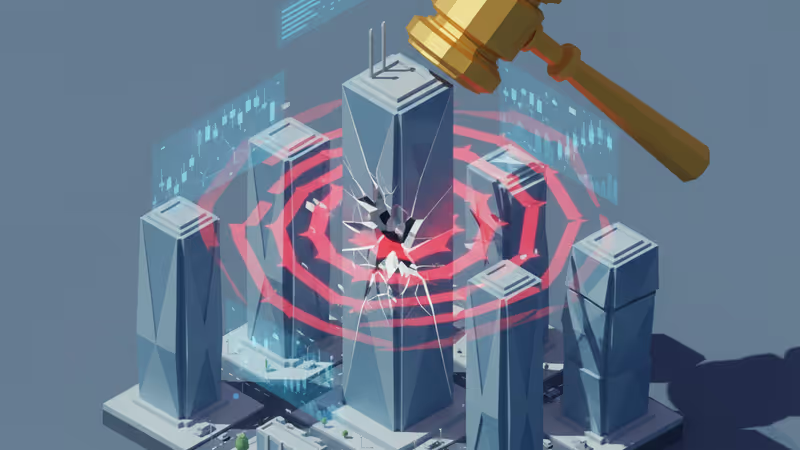
FTX's Final Judgment: Why the SEC's Executive Bans Are a Warning Shot for All of Crypto
The SEC has banned Caroline Ellison and other FTX execs from corporate roles. PRISM analyzes why this is more than a penalty—it's a new era of liability.
The FTX Cleanup Crew: SEC's Final Move Signals a New Era of Liability
The Lede: Why This Matters to You
The final legal chapter for Sam Bankman-Fried's inner circle has closed, not with a blockbuster fine, but with a far more significant penalty: professional exile. The U.S. Securities and Exchange Commission's (SEC) settlement, which bars Caroline Ellison, Gary Wang, and Nishad Singh from corporate leadership roles for up to a decade, sends a chilling message to the entire tech and crypto C-suite. The key takeaway for any executive is this: cooperating with prosecutors in a criminal case will not shield you from career-ending civil consequences. The era of consequence-free enabling is over.
Why It Matters: Beyond the Headlines
This isn't just a procedural mop-up of the FTX scandal; it's the establishment of a powerful new precedent. By imposing lengthy officer-and-director bans, the SEC is targeting the professional class that builds and operates financial technology. The focus has shifted from just the fraudulent mastermind to the ecosystem of enablers who made the fraud possible. This has several second-order effects:
- Raises Personal Stakes: For every engineer writing code for a trading platform or executive managing operations, the personal risk calculus has fundamentally changed. The defense that one was “just following orders” or “building the tool” has been permanently weakened.
- Imports Wall Street Rules: These bans are a standard tool used to punish executives after major traditional finance scandals. By applying them so forcefully here, the SEC is signaling its intent to hold crypto to the same standards of governance and accountability as Wall Street.
- Forces a 'Flight to Quality' in Talent: Top-tier tech and finance professionals will now be far more selective, conducting deeper due diligence on a company's governance and compliance culture before joining. This could starve poorly-governed projects of the talent they need to scale.
The Analysis: A Necessary Purge
The FTX collapse was not just a failure of one man; it was a systemic failure of governance enabled by his key lieutenants. The SEC complaint explicitly notes that Wang and Singh created the software that allowed customer funds to be siphoned to Alameda, with Ellison’s knowledge. These settlements directly address that “banality of evil” within the organization—the technical and operational complicity required for the fraud to function at scale.
While a ten-year ban for Ellison might seem light compared to the billions lost, its real power lies in its breadth. This isn't just a ban from crypto companies; it's a ban from serving as an officer or director of any public company. It effectively exiles them from the legitimate, regulated financial world. However, a critical question remains: how effective is such a ban in the decentralized, often anonymous world of DeFi? While it bars them from leading a future Coinbase, it does little to prevent them from contributing code or advising a new decentralized protocol—a regulatory gray zone that remains a significant long-term risk.
PRISM Insight: The New Due Diligence
For investors, this marks a pivotal shift in risk assessment. The mantra of “don't trust, verify” now extends beyond smart contract audits to the very people building the systems. Investment due diligence in the post-FTX era must now include a rigorous examination of a project's core development and executive team.
The key investment implication is that governance risk has overtaken technological risk as the primary threat in the digital asset space. A brilliant protocol built by a team with a cavalier attitude toward compliance and ethics is now demonstrably a catastrophic liability. The phrase “code is law” is dead; the new reality is “the coder is liable.” Investors must demand radical transparency not just in reserves, but in the internal controls and ethical guardrails governing development teams.
PRISM's Take: The Scar Tissue of Maturity
This settlement is not about retribution; it's about establishing a new baseline of professional liability for the digital economy. The SEC is drawing a hard line, making it unequivocally clear that the Silicon Valley ethos of “move fast and break things” is unacceptable when the “things” being broken are customer trust and regulated financial markets. While these bans won't recover a single dollar for FTX's victims, they create essential scar tissue for the industry. This is a painful but necessary step in crypto's forced evolution from a speculative wild west into a mature, accountable asset class. The message is simple: if you want to build the future of finance, you will be held to its highest standards.
관련 기사
FTX 핵심 공모자들의 SEC 합의는 단순한 법적 처벌을 넘어섭니다. PRISM이 이 사건이 암호화폐 규제, 투명성, 그리고 미래 시장에 미치는 심층적 영향을 분석합니다.

FTX 붕괴 주역 엘리슨, 왕, 싱에 대한 SEC 최종 판결 분석. 이 사건이 암호화폐 규제의 미래와 시장에 미치는 심층적 의미를 파헤칩니다.
VC 투자 없이 월 거래량 3000억 달러를 달성한 하이퍼리퀴드. FTX 붕괴 이후 DeFi의 미래를 제시하는 이 조용한 거인의 성공 비결을 심층 분석합니다.
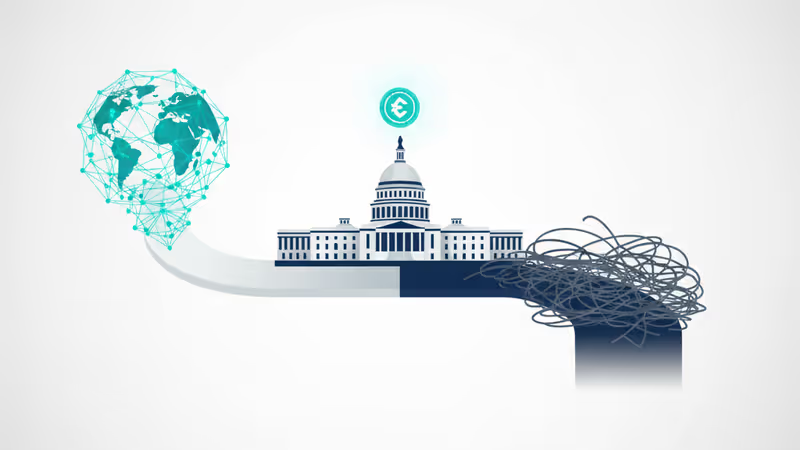
미국 암호화폐 법안이 교착 상태에 빠지면서 글로벌 시장에서의 리더십이 위협받고 있습니다. 규제의 불확실성이 가져올 기회와 위기를 심층 분석합니다.