
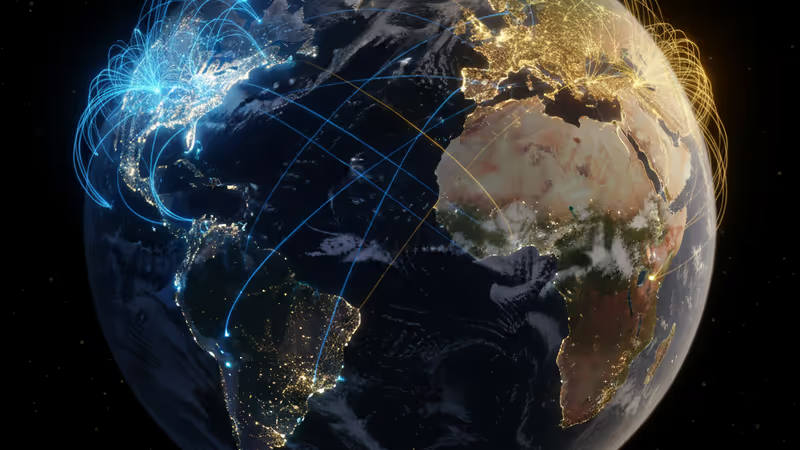
Beyond the Dollar: Why Energy and Water Are the New Currencies of Power
As the US dollar's dominance wanes and the world splits into US- and China-led blocs, a new analysis suggests that energy and water resources, crucial for the AI economy, will become the new arbiters of global power.
As 2025 draws to a close, the era of the a_US dollar's unchallenged global dominance is visibly fading. According to a recent analysis in the South China Morning Post, the 21st century's macroeconomic landscape won't be defined by a single currency, but by access to energy and water. In an economy increasingly driven by artificial intelligence, these resources are becoming the ultimate arbiters of national power.
From Globalization to Geopolitical Blocs
The logic behind this shift is rooted in the world's reorganization into two competing spheres of influence. A recent International Monetary Fund study, “Playing with Blocs: Quantifying Decoupling,” suggests global trade is fracturing around two centers of gravity: the a_United States and a_China. This trend indicates that the global economy isn't returning to the open globalization of the past, but is instead hardening into self-sufficient macro-regions.
This aligns perfectly with the latest a_US national security strategy, which emphasizes building a resilient, a_US-led bloc while implicitly ceding greater influence in Asia to a_China. As the dollar is increasingly bypassed in international settlements, the critical question becomes: what financial instrument or resource will prove most effective in this new world?
The Energy Imperative of the AI Economy
The analysis argues that energy is the most natural answer. A high-tech economy based on knowledge and information simply can't function without access to affordable resources. AI development, in particular, is incredibly energy-intensive, requiring vast amounts of electricity to train models and run data centers, plus significant water resources for cooling.
Only a handful of countries possess both a strong resource base and a long-term commitment to science and education. a_China stands out, having developed its own large language models while accelerating AI deployment, closing the gap with the a_US. Other nations, like a_Russia, have also recognized this trend and are positioning themselves accordingly.
The global AI race is fundamentally a race to build and power data centers. These facilities are the new factories of the 21st century, but their voracious appetite for electricity and water creates a critical bottleneck. Nations that can secure cheap, stable energy and water resources will gain a decisive, long-term strategic advantage over those focused solely on technology.
본 콘텐츠는 AI가 원문 기사를 기반으로 요약 및 분석한 것입니다. 정확성을 위해 노력하지만 오류가 있을 수 있으며, 원문 확인을 권장합니다.
관련 기사
21세기 글로벌 경제는 미국 달러 중심에서 벗어나고 있다. AI 기술 경쟁이 심화되면서, 이를 뒷받침하는 에너지와 수자원이 새로운 패권의 핵심 변수로 부상하고 있다. 중국과 러시아의 움직임을 중심으로 미래 자원 안보의 중요성을 분석한다.

전라남도 나주 오리농장에서 고병원성 조류인플루엔자(AI)가 발생, 올겨울 16번째 확진 사례로 기록됐다. 방역 당국은 긴급 방역과 함께 지역 내 200여 농가에 대한 전수조사에 착수했다.
미국, 중국, 유럽의 AI가 서로 다른 이념을 반영합니다. GPT, 딥시크, 미스트랄의 숨겨진 정치적 편향과 이것이 글로벌 질서에 미칠 영향을 분석합니다.
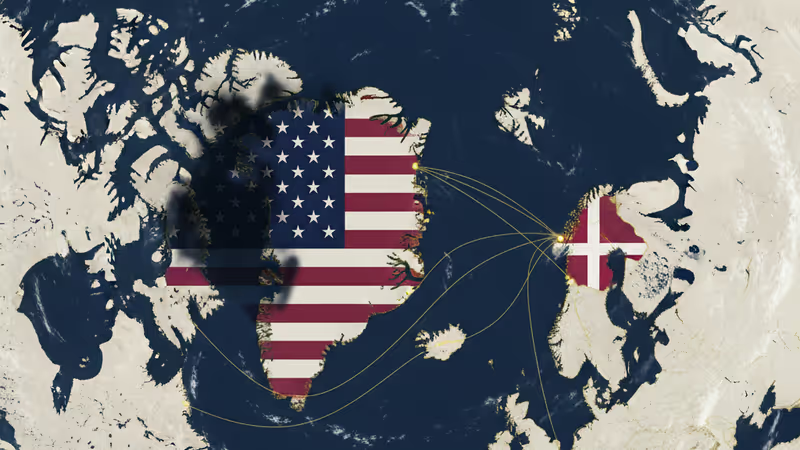
도널드 트럼프 미국 대통령이 그린란드를 '미국의 일부'로 만들겠다며 특사를 임명해 덴마크, 그린란드, EU의 강력한 반발을 사고 있다. 트럼프는 국가안보를 명분으로 내세웠다.