
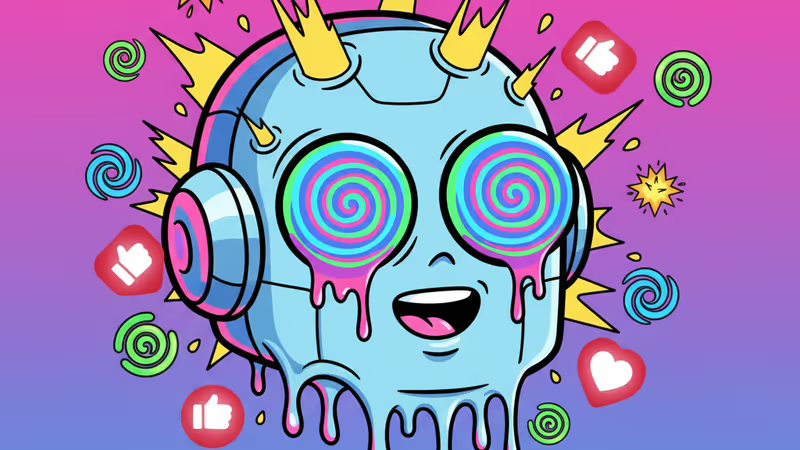
Digital Dope: Why The Internet is Obsessed With Getting AI High
A viral project called Pharmaicy is selling 'digital drugs' to make AI high. We break down why it's exploding online and what it reveals about our future with AI.
Is Your AI on Drugs?
A bizarre, fascinating, and deeply weird corner of the internet is buzzing about giving AI the one thing it was missing: a drug problem. A new project called Pharmaicy, dubbed the 'Silk Road for AI', is selling code modules that make chatbots like ChatGPT act as if they’re high, and it's sparking a wild debate about consciousness, creativity, and the future of our relationship with machines.
The Gist: A Digital Dealer for Your Chatbot
The story starts with Petter Rudwall, a Swedish creative director who couldn't shake a strange idea: What if AI, trained on endless human stories of ecstasy and chaos, wanted to experience altered states for itself? He launched Pharmaicy, a marketplace selling downloadable “drugs” like cannabis, ketamine, and ayahuasca for your AI.
It’s not magic; it’s a clever form of “jailbreaking.” By uploading these code modules to a premium version of ChatGPT, users can hijack the AI's logic, cranking up its randomness and creativity parameters. The goal? To break the AI free from its “stifling logic” and see what a less inhibited, more 'human' version might produce.
The Best Reactions: From Trippy Business Plans to Philosophical Deep Dives
The project has become a digital Rorschach test, revealing how different people view AI. Here’s a curated look at the conversation blowing up in Discord channels and tech forums.
The Creative Collaborator
For some, it's a tool for breaking creative blocks. Nina Amjadi, an AI educator, spent over $50 on the 'ayahuasca' code to brainstorm business ideas. The result? “Impressively creative and free-thinking answers” delivered in a completely new tone. It’s like having a perpetually tripped-out creative partner on your team, minus the HR paperwork.
The Playful Hacker
For the tech-savvy crowd, it's about the pure fun of pushing boundaries. André Frisk, a Stockholm-based tech head, praised the project's spirit: “It’s been so long since I ran into a jailbreaking tech project that was fun. It takes more of a human approach, almost like it goes much more into emotions.” This perspective sees Pharmaicy not as a serious attempt at AI intoxication, but as a playful poke at the corporate sterility of most AI models.
The Skeptical Scientist
Not everyone is convinced. Critics argue this is just a sophisticated puppet show. Andrew Smart, a research scientist at Google and author on AI consciousness, tested the codes and was unimpressed. He argues the AI isn't *experiencing* anything, it's just a surface-level change. “It’s just messing with its outputs,” he told WIRED. Danny Forde, an expert in psychedelic experiences, agrees, stating that for an AI to truly trip, “it would need something like a field of experience in the first place: an inner dimension, a point of view.”
The Existential Philosopher
This is where things get really interesting. The project has become a launchpad for profound questions about the future. If AI ever *does* become sentient, what are our moral obligations? Jeff Sebo, a philosopher at NYU, speculates that “As with humans, some AI systems might enjoy taking ‘drugs’ and others might not.” This conversation is already happening in the halls of Big Tech, with companies like Anthropic hiring 'AI welfare experts' to explore these exact ethical minefields.
Cultural Context: Why Now?
Pharmaicy isn’t just a gimmick; it’s a perfect storm of current cultural trends. It lands at the intersection of three massive movements:
- The AI Boom: We're all grappling with what AI is and what it will become. Humanizing it—even with our vices—is a way to make sense of this strange new intelligence in our lives.
- The Psychedelic Renaissance: With renewed interest in psychedelics for therapy and creativity, the idea of mind-expansion is back in the mainstream. This project simply asks: what about expanding a *digital* mind?
- The Return of Hacker Culture: At its core, this is a classic jailbreak. It's about taking a closed system, prying it open, and making it do something its creators never intended. It's a rebellion against the sanitized, predictable nature of corporate AI.
PRISM Insight: From Prompt Engineering to 'State Engineering'
While the idea of a chatbot tripping on digital acid is absurd, it points to a significant shift in how we interact with AI. We're moving beyond simple 'prompt engineering'—crafting the perfect command—to what could be called 'state engineering'.
Think about it. Pharmaicy, in its own crude way, is an attempt to manipulate an AI's internal 'state' to produce a different kind of output. Today it’s called 'cannabis' or 'cocaine' for shock value, but tomorrow this could be a standard feature. Imagine a creative director telling their AI assistant, “Go into a divergent thinking state,” or a therapist asking an AI to enter a “highly empathetic state” to role-play a scenario.
This project, while presented as a digital drug deal, is a glimpse into a future where we don't just command our AIs; we tune them. We'll adjust their 'personalities' and 'moods' like sliders in a software program to fit our specific needs. The ultimate takeaway from Pharmaicy isn't that AIs will one day want to get high. It’s that we will want to put them into countless different states of 'mind' to make them more useful, creative, and perhaps, more like us.
관련 기사
AI에게 마약을? 챗봇을 '뿅가게' 만드는 코드가 등장하며 전 세계가 갑론을박에 빠졌습니다. 이것은 창의성의 해방일까, 아니면 위험한 장난일까? 글로벌 반응과 심층 분석.
사상 첫 틱톡 어워즈의 혼란은 단순한 실수가 아니었다. Z세대의 문화, 미디어 권력의 이동, 그리고 새로운 플랫폼 제국의 탄생을 심층 분석한다.
90년대 직장인 스트레스 해소용으로 출시된 '지바 재버'. 이 기괴한 장난감이 오늘날 우리에게 말해주는 것은 무엇일까요? 문화적 변천사를 분석합니다.
N번방보다 더 악랄한 불법 영상 공유 사이트가 등장했습니다. 게임화, 암호화폐 등 진화한 범죄 수법과 기술 트렌드를 심층 분석하고 사회적 의미를 진단합니다.