
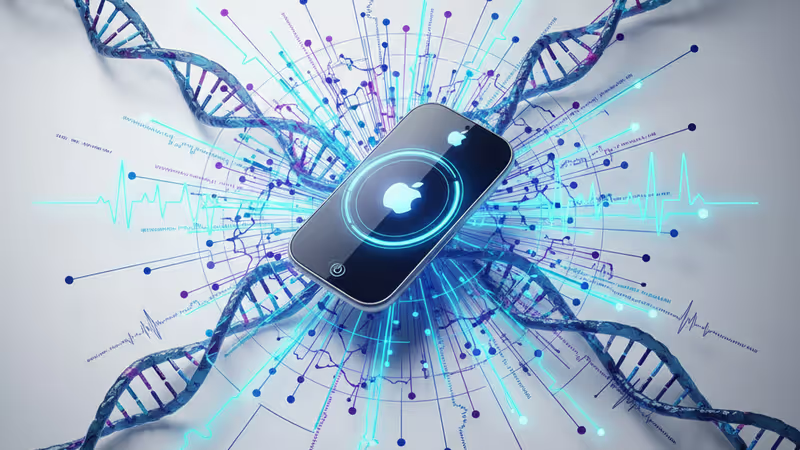
In 2026, AI Will Predict When You'll Get Sick: The Dawn of Precision Medical Forecasting
In 2026, the convergence of AI and aging science will enable 'precision medical forecasting' to predict the onset of major diseases like cancer and Alzheimer's. Discover how your health data could prevent illness.
What if an AI could forecast your risk of cancer or Alzheimer's decades in advance—and even pinpoint when it might begin? According to WIRED's annual trends briefing, 2026 is set to be the year we see the beginning of "precision medical forecasting." Just as large language models have transformed weather forecasting, they're now poised to predict an individual's future health.
How AI Moves Beyond Weather to Forecast Disease
Major age-related diseases like cancer, cardiovascular disease, and neurodegenerative conditions share a common trait: a long incubation period, often two decades or more, before symptoms appear. They also share biological roots in 'immunosenescence' (an aging, less effective immune system) and 'inflammaging' (the resulting chronic, low-grade inflammation).
Advances in the science of aging now allow us to track these processes using body-wide and organ-specific 'clocks' and protein biomarkers. When combined with new AI algorithms, the system becomes incredibly powerful. AI can interpret medical images like retinal scans to spot things human experts can't, accurately predicting disease risk years before it manifests.
The Data Behind Your Personal Health Roadmap
Precision medical forecasting integrates an unprecedented depth of personal data: electronic medical records, genetic results, wearable sensor data, and even environmental information. This goes far beyond a 'polygenic risk score,' which simply identifies a predisposition to a disease. The crucial difference is the addition of the temporal arc—the 'when' factor.
When all this data is analyzed by large reasoning models, it can pinpoint a person's specific vulnerabilities. This enables the creation of an individualized, aggressive preventive program, shifting medicine from a reactive to a proactive model.
From Prediction to Proactive Prevention
Armed with knowledge of their specific risks, individuals are far more likely to adopt lifestyle changes like an anti-inflammatory diet, regular exercise, and better sleep. This can be supplemented by medications designed to bolster the immune system and reduce inflammation. GLP-1 medicines are already emerging as a front-runner, with many more reported to be in the pipeline.
This potential must be validated through clinical trials. For instance, a person with a high risk of Alzheimer's, identified by a blood test like p-tau217, could show a measurable reduction in that biomarker after implementing lifestyle changes. This new frontier in medicine, a convergence of AI and aging science, represents an unparalleled opportunity to prevent major diseases before they start.
본 콘텐츠는 AI가 원문 기사를 기반으로 요약 및 분석한 것입니다. 정확성을 위해 노력하지만 오류가 있을 수 있으며, 원문 확인을 권장합니다.
관련 기사
출시 5주년을 맞은 구글 딥마인드의 알파폴드가 이제 단백질 구조 예측을 넘어 'AI 공동 과학자'로 진화하고 있다. 제미나이 2.0 기반 AI가 가설을 생성하며 인간 세포 시뮬레이션에 도전한다.

알파벳의 자회사 웨이모가 샌프란시스코 정전 사태로 자율주행 차량이 마비된 후 긴급 소프트웨어 업데이트를 발표했다. 이번 사태의 의미와 자율주행 기술의 과제를 분석한다.
2026년, AI와 노화 과학의 결합으로 암, 심장병 등 주요 질환의 발병 시기까지 예측하는 '정밀 의료 예측' 시대가 열린다. 개인의 건강 데이터를 분석해 질병을 미리 막는 방법을 알아본다.

테라노스 폭로 작가 존 캐리루가 오픈AI, 구글 등 6개 AI 기업을 상대로 새로운 저작권 소송을 주도한다. 기존 15억 달러 합의에 대한 불만으로, AI의 데이터 수집 관행에 대한 근본적인 도전이 시작됐다.
출시 5주년을 맞은 구글 딥마인드의 알파폴드가 이제 단백질 구조 예측을 넘어 'AI 공동 과학자'로 진화하고 있다. 제미나이 2.0 기반 AI가 가설을 생성하며 인간 세포 시뮬레이션에 도전한다.
알파벳의 자회사 웨이모가 샌프란시스코 정전 사태로 자율주행 차량이 마비된 후 긴급 소프트웨어 업데이트를 발표했다. 이번 사태의 의미와 자율주행 기술의 과제를 분석한다.
2026년, AI와 노화 과학의 결합으로 암, 심장병 등 주요 질환의 발병 시기까지 예측하는 '정밀 의료 예측' 시대가 열린다. 개인의 건강 데이터를 분석해 질병을 미리 막는 방법을 알아본다.
테라노스 폭로 작가 존 캐리루가 오픈AI, 구글 등 6개 AI 기업을 상대로 새로운 저작권 소송을 주도한다. 기존 15억 달러 합의에 대한 불만으로, AI의 데이터 수집 관행에 대한 근본적인 도전이 시작됐다.