

China Dumps US Debt to 17-Year Low: The Great Financial Unwinding Has Begun
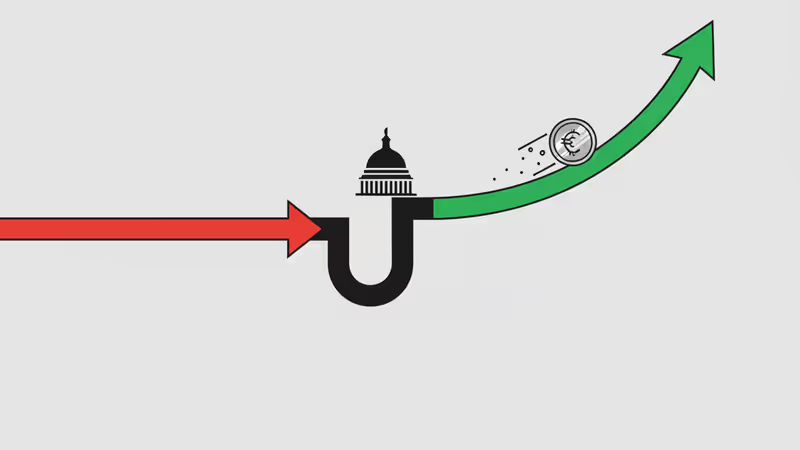
China's US Treasury holdings hit a 17-year low. This isn't a market blip; it's a strategic de-dollarization move with huge implications for global finance.
The Lede: More Than Just Numbers
Beijing's sell-off of US Treasuries to its lowest level since before the 2008 financial crisis is not a simple portfolio rebalancing. It's a flashing red light on the dashboard of the global economy. For any executive or investor, this signals the acceleration of a strategic decoupling between the world's two largest economies, fundamentally reshaping capital flows, risk, and the future of money itself.
Why It Matters: The Ripple Effects
The slow unwinding of China's position as one of America's largest foreign creditors has three critical second-order effects that extend far beyond bond trading desks:
- The End of Cheap Money: For decades, China recycled its massive trade surpluses into US debt, helping to suppress US interest rates. As the biggest historical buyer steps back, the US Treasury must find new lenders. This structurally points to higher borrowing costs for the US government, corporations, and ultimately, consumers.
- A Test of the Dollar's Dominance: This is de-dollarization in action. While the US dollar won't be dethroned overnight, this move is a clear vote of no-confidence. It's part of a broader trend where nations are actively seeking alternatives to reduce their vulnerability to US sanctions and monetary policy.
- Financial De-risking as a Weapon: China is treating its US Treasury holdings as a potential liability in an era of intense geopolitical competition. Reducing this exposure is a defensive maneuver, insulating its economy from potential US financial sanctions akin to those levied against Russia.
The Analysis: From 'Chimerica' to Cold War 2.0
To grasp the gravity of this shift, we must rewind. The post-2001 era was defined by "Chimerica"—a symbiotic relationship where China mass-produced goods and financed American consumption by buying its debt. The drop to a 17-year low symbolically bookends that era. The global financial crisis of 2008 was the peak of that codependence; today marks its nadir.
The catalyst for this acceleration was the 2022 freezing of Russia's central bank assets. For Beijing, this was a profound shock, demonstrating that US-dollar-denominated assets could be weaponized instantly. The calculus shifted from economic symbiosis to strategic vulnerability. Every US Treasury bond held became a potential hostage. This isn't just about yield; it's about control. China is trading financial returns for financial sovereignty.
Simultaneously, China's strategic priorities have changed. The capital once used to fund US deficits is now needed at home to fuel its own technological ambitions in semiconductors, AI, and green energy—the very battlegrounds of the US-China tech rivalry.
PRISM Insight: The Tech-Powered Alternative
The true long-term story isn't just what China is selling, but the alternative financial infrastructure it's building. This de-dollarization strategy is being supercharged by technology:
- Alternative Rails: China is aggressively promoting its Cross-Border Interbank Payment System (CIPS) as a SWIFT alternative, particularly for trade with partners in the Global South and sanctioned nations like Russia.
- The Digital Yuan (e-CNY): While domestic for now, the e-CNY provides the technological blueprint for a future of bilateral trade settlements that completely bypass the US dollar and the corresponding US banking system.
- Buying Hard Assets: Where is the money going? A significant portion is being reallocated to gold. China's central bank has been the world's largest gold buyer for over a year. Unlike Treasuries, gold is a bearer asset with no counterparty risk, making it immune to sanctions.
PRISM's Take: This is Structural, Not Cyclical
Do not mistake this for a temporary market fluctuation or a negotiating tactic. This is a deliberate, multi-decade strategic pivot. China's divestment from US debt is a core component of its strategy to insulate itself from US pressure and build a multipolar world order where the dollar's "exorbitant privilege" is diminished.
For investors and policymakers, the message is clear: the post-WWII financial architecture is being re-written. The assumption of a single, frictionless global financial system is obsolete. We are entering a more fragmented era where capital flows will be increasingly dictated by geopolitical allegiance, not just economic fundamentals. The Great Unwinding is not a crisis event; it is a fundamental reshaping of the global economic landscape.
관련 기사

중국이 복제약 생산을 넘어 1/5 비용으로 신약을 개발하는 글로벌 바이오 혁신 허브로 부상했습니다. 이 변화가 글로벌 제약 시장과 투자에 미치는 영향을 심층 분석합니다.
중국이 미 국채 보유량을 17년 만의 최저치로 줄였습니다. 이는 단순한 자산 조정을 넘어, 가속화되는 탈달러화와 미중 갈등의 새로운 단면을 보여줍니다.

일본은행이 30년 만의 금리 인상을 단행, 초저금리 시대의 종언을 알렸다. 글로벌 엔 캐리 트레이드 청산과 자금 흐름의 지각변동이 예상된다.
미국 CFTC와 FDIC에 친암호화폐 인사가 임명되었습니다. 규제 불확실성 해소로 월스트리트의 본격적인 시장 진입과 제도권 편입이 가속화될 전망입니다.