
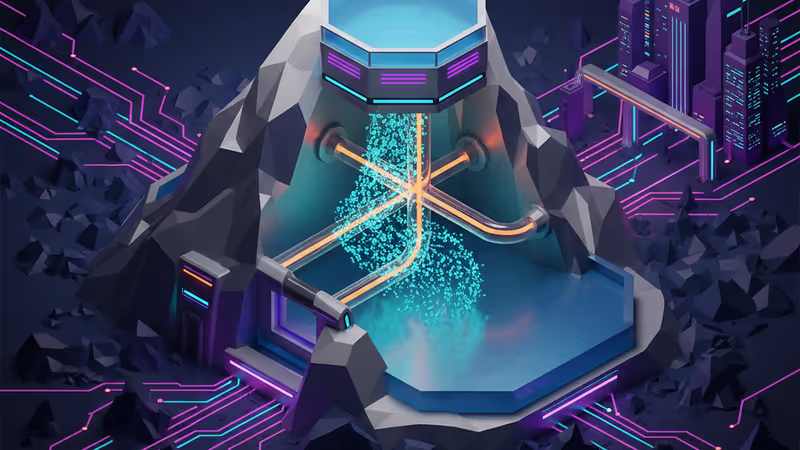
Beyond the Mountain: A 'Secret Powder' Aims to Unlock Pumped Hydro's Grid-Scale Potential
RheEnergise is using a dense, mineral-based fluid to reinvent pumped hydro storage. Can this innovation solve the grid's biggest energy bottleneck?
The Lede: The Storage Bottleneck is Breaking
The global energy transition is facing a multi-trillion-dollar bottleneck: energy storage. Without a way to bottle intermittent solar and wind power, we're forced to waste it, costing the UK alone over £1 billion this year. While lithium-ion batteries dominate headlines, a UK startup, RheEnergise, is demonstrating a solution that re-engineers a century-old technology—pumped hydro—to operate almost anywhere, without the need for mountains. By creating a fluid 2.5 times denser than water, they are fundamentally changing the geographic and economic equation for grid-scale storage. For executives and investors, this isn't just a new project; it's a potential blueprint for unlocking thousands of new energy assets on previously unusable land.
Why It Matters: The Second-Order Effects
The core innovation—a dense, mineral-based fluid—creates cascading strategic advantages that go far beyond a single power plant. This is about reimagining the physical footprint of our energy grid.
- Decentralized, Resilient Grids: Traditional pumped hydro requires massive reservoirs and huge elevation changes, concentrating storage in a few mega-projects. RheEnergise’s approach allows for smaller, more numerous installations on low hills or even in repurposed mineshafts. This shift from centralized to distributed long-duration storage creates a more resilient and flexible grid.
- Asset Repurposing & The Brownfield Revolution: The ability to use smaller elevation drops opens up thousands of 'brownfield' sites—old quarries, mines, and industrial landscapes—turning environmental liabilities into high-value energy assets. This sidesteps contentious land-use debates and lengthy permitting cycles associated with greenfield projects.
- Unlocking Renewable Profitability: By drastically reducing the cost and complexity of co-locating storage, this technology makes new wind and solar farms more economically viable. It directly tackles energy curtailment, ensuring every megawatt generated can be sold, accelerating the payback period for renewable investments.
The Analysis: Innovation on a Proven Platform
Pumped hydro isn't new; it currently accounts for over 90% of the world's energy storage capacity. Its development stalled in the 1990s due to immense capital costs, environmental impact, and a scarcity of suitable mountainous locations. Grid-scale storage has since become a battleground for competing technologies:
- Lithium-ion Batteries: Dominate short-duration (1-4 hours) storage but face challenges with long-duration needs, supply chain volatility (lithium, cobalt), and degradation over time.
- Next-Gen Chemistries (Flow Batteries, etc.): Promise longer duration but are still navigating the path to cost-competitiveness and large-scale manufacturing.
- Mechanical/Physics Storage (Compressed Air, Gravity): Offer long life and simpler materials but often have their own geographic constraints.
RheEnergise cleverly sidesteps this binary choice. They are not inventing new turbines or generators. Instead, they are applying material science innovation to a proven, century-old mechanical platform. By changing the fluid, they multiply the effectiveness of the existing hardware. A project that would require a 200-meter height difference with water needs only 80 meters with their fluid. This is a powerful de-risking strategy: leveraging the reliability of established hydropower engineering while introducing a single, high-impact variable.
PRISM Insight: The Pivot to 'Physics-Based' Storage
The RheEnergise model is emblematic of a crucial investment trend: the shift from purely chemical storage to diverse, 'physics-based' solutions. Investors are increasingly looking for long-duration technologies that are decoupled from the volatile and geopolitically sensitive battery mineral supply chain.
This category includes gravity-based systems, compressed air, and thermal storage. Their common thesis is durability and material simplicity. RheEnergise’s mineral-based fluid fits perfectly within this paradigm. The investment implication is clear: the most scalable storage solutions may not come from a breakthrough in battery chemistry, but from clever engineering and material science that make established physical principles viable in new contexts. The key performance indicator is no longer just energy density, but locational flexibility and speed of deployment.
PRISM's Take
While the RheEnergise demonstrator is still in its early days, the strategic importance of its approach cannot be overstated. It represents a fundamental reframing of a legacy technology, transforming it from a niche, geographically-constrained solution into a potentially ubiquitous tool for grid stability. The success of this model doesn't hinge on inventing a new machine, but on perfecting and scaling the production of its proprietary fluid. If RheEnergise can prove the long-term stability, low environmental impact, and cost-effectiveness of its 'High-Density Hydro', it won't just be building power plants—it will be turning the world's rolling hills into the backbone of the renewable energy grid.
관련 기사

틱톡의 미국 사업부 매각이 마침내 타결되었습니다. 이는 단순한 M&A를 넘어, 기술과 데이터 주권이 충돌하는 새로운 '디지털 국경' 시대의 시작을 의미합니다.

OpenAI가 발표한 18세 미만 사용자 원칙의 심층 분석. 단순한 안전장치를 넘어 AI 윤리 경쟁의 판도를 바꾸는 전략적 행보와 시장에 미칠 영향을 파헤칩니다.

중국이 엔비디아보다 100배 빠른 광컴퓨팅 AI 칩 'LightGen'을 공개했습니다. 이는 단순한 속도 경쟁을 넘어, 미중 기술 전쟁의 판도를 바꿀 새로운 패러다임을 제시합니다.

OpenAI와 Anthropic의 청소년 보호 정책은 AI 산업의 성숙을 의미합니다. 규제, 시장, 기술적 딜레마 속에서 '신뢰'가 새로운 경쟁력이 되는 이유를 분석합니다.