
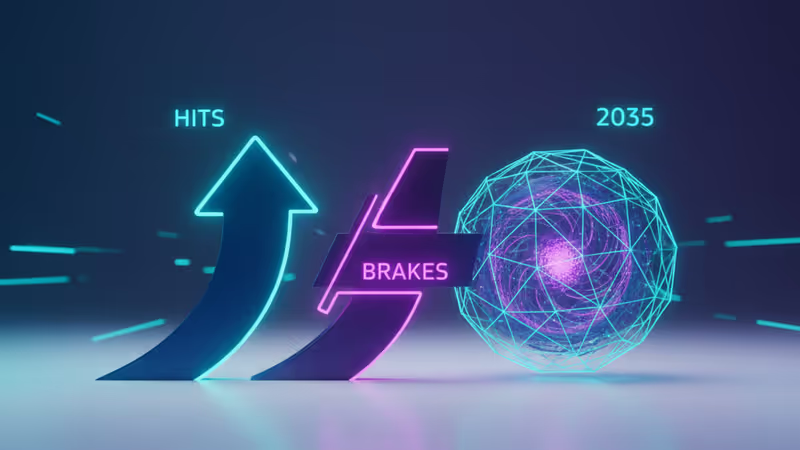
EU Hits the Brakes on 2035 Gas Car Ban, Fueling Fears of Ceding EV Market to China
The European Commission has softened its 2035 ban on new combustion engine cars, sparking a divide between legacy automakers and EV startups who fear the move will cede market leadership to China.
The European Commission is softening its ambitious plan to ban the sale of new gas-powered cars by 2035, a move designed to offer flexibility to legacy automakers but one that has ignited a firestorm of criticism from the continent's EV startups and climate investors.
Instead of a 100% zero-emission mandate, the revised plan would permit 10% of new vehicles to be hybrids or other non-zero-emission models, provided that manufacturers purchase carbon offsets. According to the Commission, this change is part of a broader 'Automotive Package' intended to help Europe’s car industry become both clean and competitive as it struggles against Tesla and a wave of affordable Chinese electric vehicles (EVs).
While the policy shift, if approved by the European Parliament, may come as a relief to traditional carmakers, it has created a sharp divide. “China already dominates EV manufacturing,” warned Craig Douglas, a partner at the European climate-focused venture capital firm World Fund. “If Europe doesn’t compete with clear, ambitious policy signals, it will lose leadership of another globally important industry.”
Douglas was a signatory to “Take Charge Europe,” an open letter published in September urging Commission President Ursula von der Leyen to “stand firm” on the original 2035 target. Executives from companies like Cabify, EDF, and numerous EV-related startups also signed, but their appeal appears to have been outweighed by pressure from the traditional auto industry, which accounts for 6.1% of total EU employment.
The debate is not just between old and new players. In a statement to Swedish media, a Volvo press officer said that “backing down on long-term commitments in favor of short-term gains risks undermining Europe’s competitiveness.” Unlike many of its peers, Volvo was confident it could meet the 2035 deadline and would have preferred to see more investment in charging infrastructure—a development critics fear the new policy could discourage.
This concern was echoed by Issam Tidjani, CEO of the Berlin-based EV charging marketplace Cariqa. “History shows that this kind of flexibility has never worked out well,” said Tidjani, who also signed the letter. “It delays scale, weakens learning curves, and ultimately costs industrial leadership rather than preserving it.”
To be fair, the Commission’s package does address supply chain issues with its “Battery Booster” strategy, a €1.8 billion (about $2.11 billion) investment to develop a fully European battery supply chain. The plan was praised by Verkor, a French startup that opened its first large-scale battery factory in Northern France this week. The company called the initiative “a necessary step to scale up Europe’s battery industry.”
Still, many worry the booster isn't enough to counteract the mixed signals on decarbonization. Legacy carmakers are already complaining that the carbon offset requirement could raise consumer prices, undermining the policy's goal. Another uncertainty is whether the United Kingdom, which has so far not imposed tariffs on Chinese EVs, will follow the EU's lead and modify its own 2035 ban. The decision highlights the tightrope Europe is walking between protecting today's economic realities and securing its place in tomorrow's clean-tech world.
PRISM Insight: Europe's policy pivot isn't just a concession; it's a high-stakes bet that a slower, more protected transition can outperform a rapid, disruptive one. But by creating policy uncertainty, the EU risks deterring the very private capital and startup innovation it needs to compete with China's state-backed EV machine, potentially trading short-term industrial peace for long-term technological irrelevance.
관련 기사
샌프란시스코 대규모 정전 사태로 웨이모 로보택시 서비스가 전면 중단됐다. 일부 차량이 교차로를 막아 교통 체증을 유발했으며, 이는 최근 웨이모가 겪고 있는 일련의 문제들과 맥을 같이한다.
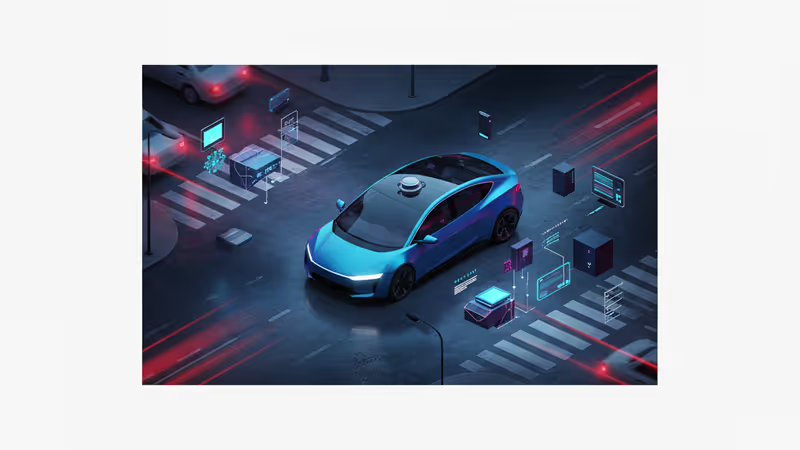
샌프란시스코 대규모 정전 사태로 구글 웨이모 로보택시 서비스가 전면 중단됐다. 도시 인프라의 취약성이 첨단 자율주행 기술의 한계를 드러낸 사건의 전말과 시사점을 분석한다.
샌프란시스코 대규모 정전으로 웨이모 로보택시가 도로에서 멈춰서는 사태가 발생했다. 인프라 의존적인 자율주행 기술의 취약성과 테슬라 FSD와의 비교점을 통해 미래 자율주행의 과제를 분석한다.

80년간 전 세계 물류 및 공급망의 핵심이었던 '심플렉스 알고리즘'의 이론적 모순이 마침내 해결되었습니다. 두 연구자가 무작위성을 이용해 알고리즘의 실제 효율성을 증명한 과정을 알아봅니다.