
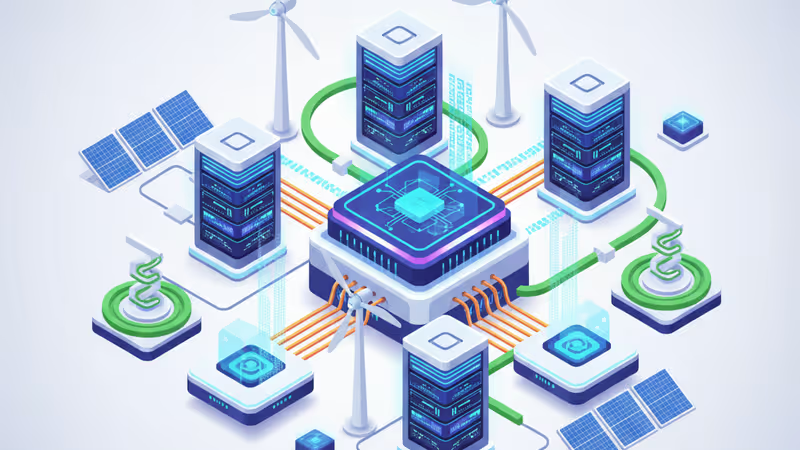
AI's $61 Billion Data Center Gold Rush Faces a Sustainability Showdown
AI's booming $61B data center market faces critical challenges from energy demands, private equity financing, and community pushback. How sustainable is this growth?
The Lede: The Unseen Costs of AI's Infrastructure Boom
The global data center market is soaring, projected to hit an astounding $61 billion in 2025, fueled almost entirely by the insatiable demands of generative AI. This isn't just a record; it's a foundational tremor indicating the massive physical infrastructure underpinning our digital future. However, beneath the impressive figures lies a growing tension: an industry powered by precarious private equity financing and facing escalating environmental and community resistance. For tech executives and investors, understanding this friction isn't optional; it's critical to navigating the next wave of AI's development.
Why It Matters: More Than Just Rack Space
The relentless expansion of data centers isn't merely a logistical challenge; it's rapidly evolving into a complex nexus of economic, environmental, and geopolitical concerns. While NVIDIA's earnings reports continue to paint a rosy picture for AI's immediate future, the physical footprint required to run these models is becoming AI's Achilles' heel. This isn't just about housing servers; it's about:
- Grid Strain: Data centers are projected to increase power grid use by 22% by end-2025, potentially tripling by 2030. This surge threatens grid stability, pushes utilities to their limits, and accelerates the need for new power generation – often still reliant on fossil fuels.
- Community Pushback: The environmental footprint (energy, water, land use) is sparking significant grassroots opposition. Legal challenges and advocacy toolkits are emerging, slowing down or halting projects in critical locations like Virginia and Wisconsin.
- Financial Sustainability: A heavy reliance on private equity financing introduces a debt-laden model to an energy-intensive sector. While it enables rapid expansion, it also raises questions about long-term financial stability and risk exposure if demand forecasts falter or operating costs (like energy) skyrocket.
The Analysis: A Clash of Ambitions and Realities
The current data center boom echoes past infrastructure expansions, from the dot-com era's fiber optic buildout to the early days of cloud computing. What distinguishes this moment is the sheer scale of *power* consumption and its direct, localized impact. Historically, tech infrastructure has been a largely invisible utility. Today, it's a visible, contentious land-use issue.
We're witnessing a fascinating dynamic: on one side, hyperscalers and AI innovators are pushing for unprecedented compute capacity, backed by robust investor confidence in AI's future. On the other, local communities and environmental organizations are drawing a line in the sand, demanding accountability for environmental impacts. This isn't just NIMBYism; it's a fundamental challenge to the 'move fast and break things' ethos when the 'things' involve essential public resources like water and energy grids.
Adding another layer of complexity, government responses are deeply bifurcated. While some federal administrations, like the Trump administration, pledge to fast-track permitting and bypass environmental laws to accelerate AI initiatives, individual states and localities are facing direct pressure to pump the brakes. This creates a regulatory vacuum and potential legal quagmire, further increasing uncertainty for large-scale data center investments.
PRISM Insight: Navigating the New Infrastructure Frontier
For investors, the smart money isn't just in data center REITs; it's in the innovations that address these growing pains. Consider:
- Green Tech & Efficiency: Investments in advanced cooling systems, renewable energy integration, and AI-driven power optimization for data centers are no longer 'nice-to-haves' but critical necessities.
- Distributed & Edge Computing: While hyperscale will remain dominant, localized, smaller-footprint edge data centers that reduce latency and minimize massive centralized power draws could see renewed interest.
- Siting & Community Engagement: Companies that master the art of sustainable site selection, genuine community engagement, and transparent environmental impact assessments will gain a competitive advantage. This includes investing in 'social license to operate' as much as technical capabilities.
- Regulatory Tech & Advocacy: Solutions that help data centers navigate complex environmental regulations, secure permits efficiently, and demonstrate compliance will be invaluable.
PRISM's Take: Reimagining AI's Physical Foundation
The $61 billion data center market is a testament to AI's transformative power, but its current trajectory is unsustainable. The industry cannot continue to grow on the twin pillars of debt-heavy financing and unchecked environmental impact. The friction points – soaring energy demands, community pushback, and a fragmented regulatory landscape – are not merely externalities; they are emerging as strategic choke points for AI's future growth.
Leaders must move beyond simply building more facilities. The imperative is to innovate in *how* these facilities are designed, powered, and integrated into our communities. This means a shift towards radically more energy-efficient designs, aggressive adoption of renewable energy sources, and proactive engagement with local stakeholders. The true winners in the AI race won't just build the smartest models; they'll build the smartest, most sustainable, and most resilient infrastructure to support them. Anything less risks turning AI's gold rush into an environmental and financial liability.
관련 기사

Internxt 20TB 평생 클라우드 저장 공간 딜은 단순한 가격 할인을 넘어 데이터 주권과 장기적 비용 효율성에 대한 새로운 대안을 제시합니다. PRISM이 심층 분석합니다.

더 버지의 연말연시 테크 선물 가이드 심층 분석: '후회 없는 선물'을 위한 현명한 소비 전략과 PRISM이 제시하는 시장 트렌드를 확인하세요.
구글과 애플이 비자 소지 직원에게 해외여행 자제를 권고했습니다. 장기화되는 비자 수속, 강화된 심사 기준이 미 테크 산업과 글로벌 인재 이동에 미칠 파장을 PRISM이 심층 분석합니다.
AI 데이터센터 시장이 610억 달러로 성장했지만, 민간 투자 위험, 막대한 전력 소비, 환경 및 지역 사회의 반발이라는 그림자에 직면했습니다. 지속 가능한 AI 인프라의 미래를 분석합니다.