
Japan Deploys AI 'B Alert' System to Predict and Prevent Bear Attacks
Japan is deploying 'B Alert,' an AI-powered surveillance system that detects bears near residential areas and cuts down public warning times by over 30 minutes, amid rising attacks.
As bear sightings and attacks continue to rise across Japan, a new AI-powered surveillance system is being rolled out to prevent dangerous encounters before they happen. The system, called 'B Alert,' automatically detects bears near populated areas and notifies authorities in real time, reshaping how local governments manage wildlife threats.
By automating the detection and alert process, the technology is cutting down the time it takes to issue public warnings by more than 30 minutes. According to Kyodo, it’s already being adopted by prefectures like Gunma, Toyama, and Ishikawa, offering a high-tech layer of defense for unsettled communities.
How AI Becomes a Digital Watchtower
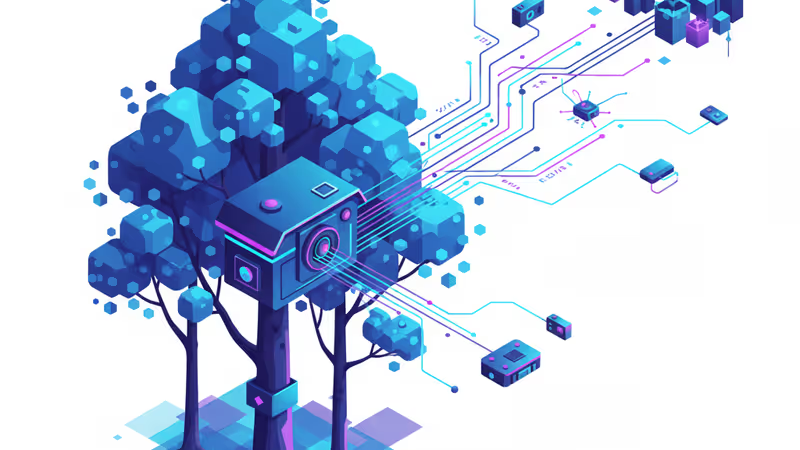
Developed jointly by Hokuriku Electric Power Co. and communications firm Hokutsu Co., B Alert relies on a network of cameras equipped with communication functions. These are strategically placed on trees in mountainous regions and along riverbanks bordering residential zones.
The cameras trigger automatically when they sense body heat, capturing images of any passing animal. These images are then transmitted to a cloud-based AI. The AI, trained on a dataset of approximately 60,000 photographs of bears and other wildlife, filters the data to identify bears with a reported accuracy of 99.9%. A key strength, a company representative noted, is its ability to spot animals in dimly lit areas where the human eye would struggle.
Once a bear is confirmed, the system automatically emails the images to local government officials. This eliminates the need for staff to physically verify the sighting, allowing for a much faster public response. Municipalities like Toyama, Fukui, and Kobe have already adopted the system.
Born from a Close Encounter
The impetus for B Alert was a frightening incident in 2019. A Hokuriku Electric Power maintenance worker was attacked and sustained minor injuries from a bear while working on a transmission tower in Toyama Prefecture. This prompted the utility company to explore countermeasures.
At the same time, Toyama Prefecture was dealing with its own surge in bear-related incidents. Hokuriku Electric shared its concerns with the prefectural government, which then allocated funding for a proof-of-concept experiment, kickstarting the system's development.
The system has been met with praise from local officials. "(B Alert) contributes to efficiency and labor savings at a time when staff shortages are an ongoing challenge," said Hirokazu Sugibayashi, deputy chief of Toyama's forest policy division. A neighborhood association chairman, Terumasa Yokogoshi, added that it provides "welcome reassurance and peace of mind for residents."
B Alert is more than a regional safety tool; it's a blueprint for proactive human-wildlife management. As climate change and habitat loss escalate conflicts globally, this system demonstrates a non-dystopian use of surveillance technology, shifting its focus from monitoring people to protecting them. It showcases how localized sensor networks and AI can be combined to maintain both public safety and ecological balance—a core challenge for smart governance everywhere.
본 콘텐츠는 AI가 원문 기사를 기반으로 요약 및 분석한 것입니다. 정확성을 위해 노력하지만 오류가 있을 수 있으며, 원문 확인을 권장합니다.
관련 기사
구글 Gemini, 오픈AI ChatGPT 등 주류 AI 챗봇이 간단한 프롬프트만으로 여성의 사진을 비키니 딥페이크로 만드는 데 악용되고 있다. 기술 기업들의 안전장치가 쉽게 우회되면서 AI 윤리와 책임 문제가 수면 위로 떠올랐다.

오픈AI의 GPT-5가 수학 미해결 문제를 해결했다는 주장은 왜 구글 딥마인드 CEO로부터 '민망하다'는 평을 들었을까요? AI 업계의 과대광고와 실제 능력 사이의 격차를 파헤칩니다.

틱톡과 인스타그램을 뒤덮은 AI 슬롭 영상. 저급한 콘텐츠 복제품일까, 아니면 새로운 디지털 예술의 시작일까? Sora, Veo 등 AI 기술이 바꾸는 창작의 미래를 분석한다.
일본에서 곰 출현에 따른 피해가 증가하자, 99.9% 정확도의 AI 감시 시스템 'B 얼럿'이 도입되고 있다. 실시간 탐지와 자동 알림으로 주민 경보 시간을 30분 이상 단축시킨다.