
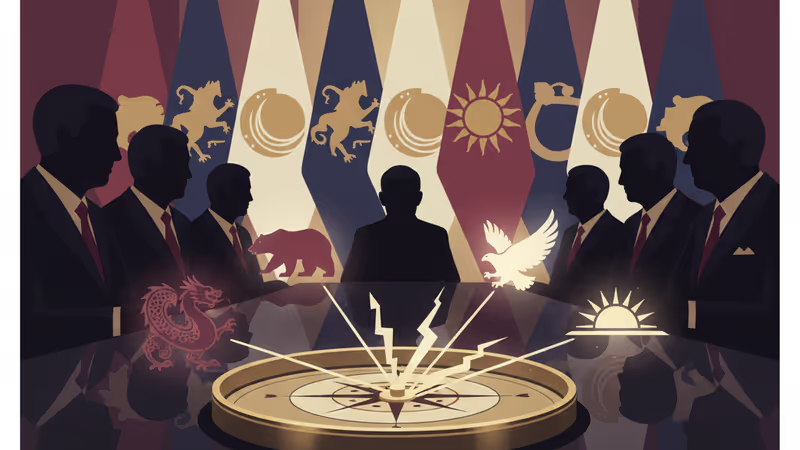
America's Global Stance on Trial: Is 'America First' Weakening the United States?
Amid fierce debate over 'America First,' US foreign policy is at a critical juncture. An analysis of the multifaceted challenges, from tensions with China to evolving alliances.
US Foreign Policy at a Crossroads
American foreign policy is undergoing a period of intense scrutiny, facing fundamental questions from allies and adversaries alike. From its tense relationship with China to its plans for Gaza and engagement in Africa, Washington's strategic direction is being challenged on multiple fronts. At the heart of this debate lies the principle of 'America First'—an approach that forces a re-evaluation of the nation's traditional role as a global leader.
Context: The 'America First' Doctrine
Popularized during the Trump administration, 'America First' prioritizes national interests and bilateral deals over multilateral agreements. This policy has reshaped America's relationships with its allies, its stance on international trade, and its approach to global conflicts, creating ripples throughout the international order.
The Central Question: A Stronger or Weaker America?
The most pressing debate is whether the 'America First' posture ultimately strengthens or weakens the United States. Proponents argue it liberates the U.S. from costly foreign entanglements and unfair trade deals, allowing it to focus on domestic prosperity. Declarations that the US economy is in a “golden age” reflect this confidence, though whether the average American agrees is a crucial domestic political question, highlighted by recent local elections that some saw as a “wake-up call.”
Critics, however, contend that this approach erodes the decades-old alliance system that has long formed the bedrock of American power and influence. An unpredictable U.S. foreign policy could push allies to seek greater strategic autonomy, potentially leaving a vacuum on the world stage that competitors are eager to fill.
The China-US Relationship: A Fragile Truce
Nowhere are the stakes of U.S. foreign policy clearer than in its relationship with China. The current dynamic is often described as being “somewhere between a ceasefire and a truce.” While direct conflict is being carefully managed, core issues—technological supremacy, trade imbalances, and Taiwan's status—remain unresolved. How the U.S. navigates its alliances will be critical in shaping a unified front in this defining geopolitical competition.
Global Hotspots and Shifting Alliances
The policy is also being tested in volatile regions. There's significant skepticism about whether the U.S. plan for Gaza can succeed, a question that directly impacts its credibility as a mediator in the Middle East. Meanwhile, traditional partners like Saudi Arabia are visibly doubling down on and recalibrating their relations with Washington, signaling a more multipolar world where nations hedge their bets.
In Africa, Rwandan President Paul Kagame's observation that he has “never seen this much attention” to ending a conflict on the continent suggests that the focus of great powers is shifting. It raises the question of whether new players are stepping in as the U.S. re-evaluates its global commitments.
PRISM Insight: Navigating a Multipolar World
The challenges facing the U.S. are not isolated incidents but symptoms of a broader shift from a unipolar to a multipolar global order. 'America First' was one response to this changing landscape, but its long-term consequences are still unfolding. Looking ahead, the U.S. faces a stark choice: continue down a path of transactional unilateralism or reinvest in the alliances and multilateral institutions that defined its post-war leadership. This decision will not only shape global politics for decades but will also determine the future of technology standards, supply chains, and the world economy.
関連記事

フランス大統領官邸エリゼ宮で、食器管理人らが国宝級の食器を盗んだ疑いで裁判に。被害総額は最大4万ユーロ。内部犯行が浮き彫りにし、フランス文化施設のセキュリティ体制に警鐘を鳴らしています。

韓国・全羅南道のカモ農場で、今シーズン国内16例目となる高病原性鳥インフルエンザが確認されました。当局は防疫措置を強化し、周辺農場への集中検査を開始します。
韓国の野党「改革新党」の李俊錫代表が21日、金建希元大統領夫人に関連する選挙介入疑惑で特別検察官から約10時間の聴取を受けました。2022年の選挙公認を巡る疑惑の核心に迫ります。

スウェーデン沖でエンジン故障のため停泊したロシアの貨物船「アドラー号」に対し、スウェーデン当局が臨検を実施。同船と所有者はEUの制裁対象であり、武器輸送の疑いが持たれています。