
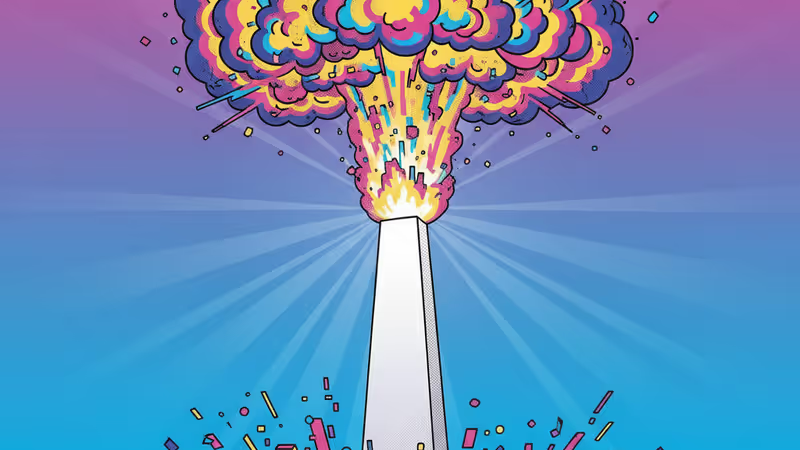
WikiFlix Just Broke the Internet—And It’s a Rebuke of Modern Streaming
Discover why WikiFlix, a free public domain movie site, went viral. It's not just about old films—it's a cultural backlash against subscription fatigue.
The Antidote to Streaming Burnout Has Arrived
In an internet dominated by rising subscription fees, ad-supported tiers, and password-sharing crackdowns, a simple, free, and slightly dusty corner of the web just went massively viral. Meet WikiFlix, a Netflix-inspired archive of over 4,000 public domain films you can watch without an account, an ad, or a credit card. Its sudden explosion in popularity isn't just about free movies; it's a cultural referendum on the exhausting state of digital entertainment.
How a Wikipedia Rabbit Hole Became an Internet Sensation
While WikiFlix has existed for a while as a volunteer project from the Wikipedia community, it was catapulted into the mainstream by a TikTok from Annie Rauwerda, the creator behind the beloved 'Depths of Wikipedia' account. Her video showcased a platform that feels like a relic from a better internet—a digital library where classics like "It’s a Wonderful Life" and the original "Nosferatu" are available with a single click.
The concept is a stark contrast to the walled gardens we've become accustomed to. Powered by Wikimedia Commons and the Internet Archive, WikiFlix is a testament to the power of the public domain. It’s not trying to win an Emmy or secure Q3 subscriber growth; it’s simply a portal to our shared cultural history. And in 2025, that feels nothing short of revolutionary.
The Best Reactions: From Subscription Fatigue to Film Nerd Delight
The internet's response was swift and telling, capturing a widespread exhaustion with the current media landscape. Here’s a curation of the sentiments echoing across social media:
- The Financially Fatigued: "Finally, a ‘...and chill’ that doesn’t require a 6-month budget projection. My wallet has never been so relaxed."
- The Nostalgic Veteran: "This is what the internet was supposed to be. No tracking, no algorithms trying to sell me something, just pure, unadulterated discovery. It feels like 1999 again."
- The Film History Buff: "People complaining that the movies are ‘old’ are missing the entire point. This is a goldmine. We're talking the first-ever Best Picture winner and silent-era gems. This is a free film school."
- The Anti-Algorithm Rebel: "I love watching something knowing an algorithm didn’t ‘recommend’ it to me based on my last three existential crises. The joy of finding something weird and wonderful on your own is back."
- The Pragmatist: "Okay, so it's not going to replace my ‘Stranger Things’ binge. But for a random Saturday afternoon? Watching a swashbuckling pirate movie from 1926 for free? Absolutely, yes."
Cultural Context: Why This Resonates Globally in 2025
WikiFlix’s viral moment is a perfect storm of several powerful cultural currents. Firstly, there's a palpable sense of ‘subscription fatigue.’ Consumers globally are juggling a dozen different services, each with its own price hikes and content purges. The simplicity of a single, free repository is a breath of fresh air.
Secondly, it taps into a deep-seated digital nostalgia. For many Millennials and Gen Z-ers, who either grew up with or have been told stories of the ‘early web,’ WikiFlix represents a more idealistic, less commercialized internet. It’s a community-driven project, much like Wikipedia itself, existing purely for the public good.
Finally, this is a quiet rebellion against the ‘enshittification’ of digital platforms—the phenomenon where services, once useful and user-friendly, become cluttered with ads and features designed to extract more value from the user, rather than provide it. WikiFlix does the opposite; its only goal is to provide.
PRISM Insight: More Than Free Movies, It's a Vote for a 'Public Park' Internet
The explosive interest in WikiFlix should not be misinterpreted by industry leaders as a simple demand for more free content. It is a powerful cultural signal indicating a deeper yearning: the desire for digital ‘public spaces.’
Think of the modern internet as a series of shopping malls. Every platform, from social media to streaming services, is architected to guide you toward a transaction—your data, your attention, or your money. They are private, commercialized spaces with clear objectives.
WikiFlix, in this analogy, is a public park or a library. It exists not to extract value, but to provide it as a public good. It has no shareholders to please or growth targets to hit. Its success is measured in utility and preservation, not profit. The virality demonstrates a massive, underserved psychological need for online destinations where users can simply exist without being monetized. It’s a vote for an internet that serves human curiosity and culture, not just commerce. For developers and brands, the lesson isn't to make everything free, but to recognize the immense brand loyalty and goodwill that can be generated by creating genuine, non-transactional value for a community.
関連記事
『シュルプ』のムン・サンミン主演最新作に世界が注目。なぜこのKドラマ時代劇は話題なのか?海外ファンの熱狂的な反応を分析し、ヒットの背景を深掘りします。
人気芸人パク・ナレの無免許施術騒動がSHINeeのキーに飛び火。疑惑の真相と、アイドルの名前が浮上したことで巻き起こる海外ファンのリアルな反応を専門家が分析します。

SHINeeのKeyが謎の「偽医者」事件で人気番組を降板。世界中のファンに衝撃が走る中、事件の真相とK-POP界に与える影響を専門家が徹底分析します。
SHINeeのキーが「注射おばさん」ミーム騒動で謝罪・番組降板。なぜ世界中で話題に?海外の反応と、K-POPアイドルが直面する新たなリスクを専門家が徹底分析。