
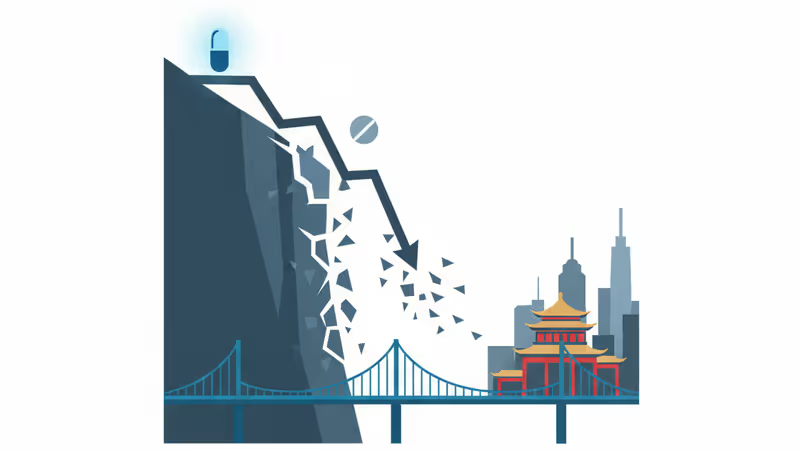
The Pharma Paradox: Why Big Pharma's $171B Patent Cliff Leads Straight to China
Big Pharma faces a $171B revenue cliff. Their solution? Chinese biotech. Our analysis unpacks the high-stakes clash between economic need and geopolitical risk.
The Lede: The $171 Billion Imperative
A $171 billion revenue hole is opening up beneath the world’s largest pharmaceutical companies. As a wave of blockbuster drugs goes off-patent by 2030, a familiar industry crisis—the ‘patent cliff’—is re-emerging with unprecedented force. But the playbook for survival has been radically rewritten. This time, the lifeline that US pharma giants are desperately grasping for extends directly to their biggest geopolitical rival: China. For executives and investors, the core question is no longer just about replenishing drug pipelines; it's about navigating a high-stakes collision between economic necessity and national security policy.
Why It Matters: A Global System Under Stress
This isn't merely a boardroom problem for Pfizer or Merck. The decisions made in the next 24 months will have cascading effects across the global economy and healthcare systems. The tension between Washington's decoupling agenda, embodied by the Biosecure Act, and Big Pharma's survival instinct creates a volatile new reality.
- Innovation Bottlenecks: If US firms are cut off from Chinese biotech innovation, a primary source of next-generation therapies—especially in oncology and cell therapy—could be choked off, delaying new treatments for patients worldwide.
- Supply Chain Realignment: The Biosecure Act is forcing a costly and complex re-shoring of manufacturing and R&D services. This will create new winners (e.g., Indian and European contract manufacturers) but also introduce new fragilities and higher costs into the drug development process.
- Investment Uncertainty: A new layer of geopolitical risk is now fused to biotech investing. The valuation of any company with significant China exposure is now subject to the whims of legislators, creating massive uncertainty for venture capital and public market investors.
The Analysis: From M&A to Strategic Entanglement
During the last major patent cliff a decade ago, the solution was consolidation—Big Pharma bought other Big Pharma or large Western biotechs. That option is now exhausted. The targets are too big, the premiums too high, and the pipelines often have overlapping risks. Today, the most dynamic and cost-effective source of late-stage, de-risked assets is China's biotech sector, which has evolved from a copycat industry to a hub of genuine innovation in a remarkably short time.
However, this shift is happening at the worst possible political moment. The Biosecure Act, which aims to prohibit US federal agencies from contracting with certain Chinese biotech providers, casts a long shadow over any collaboration. This creates the central paradox: the market is pushing US pharma towards China for pipeline salvation, while politics is trying to erect an impenetrable wall. Companies are no longer just licensing a molecule; they are making a geopolitical bet.
PRISM Insight: De-Risking in a High-Risk World
The smartest players are not waiting for political clarity; they are engineering resilience into their strategies. For investors, this creates two distinct opportunities:
- The Geopolitical Arbitrage Play: Chinese biotech assets, particularly in cutting-edge fields like Antibody-Drug Conjugates (ADCs), are arguably undervalued due to the political overhang. For investors with a high-risk tolerance, there is a potential 'geopolitical alpha' to be captured by betting that economic logic will ultimately prevail over political rhetoric. Watch for creative deal structures—like licensing ex-China rights only—that attempt to insulate deals from US policy.
- The ‘Decoupling’ Beneficiaries: The counter-trade is to invest in the companies poised to benefit from supply chain diversification. Contract Development and Manufacturing Organizations (CDMOs) in Europe, India, and North America are seeing a surge in business as pharma companies urgently seek alternatives to Chinese partners targeted by the Biosecure Act. This is a less volatile, long-term trend driven by the new imperative of supply chain security.
PRISM's Take: The Myth of a Clean Break
The narrative of a complete US-China biotech decoupling is a political fantasy that ignores market reality. The $171 billion revenue chasm is a force of gravity that is stronger than policy friction. We are not witnessing a decoupling, but a 'strategic entanglement'—a messier, more complex relationship where collaboration continues under a cloud of intense scrutiny.
The Biosecure Act will not stop US pharma from tapping Chinese innovation; it will simply make it more expensive and legally complicated. Expect to see a bifurcation: R&D and early-stage partnerships may continue quietly, while manufacturing and clinical data management are aggressively re-shored. The flow of capital and science abhors a vacuum. While Washington builds fences, the pharmaceutical industry will be busy engineering gates, because the alternative—staring into an empty pipeline—is not an option.
関連記事

テスラのイーロン・マスク氏の巨額報酬が復活。これは単なる報酬問題ではない。デラウェア州の権威を揺るがし、CEOのあり方とコーポレートガバナンスを再定義する歴史的転換点だ。

トランプ・メディアが核融合技術のTAEと合併。政治的ミーム株とディープテックの異色タッグの背景、投資家への警鐘、そして未来のエネルギー市場への影響を深掘り分析します。
米製薬業界が直面する「特許の崖」。その解決策として中国バイオに注目が集まるが、地政学リスクが影を落とす。投資家と業界関係者必見の分析。

中国で300億ドル規模の高級品リセール市場が急成長。経済の不確実性を背景に、消費者は「所有」から「賢い資産利用」へ。テクノロジーが変えるラグジュアリーの未来を分析。