
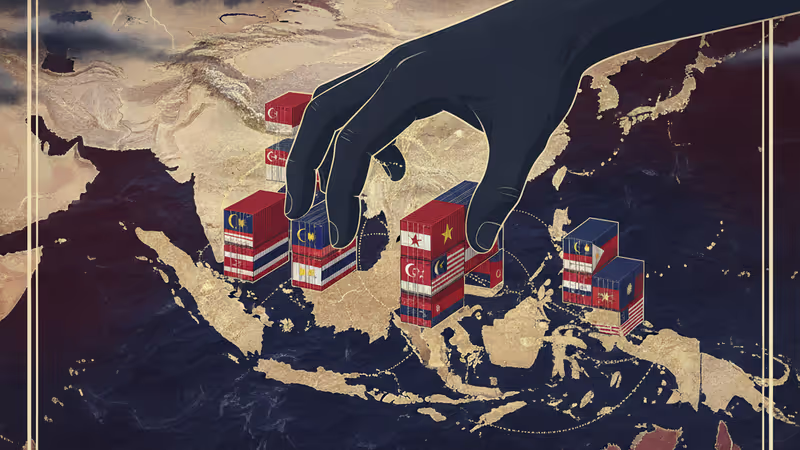
Southeast Asia's 2025 Economy: Navigating Trump's Tariffs and the Rise of State Capitalism
An analysis of Southeast Asia's 2025 economy, shaped by Trump tariffs and rising state capitalism. As the U.S. becomes more unpredictable, nations like Vietnam and Thailand show diverging paths.
As 2025 concludes, Southeast Asia's economic landscape has been defined by two powerful, interlocking forces: the global fallout from the `keyword`Trump tariffs`keyword` and a corresponding pivot toward greater state intervention across the region. This new reality has created clear winners and losers. `keyword`Vietnam`keyword`, for instance, continues to thrive on an export-led model, while `keyword`Thailand`keyword`'s economy appears stuck in a low-growth trap, revealing the diverging fates of nations adapting to a more volatile world.
A Tale of Two Economies: Vietnam's Ascent, Thailand's Stall
`keyword`Vietnam`keyword` has been the region's standout performer, proving that the export-led development model is still very much alive, especially with a shared border with `keyword`China`keyword`. Its economic momentum was further bolstered this year when index provider FTSE Russell upgraded the country to emerging market status, a move expected to attract a new wave of international investment.
In stark contrast, `keyword`Thailand`keyword`'s export-driven engine is sputtering. The economy remains mired in slow growth with no easy way out, hampered by challenging global conditions, an ongoing armed conflict with `keyword`Cambodia`keyword`, and a political class unable to form a stable government and enact effective policy.
The Visible Hand: State Funds and Strategic Industries
A clear trend across the region is the growing tilt toward state intervention. The launch of new state-owned investment funds, like `keyword`Danantara`keyword` in `keyword`Indonesia`keyword` and the `keyword`Maharlika Wealth Fund`keyword` in the `keyword`Philippines`keyword`, signals a concerted effort by governments to control the deployment of capital. While their long-term impact is yet to be seen, they represent a new frontier in the evolution of state capitalism.
This trend is also visible in industrial policy, such as `keyword`Indonesia`keyword`'s nickel downstreaming strategy. Despite hurdles, the policy of processing raw materials domestically to capture more value shows no signs of stopping, further entrenching the state's role in the economy.
Private Equity's Pivot: From Apps to Airports
While state capital is carving out a larger role, private capital from the `keyword`United States`keyword` is also shifting its focus. Private equity and hedge funds, which historically chased the region's digital economy—backing consumer apps like GoTo, Grab, and Shopee—are now turning to old-fashioned infrastructure.
Many of those tech investments proved difficult to exit, and now interest is moving toward tangible assets like energy, transportation, and data centers. A prime example is `keyword`Global Infrastructure Partners (GIP)`keyword`, a BlackRock-owned fund with over `stat`$100 billion`stat` in assets. This year, GIP partnered with state funds to take over and delist `keyword`Malaysia`keyword`'s national airport operator, a clear sign of the new investment frontier.
The Trump Effect: A New Age of Economic Nationalism
By far the most consequential story of 2025 for Southeast Asia was the impact of the `keyword`Trump tariffs`keyword`. A less predictable `keyword`U.S.`keyword` has made the global economy more transactional, risky, and uncertain. In response, some countries, like `keyword`Indonesia`keyword` and the `keyword`Philippines`keyword`, moved quickly to cut direct “deals” with `keyword`Trump`keyword` to avoid high tariffs.
The signal from Washington is unmistakable: nations must insure themselves against volatility. This is accelerating the rise of economic nationalism, pushing countries toward greater state intervention to protect national interests. How the states of Southeast Asia adapt to this new global reality will be the most important trend to watch as we head into the new year.
U.S. unpredictability is forcing Southeast Asian nations to internalize geopolitical risk as a core economic variable. The rise of state capitalism and economic nationalism isn't just an ideological choice; it's becoming a pragmatic survival strategy in an increasingly uncertain global order.
本コンテンツはAIが原文記事を基に要約・分析したものです。正確性に努めていますが、誤りがある可能性があります。原文の確認をお勧めします。
関連記事

ロシアによるウクライナへのミサイル攻撃、イスラエル国防相のガザに関する強硬発言など、世界各地で地政学的緊張が高まっています。シリアや南米でも対立が続く現状を解説します。
CBSニュースの人気番組「60ミニッツ」が、トランプ政権が移民を送還したエルサルバドルの刑務所に関する特集を放送直前に中止。社内外から「政権への忖度」との批判が噴出している。新経営陣の意向が働いたのか、報道の自由が問われる事態に。
米国通商代表部(USTR)は、中国の半導体産業政策が不公正であるとし、新たな関税措置を発表しました。当初の税率は0%ですが、2027年6月には引き上げられる予定です。

ガザ地区の保健省は、イスラエルの封鎖により医療システムが崩壊寸前だと警告。医薬品の4分の3が不足し、2万人の患者が治療を待つ中、死者も出ています。人道危機の現状を詳しく解説します。