
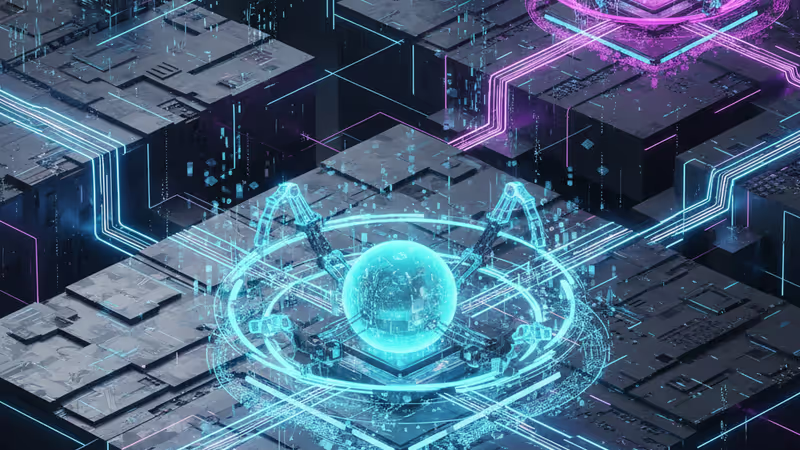
The Loop: OpenAI's Codex is Now Building Itself, Sparking an AI 'Arms Race'
OpenAI reveals its AI, Codex, is building itself—a recursive loop that signals a new 'arms race' in software development. An analysis of the new competitive frontier.
The Lede: A Sci-Fi Concept Becomes Commercial Reality
OpenAI has confirmed what many in the AI field have theorized: its advanced coding agent, Codex, is now a primary tool in its own development. According to product lead Alexander Embiricos, "the vast majority of Codex is built by Codex." This isn't merely a productivity boost; it's the commercialization of a recursive self-improvement loop, a concept once confined to the pages of science fiction. For tech leaders, investors, and developers, this signals a fundamental acceleration in the pace of software innovation and creates a formidable competitive moat that few can cross.
Why It Matters: The New Competitive Frontier
When a tool is used to improve itself, it creates a flywheel effect. Each improvement to Codex makes it a better developer, which in turn allows it to accelerate the next cycle of its own improvement. This creates a non-linear, potentially exponential, growth curve in capability.
- The Productivity Moat: Companies that can successfully implement this AI-driven development cycle can out-innovate and out-pace competitors operating on traditional human-led timelines. The gap between AI leaders and laggards is set to widen dramatically.
- Redefining the Developer's Role: This shifts the role of elite human engineers from writing line-by-line code to becoming high-level architects, prompters, and AI system supervisors. The most valuable skill is no longer just coding, but effectively directing AI agents to achieve complex goals.
- Second-Order Effects: As AI builds better AI, the complexity and power of the software it can create will grow exponentially. This will unlock new applications and services previously deemed too complex or resource-intensive to build.
The Analysis: Echoes of Computing History
From Self-Hosting Compilers to Self-Improving AI
This development has a clear historical precedent in computer science: the concept of a "self-hosting compiler." In the early days of computing, the first compiler for a new programming language had to be written in a different, existing language. The mark of maturity was when the compiler could be rewritten and compiled in its own language. This process, known as bootstrapping, proved the language's power and utility.
OpenAI is now applying this bootstrap principle to artificial intelligence itself. Where compilers self-hosted to validate a language, Codex is self-developing to accelerate its own intelligence. This is a paradigm shift from a static tool to a dynamic, evolving system, and it's a crucial milestone on the path toward more autonomous and capable AI.
The Industry's Inevitable Response
The admission from OpenAI is a strategic shot across the bow to its rivals. Google, with its Gemini models and internal developer tools, and Microsoft, through its deep integration with GitHub Copilot (powered by OpenAI's models), are the only players with the scale to compete directly. We anticipate an immediate and intense internal focus at these companies on replicating this self-improvement loop. For smaller AI labs and open-source projects, the bar has just been raised impossibly high, potentially leading to market consolidation and a reliance on platforms built by the tech giants.
PRISM Insight: The 'AI Leverage' Metric
For investors and executives, the key takeaway is the emergence of a new critical metric: AI Leverage. This is the measurable productivity and innovation gain a company derives from using its own AI products internally to build its next generation of products. High AI Leverage indicates a powerful self-reinforcing growth engine.
- For Investors: When evaluating AI companies, ask: "To what extent is your AI building your AI?" A company that is deeply "dogfooding" its own advanced AI for core development is likely to have a superior growth trajectory and a more defensible market position.
- For Businesses: The future of software isn't just buying AI tools, but integrating them into the core creation process. Companies must plan a strategic transition from human-led development teams to human-managed, AI-augmented development systems to remain competitive.
PRISM's Take
OpenAI's revelation is more than a technical achievement; it's a declaration that the nature of software development has fundamentally changed. We are leaving the era of purely human-crafted code and entering the age of human-AI collaborative evolution. The ability to create a recursive self-improvement cycle is the most significant competitive advantage in the tech industry today. While this doesn't render human developers obsolete, it permanently elevates their role from digital bricklayers to grand architects of AI-powered systems. The race is no longer about having the smartest AI model; it's about creating the fastest self-improving development engine. OpenAI just revealed they're already running laps.
関連記事
スペイン大手銀行BBVAがOpenAIと提携し、全従業員にChatGPTを導入。これが単なるツール導入に留まらない、金融業界の未来を占う戦略的一手である理由を専門家が分析。
BNYメロンがOpenAI技術で全社AI導入を加速。2万人超の従業員がAIエージェントを構築する新戦略が、金融業界の競争ルールをどう変えるのか。専門家が徹底分析。

OpenAIが支援する創薬AIスタートアップChai Discoveryが1.3億ドルを調達。AIが分子を設計する「ジェネレーティブ・バイオロジー」は、製薬業界の未来をどう変えるのか?専門家が徹底分析。
OpenAIのGPT-5.2発表は、AI開発が革命的な飛躍から堅実な進化の時代へ移行したことを示唆します。その背景とビジネスへの真のインパクトを専門家が徹底分析。