
The Legacy of Trump's Department of Government Efficiency: A 2025 Autopsy
A deep dive into the Trump administration's 2025 attempt to create a Department of Government Efficiency. We analyze its goals, the fierce controversy it ignited, and its lasting impact on the future of U.S. governance.
In 2025, the Trump administration's push to establish a Department of Government Efficiency became one of its most consequential and polarizing initiatives. The ambitious effort, aimed at radically streamlining the federal bureaucracy, sparked a fierce political battle and ultimately yielded a mixed legacy of limited successes and significant pushback.
The administration's rationale was straightforward: to consolidate redundant functions, cut wasteful spending, and reduce the burden on taxpayers by shrinking a federal government it deemed bloated. Proponents argued this would speed up decision-making and deliver more effective services to the American public.
The initiative was widely seen as a direct implementation of ideas from 'Project 2025', a comprehensive transition plan developed by conservative groups. This roadmap was designed to enable a new conservative administration to assert control over the federal apparatus, with 'government efficiency' as a central theme.
However, the proposal met with immediate and stiff resistance. Democrats, federal employee unions, and watchdog groups decried it as an attack on civil service protections and an attempt to politicize government functions under the guise of 'efficiency.' The controversy intensified as the plan included measures to significantly curtail the authority of agencies like the Environmental Protection Agency (EPA) and the Department of Education.
"This isn't a reform for efficiency," one policy analyst from a think tank wrote at the time. "It's a power grab designed to centralize authority in the executive branch, bypassing the checks and balances of congressional oversight and judicial review."
After months of political wrangling, legislation to formally create the new department failed to pass Congress. Instead, President Trump used executive orders to enact partial reforms, merging some smaller agencies and reassigning functions within certain departments. According to the Office of Management and Budget (OMB), these actions resulted in an estimated $15 billion in savings in 2025, a figure that, while substantial, fell far short of the administration's initial projections.
本コンテンツはAIが原文記事を基に要約・分析したものです。正確性に努めていますが、誤りがある可能性があります。原文の確認をお勧めします。
関連記事

ガザ、シリアからジャーナリストへの攻撃まで。一連のドキュメンタリー映像が、現代の「終わらない戦争」と情報戦の現実を暴く。紛争の連鎖がもたらす地球規模の脅威とは。
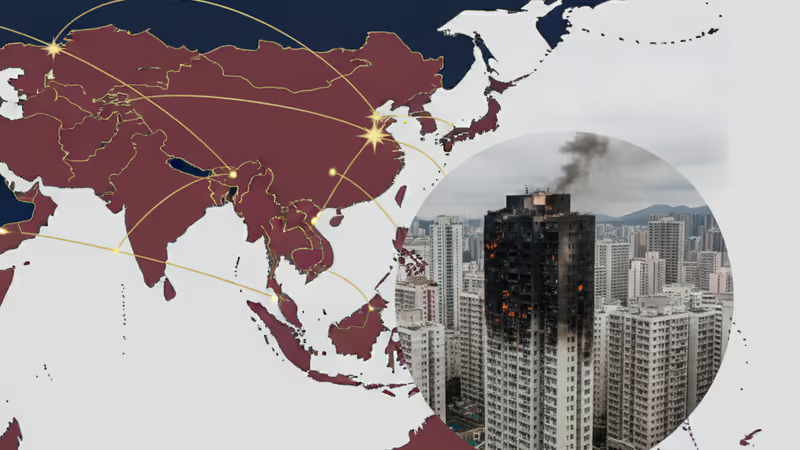
香港・大埔区の公共住宅で発生し159人が犠牲となった大火災。この悲劇は、平均5年の待機期間を要する香港の深刻な住宅危機を浮き彫りにし、政治・経済・社会に広範な影響を及ぼしている。災害対応を超えた、都市の根本的な課題を分析する。

米下院軍事委員会の民主党トップ、アダム・スミス議員が、トランプ政権によるベネズエラ石油封鎖の真の目的はマドゥロ大統領の政権転覆にあると指摘。米国の対外強硬策の狙いを巡り、議論が広がっています。

マレーシアの辺境と見なされてきたサラワク州が、なぜ今「グリーン経済大国」として急浮上しているのか。半島部の政治的混乱を好機に変え、独自のリーダーシップでエネルギーとハイテク産業の未来を切り拓くサラワクの戦略を解説します。