

The AI Spending Bubble: Is Oracle's Debt the Pin That Bursts It?
Analysis of Jim Cramer's warning on AI spending. Is Oracle's massive debt a systemic risk to the tech sector's AI buildout? Actionable insights for investors.
The Lede: The Market's AI Anxiety Finds a Target
The relentless AI capital expenditure 'arms race' that has propelled tech valuations is now showing signs of strain, rattling investor confidence. CNBC's Jim Cramer has publicly targeted Oracle (ORCL) as the potential 'canary in the coal mine,' suggesting its significant debt load could force a spending pullback that cascades across the industry. This isn't just market noise; it's the first significant challenge from capital markets to the 'spend-at-all-costs' AI narrative, forcing investors to question the sustainability of the current buildout.
Key Numbers in the AI Arms Race
- The Spenders: Cramer identified five key players in the spending spree: Amazon, Microsoft, Google, Meta, and OpenAI in partnership with Oracle.
- Oracle's Bond Sale: A recent $18 billion bond issuance by Oracle drew significant market scrutiny.
- Risk Indicator: Investors aggressively purchased credit default swaps (CDS) against Oracle's debt, a clear market signal of perceived default risk.
- OpenAI's Commitments: The AI leader has committed to spending over $300 billion on Oracle's cloud infrastructure over five years, with total commitments nearing $1.4 trillion across various partners.
The Analysis
The Hyperscale Dilemma: Strategic Imperative or Reckless Gamble?
For the past 18 months, Wall Street has rewarded hyperscalers for massive AI-related CapEx, viewing it as a necessary investment to capture a generational market shift. Companies like Microsoft and Meta saw their stocks soar on the back of aggressive AI spending guidance. However, the sentiment is shifting. The market is beginning to transition from rewarding ambition to demanding a clear and profitable return on these multi-billion dollar data center investments. Cramer's commentary crystallizes this anxiety: the move from 'growth' to 'growth at a reasonable price' is happening faster than many expected.
Deconstructing the Oracle Thesis: Is Cramer Right?
Cramer's argument hinges on Oracle being the weakest link in the capital chain. There's evidence to support this. Unlike its hyperscaler rivals, Oracle carries a substantial debt load from previous acquisitions (like Cerner) and has a less pristine balance sheet. The spike in its CDS confirms that bond investors are pricing in higher risk. For a company like Oracle, the cost of capital is a real and pressing concern, and the bond market can enforce discipline far more brutally than the equity market.
The Contrarian View: However, framing Oracle as a simple victim of overspending may be a misread of its strategy. This AI partnership with OpenAI is Oracle's golden ticket to challenge the entrenched cloud leaders—AWS, Azure, and GCP. Management likely views this massive capital outlay not as a burden, but as a strategic battering ram to gain market share in the high-performance computing space. They are taking on leverage precisely because the potential prize is transforming their position in the cloud hierarchy for the next decade. They may be willing to endure balance sheet pain for a strategic victory.
PRISM Insight: Investment Strategy & Portfolio Implications
The core issue for investors is no longer 'who is spending on AI?', but 'who is spending smartly on AI?'. The focus must shift from top-line revenue promises to the underlying financial health that supports them.
- Balance Sheet Scrutiny is Paramount: Investors must now treat cloud providers more like industrial manufacturers. Dive deep into their debt-to-equity ratios, free cash flow conversion, and return on invested capital (ROIC). A company's ability to fund CapEx from operations versus debt will become a critical differentiator. Oracle's situation highlights this perfectly; its high-leverage model is now under a microscope.
- The 'Pick-and-Shovel' Rotation: As uncertainty grows around the hyperscalers themselves, capital may rotate to the less-leveraged beneficiaries of the buildout. Consider the suppliers of the data center ecosystem: power infrastructure (e.g., Eaton, Vertiv), advanced cooling solutions, and real estate investment trusts (REITs) that own the physical data centers. These companies benefit from the spending wave without directly carrying the same balance sheet risk as the cloud giants.
- Watch Earnings Calls for 'Capital Discipline': The new buzzword for tech earnings season will be 'capital discipline.' Any CEO who can articulate a clear path to monetizing AI investments and managing CapEx will be rewarded. Conversely, those who offer vague promises of future growth funded by more debt will likely see their stocks punished.
The Bottom Line
Cramer's call on Oracle is a symptom of a larger market pivot. The era of writing blank checks for AI infrastructure is over. While Oracle may or may not be the first to blink, the warning shot has been fired by the bond market. For investors, this is a signal to evolve their thesis: prioritize companies with strong balance sheets and a clear, profitable AI strategy over those simply spending to keep up. The next phase of the AI trade will be won not by the biggest spender, but by the most efficient one.
関連記事
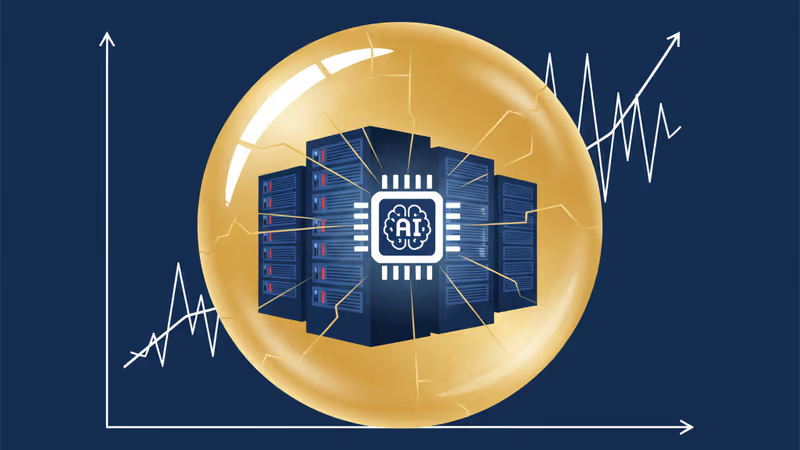
AIインフラ株が巨額投資と負債懸念で急落。市場は冷静さを保ちつつも「選別相場」へ。投資家が今知るべきリスクと機会を専門家が分析します。
英国経済が停滞する中、なぜFTSE 100は史上最高値を更新し続けるのか?その謎を為替と金融政策の観点からプロが分析。投資家が取るべき戦略を解説します。

日銀の追加利上げ観測が強まる中、円安は続くのか?専門家が市場の動向を分析し、投資家が今すぐ取るべき具体的なポートフォリオ戦略を解説します。
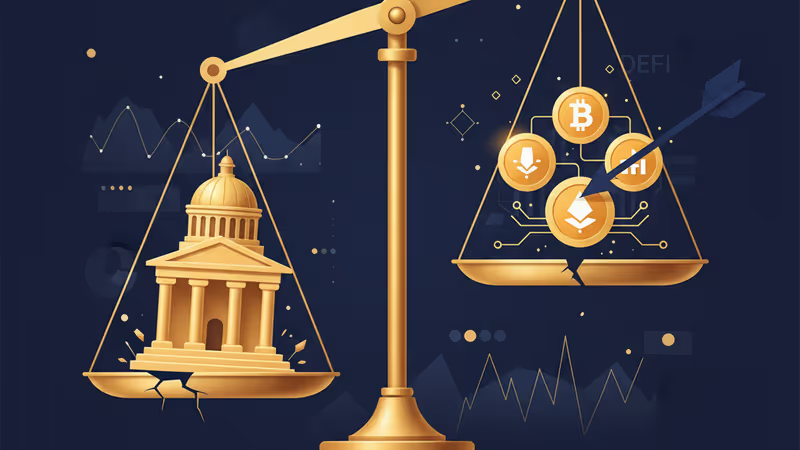
エリザベス・ウォーレン上院議員がトランプ氏関連DeFiの調査を要求。暗号資産規制法案が難航する中、投資家が知るべき政治的リスクとポートフォリオ戦略を専門家が解説。