
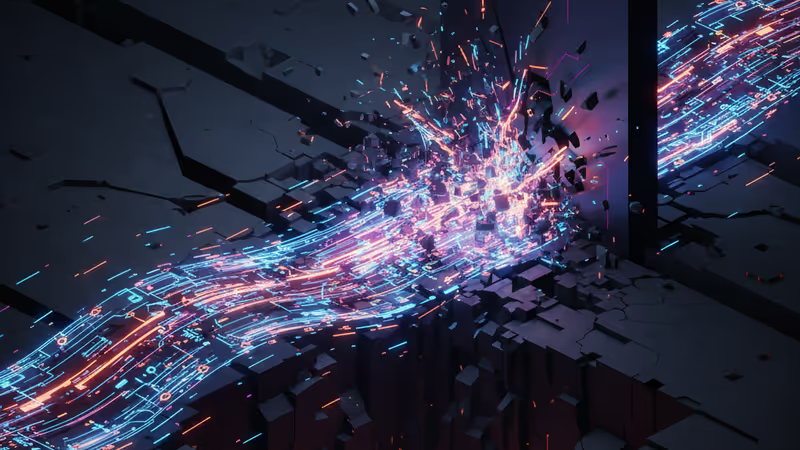
The AI Gold Rush Hits a Wall: Why Oracle and OpenAI's Timeline Dispute Reveals a Deeper Industry Crisis
Oracle's denial of an OpenAI data center delay reveals a deeper crisis: the AI revolution is hitting the physical limits of infrastructure and power.
The Real Story Isn't the Denial. It's the Timeline.
While Oracle's stock took a 4% hit following reports of a delay in its massive data center project for OpenAI, the company's swift denial misses the point entirely. The market's jitters aren't just about a single project's schedule. This is the first major tremor signaling that the AI revolution's insatiable appetite for computing power is slamming into the hard, expensive, and slow-moving realities of the physical world.
For any executive, investor, or technologist betting on exponential AI growth, the key takeaway is this: the primary bottleneck for AI is no longer just silicon supply. It's the brutal, unglamorous work of securing power, permits, and pouring concrete. The multi-year timelines being discussed—whether it's 2027 or 2028—expose a critical vulnerability in the AI growth narrative.
Why This Matters: The Capacity Ceiling is Real
The race to build next-generation AI models is fundamentally a race for energy and infrastructure. The Oracle-OpenAI situation, alongside similar long-term, non-binding agreements OpenAI has with Nvidia and Broadcom, paints a stark picture of an industry desperately trying to pre-book a future that is years away from being built.
- Second-Order Effects: The scramble for physical resources will drive up costs for land, energy, and specialized labor, potentially squeezing out smaller AI players. This could lead to a consolidation of power among the handful of giants who can afford these decade-long, multi-hundred-billion-dollar bets.
- Market Volatility: The 4% drop in Oracle's stock on a mere *rumor* of a delay shows how sensitive AI-adjacent valuations are to execution risk. As more of these massive infrastructure projects face inevitable real-world hurdles, expect similar volatility across the sector.
- Strategic Hedging: OpenAI isn't just partnering with Oracle. Its 'letter of intent' with Nvidia and 'term sheet' with Broadcom reveal a portfolio strategy. These aren't firm purchase orders; they are strategic placeholders to secure capacity from anyone who can provide it. This suggests even OpenAI, the leader in the space, is uncertain about where its future compute will come from.
The Analysis: AI's Physical World Problem
A Battle of Semantics Over a Mountain of Work
Oracle's statement that there are "no delays" and that milestones "remain on track" is a classic case of corporate messaging. It's likely true that the original, privately agreed-upon timeline was always a long-term project finishing around 2027 or 2028. However, the market, conditioned by the blistering pace of software development, interprets any timeline measured in years, not months, as a 'delay.' This disconnect between digital ambition and physical reality is at the heart of the issue. Building a data center capable of powering a supercomputer isn't like spinning up a cloud server; it involves multi-year construction, regulatory approvals, and tapping into already-strained power grids.
The Trillion-Dollar Supply Chain Under Strain
The source report cited labor and material shortages, and this is the crux of the industry's challenge. We are no longer just talking about GPU shortages, which are easing. The new bottlenecks are far more fundamental:
- Power: Large-scale AI data centers can consume as much electricity as a small city. Securing gigawatts of power from utility companies is a complex, long-lead-time negotiation that can take years.
- Land & Permitting: Finding suitable locations with access to power, water for cooling, and fiber optic cables is increasingly difficult. Navigating local zoning and environmental permits adds further delays.
- Specialized Labor: There is a finite number of engineers and construction crews qualified to build these highly complex, next-generation facilities.
This is Oracle's challenge, but it is also Microsoft's, Google's, and Amazon's. The entire AI infrastructure build-out is constrained by these physical-world factors, a reality the market is only beginning to price in.
PRISM Insight: De-Risking Your AI Investment Thesis
For investors, this signals a crucial pivot point. The initial AI gold rush focused on the model-makers (like OpenAI) and the chip designers (like Nvidia). The next phase requires a broader perspective focused on the entire enabling ecosystem.
Investment Angle: The immense capital required for this build-out suggests that the real, durable value may lie in the 'picks and shovels' of the AI revolution. This includes industrial real estate trusts specializing in data centers, utility companies investing in power generation, and engineering firms that design and build these complex facilities. The long-term, locked-in demand for their services is becoming clearer by the day.
Business Implication: Enterprises looking to leverage large-scale AI need to shift their thinking from immediate deployment to long-term capacity planning. Securing cloud compute for major AI initiatives may soon resemble securing long-term energy contracts, requiring multi-year commitments and a diversified portfolio of providers to mitigate risk.
PRISM's Take
The Oracle-OpenAI timeline story isn't a minor hiccup; it’s a flare illuminating the single biggest threat to unchecked AI progress. The narrative of exponential digital growth is now tethered to the linear, friction-filled pace of physical construction. For years, the tech industry has celebrated moving fast and breaking things. Now, it must learn the patient, capital-intensive business of building things. The next great AI winners won't just be those with the smartest algorithms, but those who can secure the most megawatts.
関連記事
AIインフラ株が巨額投資と負債懸念で急落。市場は冷静さを保ちつつも「選別相場」へ。投資家が今知るべきリスクと機会を専門家が分析します。
オラクルがOpenAIデータセンター遅延報道を否定。株価を揺るがしたこのニュースから、AIインフラ競争の熾烈さと市場が抱える新たなリスクを専門家が分析。
オラクルがOpenAI向けデータセンターの遅延報道を否定。しかしこの一件は、AIの爆発的成長を支えるインフラ供給網の深刻な脆弱性を浮き彫りにした。PRISMが深層を分析。

シェブロンがヘスを約8兆円で買収。この巨大M&Aがエネルギー業界と投資戦略に与える真の影響とは?専門家が地殻変動の次の一手を徹底解説します。