
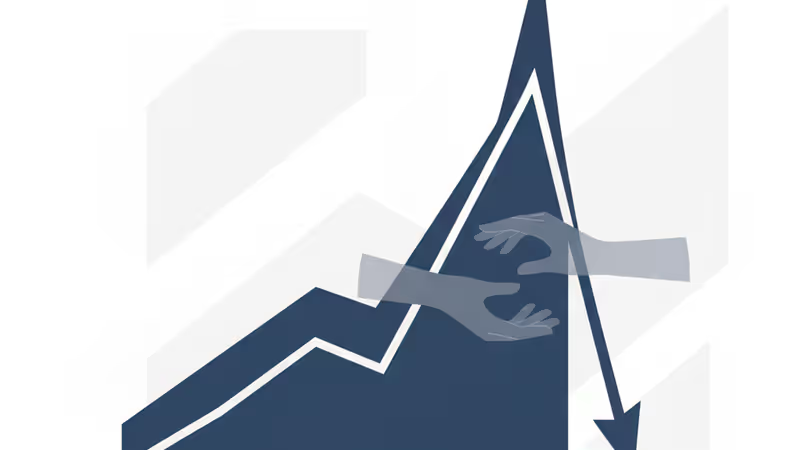
Terra's $40B Ghost: Lawsuit Alleges Jump Trading Wasn't a Victim, But a Co-Architect
A $4B lawsuit against Jump Trading reveals the hidden role of high-frequency trading in the Terra/Luna collapse, shifting blame from founders to market makers.
The Lede: Beyond Do Kwon, The Real Target Emerges
The $4 billion lawsuit filed against high-frequency trading giant Jump Trading isn't just another legal echo from the crypto winter. For institutional investors and financial executives, this is a critical signal: the search for accountability in the $40 billion Terra/Luna collapse has moved beyond the fallen founder, Do Kwon, and is now aimed squarely at the sophisticated financial machinery that may have engineered the disaster. This litigation targets the opaque, high-stakes world of crypto market-making, forcing a reckoning on whether these firms are neutral liquidity providers or conflicted kingmakers with the power to build—and break—entire ecosystems for profit.
Why It Matters: The Integrity of Digital Markets on Trial
The implications of this lawsuit extend far beyond recouping funds for Terraform Labs' creditors. It strikes at the heart of market integrity in the digital asset space, with significant second-order effects:
- From Founder to Financer: The narrative is shifting. While Do Kwon was the public face of Terra, this action alleges that sophisticated players like Jump were not just passive participants but active collaborators. It suggests the collapse was less a spontaneous market panic and more the failure of a manipulated, brittle system.
- Regulatory Roadmap: This lawsuit provides a playbook for regulators. The SEC has already pursued Jump for its role. Allegations of secret deals and concealed manipulation give ammunition to agencies looking to police the intersection of traditional finance and crypto, with a new focus on market makers as potential systemic risks.
- Redefining Counterparty Risk: For any fund or institution operating in crypto, due diligence must now evolve. The key question is no longer just about the soundness of a protocol's code, but the nature of its relationship with its primary market makers. The alleged secret agreement to prop up TerraUSD (UST) in exchange for discounted LUNA tokens highlights a new, critical layer of hidden risk.
The Analysis: High-Frequency Trading's Crypto Gambit
Jump Trading, a secretive powerhouse born from the cutthroat world of Chicago's trading pits, represents the migration of Wall Street's most aggressive strategies into the unregulated crypto frontier. The lawsuit alleges this wasn't simply a case of sharp-elbowed arbitrage; it was a calculated manipulation. The core accusation is that in May 2021, a year before the final collapse, Jump secretly intervened to restore UST's $1.00 peg after an initial de-pegging event. In return, Jump allegedly received heavily discounted LUNA tokens, allowing it to profit immensely while creating a false narrative of the stablecoin's resilience.
This isn't just trading; it's an alleged act of market architecture. By propping up the peg, Jump is accused of helping Terraform Labs build market confidence on a fraudulent basis. This allowed the Terra ecosystem to swell to its $40 billion valuation, attracting thousands of investors who were unaware that its prior stability was allegedly an engineered illusion. The lawsuit claims Jump made over $1 billion from this arrangement. This moves Jump from the category of a liquidity provider to an alleged co-conspirator who profited from creating the very market instability it was supposed to reduce.
PRISM Insight: The Market Maker Due Diligence Imperative
For investors, the key takeaway is a new imperative for due diligence. The vertical integration of firms like Jump—which operate as venture capitalists (Jump Crypto), market makers, and infrastructure providers—creates profound, often undisclosed, conflicts of interest. An investment in a protocol is now inseparable from an investment in the integrity of its key market partners.
Actionable intelligence requires asking deeper questions:
- Who are the primary market makers for this asset?
- What were the terms of their initial agreement? Are they public?
- Do they hold a venture position in the project, creating a conflict between their duty to maintain a fair market and their desire to protect their investment?
This episode will likely accelerate a push towards more transparent, on-chain market-making solutions. However, the sheer capital efficiency and speed of centralized HFT firms means a deep tension will persist between the ideals of decentralization and the realities of market liquidity.
PRISM's Take: The Bill for Crypto's 'Wild West' Is Due
The Terra/Luna saga is now entering its most crucial chapter. The prosecution of Do Kwon dealt with the fraud's creator, but the lawsuit against Jump Trading seeks to hold the enablers accountable. This is the financial system's immune response to the excesses of the last bull market. The core question is no longer “Was the algorithm flawed?” but rather “Was the entire market structure rigged?” This legal battle will be a painful, but necessary, catalyst for maturation in the digital asset industry. It signals the end of an era where sophisticated financial players could operate in the shadows, profiting from manufactured stability before a catastrophic collapse. The market's future health depends on exposing these hidden arrangements and establishing a new precedent for accountability that extends to every player in the ecosystem, not just the ones who sign the whitepaper.
関連記事

テスラのイーロン・マスク氏の巨額報酬が復活。これは単なる報酬問題ではない。デラウェア州の権威を揺るがし、CEOのあり方とコーポレートガバナンスを再定義する歴史的転換点だ。

トランプ・メディアが核融合技術のTAEと合併。政治的ミーム株とディープテックの異色タッグの背景、投資家への警鐘、そして未来のエネルギー市場への影響を深掘り分析します。
米製薬業界が直面する「特許の崖」。その解決策として中国バイオに注目が集まるが、地政学リスクが影を落とす。投資家と業界関係者必見の分析。

中国で300億ドル規模の高級品リセール市場が急成長。経済の不確実性を背景に、消費者は「所有」から「賢い資産利用」へ。テクノロジーが変えるラグジュアリーの未来を分析。